Yoga Nidra for Beginners: A Practical Guide to Non-Sleep Deep Rest
For most of my adult life I believed rest was something you earned. You practised hard, you worked hard, and then, if there was time left over and nothing more useful to do, you rested. It took a torn hamstring and four months off my mat to notice how strange that belief was, and how deeply it had shaped everything from my teaching to my sleep.
A physiotherapist suggested yoga nidra during that recovery. I remember being faintly insulted. Lying on the floor listening to a recording did not sound like a practice. It sounded like giving up with better lighting. I tried it anyway, because I could not do much else, and the first session undid something in my chest that six years of vinyasa never had.
I have taught it weekly since. Here is the honest version of what yoga nidra is, what the science actually supports, and how to run your first session tonight with a blanket and a phone.
What Yoga Nidra Actually Is
Yoga nidra translates roughly as “yogic sleep,” which is a slightly misleading name for something you do while awake. The practice is a guided, systematic rotation of attention through the body, done lying flat on your back, usually for twenty to forty minutes, while a voice gives you almost nothing to do except follow.
The form most people encounter today was systematised by Swami Satyananda Saraswati in the 1960s and 1970s from older tantric sources, and it has since been adapted into secular versions, most notably the iRest protocol developed by Richard Miller for clinical settings. The vocabulary differs. The architecture is remarkably consistent.
What makes it distinct from meditation is that there is no concentration to maintain. In seated practice you are quietly working: holding a posture, returning to the breath, catching a wandering mind. In nidra you are not working at all. The guide does the structuring. Your job is to lie still and let attention be led around the body like water finding the low places. If you have tried and abandoned seated practice, or bounced off the apps I reviewed in my comparison of the major meditation apps, this is the practice I would send you to instead.
The target state is the hypnagogic threshold, the narrow band between waking and sleeping that most of us cross unconsciously every night in about ninety seconds. Yoga nidra parks you there deliberately and keeps you there. The body reaches something close to sleep depth while a thin thread of awareness stays lit. That thread is the whole practice.
The first time I got there properly, I lost track of whether I had heard the last two minutes of instruction. My arms felt like they belonged to somebody heavier. When the guide asked us to begin moving the fingers again, I genuinely resented it.
What The Research Actually Says
I want to be careful here, because yoga nidra attracts a claim I hear repeated constantly in studios and almost never with a source attached: that one hour of nidra equals four hours of sleep. There is no good evidence for that. It appears to have come from a loose reading of EEG studies showing delta wave activity during deep nidra, and it has been passed around unexamined ever since. Please do not use it to justify sleeping less. The practice is a supplement to sleep, not a substitute.
What the evidence does support is more modest and more useful.
The strongest signal is stress reduction. Several small controlled trials have found reduced perceived stress and anxiety scores after regular nidra practice, alongside measurable shifts in autonomic markers such as heart rate variability and skin conductance. The mechanism is unsurprising: prolonged stillness with structured attention pushes the nervous system toward parasympathetic dominance and keeps it there long enough for the shift to register.
There is also reasonable evidence around sleep quality. Studies on insomnia and on shift workers have reported improved subjective sleep quality and reduced sleep onset latency after several weeks of practice. The effect sizes are moderate, the sample sizes are small, and much of the work comes from a handful of research groups in India, so I hold these findings loosely.
The most rigorous work has been done on the iRest protocol with military veterans experiencing post-traumatic stress, where it has been used as an adjunct in clinical settings for over a decade with encouraging results. That is a specific protocol delivered by trained practitioners, not a recording off the internet, and the distinction matters.
Neuroscientist Andrew Huberman popularised the term “non-sleep deep rest” as a secular relabelling of essentially this practice, which has brought a lot of people to it who would never have opened a yoga app. The underlying research he points to is real, largely around dopamine replenishment and rest-related learning consolidation, and it is also thinner than the enthusiasm around it suggests.
My honest summary after seven years of practising and teaching: yoga nidra is one of the most reliable nervous system tools I know, it costs nothing, it carries essentially no risk, and its benefits are real but ordinary. It calms you down. It helps you sleep. It does not replace sleep, cure trauma on its own, or unlock anything mystical.
How To Run Your First Session
The classical structure has eight stages. You do not need to memorise them, but knowing the shape helps you follow a recording without wondering where it is going.
Settling. You lie flat on your back in savasana, legs a little apart, palms up, and spend a few minutes letting the body find the floor. Most guides ask for a few slow exhalations here.
Sankalpa. A short intention, phrased in the present tense as though already true, repeated silently three times. Mine has been the same sentence for four years. The traditional teaching is to keep it stable rather than reinventing it each session, which I found irritating at first and now understand.
Rotation of consciousness. This is the heart of the practice and the part that does the work. The guide names body parts in a fixed sequence, usually starting at the right thumb, and you simply move attention to each one as it is named. Right thumb, second finger, third finger, palm, wrist, elbow, shoulder, armpit, and onward. You do not visualise or tense anything. You just go there. The sequence is fast enough that the analytical mind cannot keep up, which is precisely the point.
Breath awareness. Usually counting exhalations backwards from a number like 27, which is deliberately awkward enough to occupy the last of your verbal attention. This is the one stage that overlaps with the breathwork techniques I use for acute anxiety, though here the counting is a holding pattern rather than the intervention itself.
Opposites. Feeling heaviness then lightness, warmth then coolness. This tends to produce the strangest sensations of the whole practice and is where I most often lose the thread entirely.
Visualisation. Images offered rapidly, one after another, without time to elaborate them. A candle flame. An open field. A door.
Return of the sankalpa. The same sentence, repeated three times, now delivered into a much quieter mind.
Externalisation. Slowly coming back. Sound of the room, weight of the body, small movements of fingers and toes, and eventually rolling to one side before sitting up. Do not skip this part. Standing up straight from deep nidra is genuinely disorienting.
For a first session, find a twenty minute recording, lie down somewhere warm, and follow it. That is all. You do not need to understand the architecture to benefit from it.
The Problems Everyone Hits
You fall asleep. Nearly everyone does for the first several weeks. This is not failure, it is information: you were tired. If you want to stay on the threshold rather than dropping under, practise in the late afternoon instead of at bedtime, keep the room a little cool, and bend your elbows so your forearms point at the ceiling. When you slip into sleep a hand falls and wakes you. It is a crude trick and it works.
You cannot lie still. Restlessness in the first five minutes is common, particularly for people who come from a movement practice. Fidget as needed early on. It settles. If it does not, the problem is usually physical rather than mental, and a bolster under the knees fixes it more often than willpower does.
You get bored. Good. Boredom is the doorway. The rotation of consciousness is deliberately monotonous, and the moment when you stop waiting for it to become interesting is usually the moment you drop.
You feel emotional afterwards. Occasionally people surface with unexpected grief or agitation. This happened to me twice in my first year and unsettled me both times. If it happens once, sit with it. If it happens repeatedly, or if you have a trauma history, work with a trained practitioner rather than a recording. This is the one situation where I would not recommend going it alone.
Nothing happens. For some people the first three or four sessions feel like lying on the floor listening to somebody talk. Give it two weeks of three sessions before deciding. The state tends to arrive suddenly rather than gradually.
Do You Need Any Gear?
No. A floor, a blanket, and a twenty minute recording will take you the whole way. But a few things genuinely improve the practice, and I want to be honest about which ones matter and which are studio decoration. Some of the links below are affiliate links, which means PurityPeak earns a small commission if you buy through them. It costs you nothing extra and it does not change what I recommend.
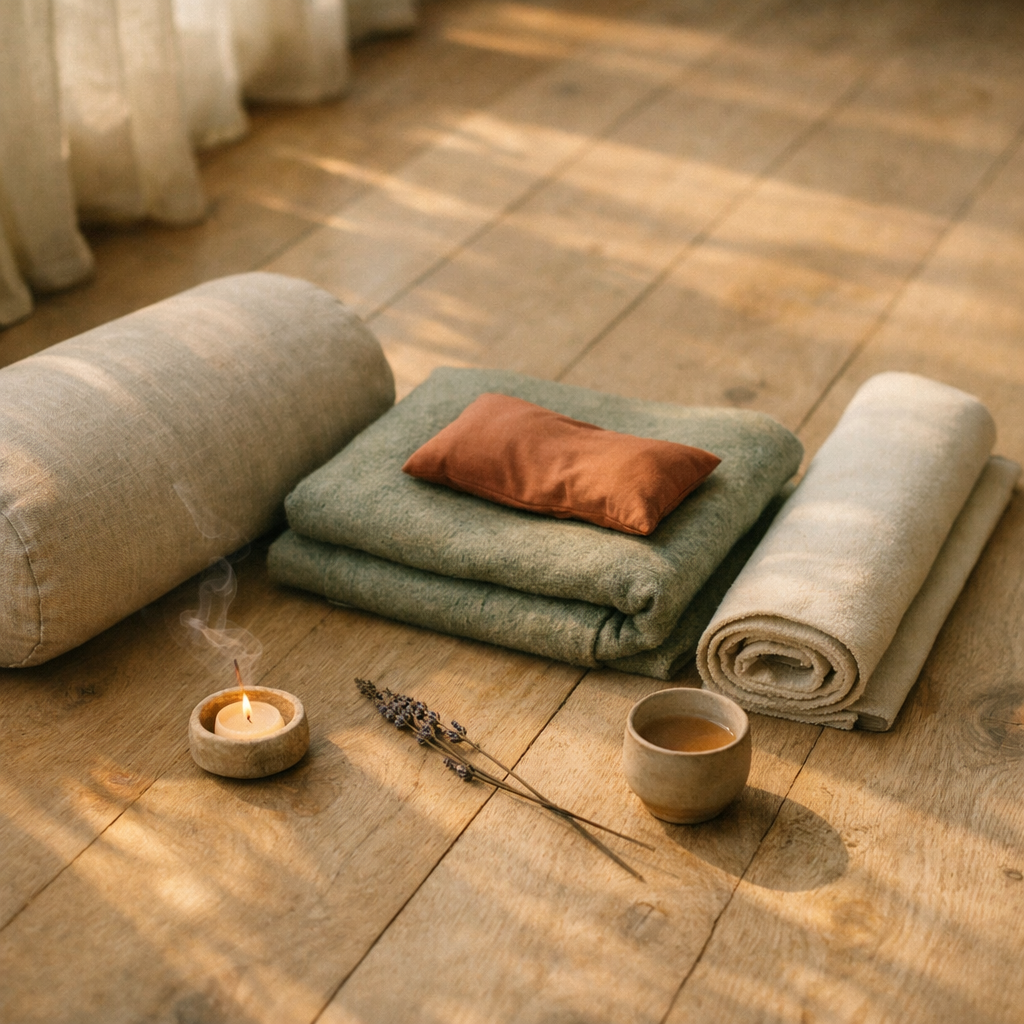
Warmth is the one that actually changes outcomes. Body temperature drops noticeably during deep rest, and being cold at minute eighteen will pull you straight out of the state. A proper wool blanket over the body and a second one folded under the head is the single best investment you can make in this practice. I have taught sessions where simply adding blankets transformed the room.
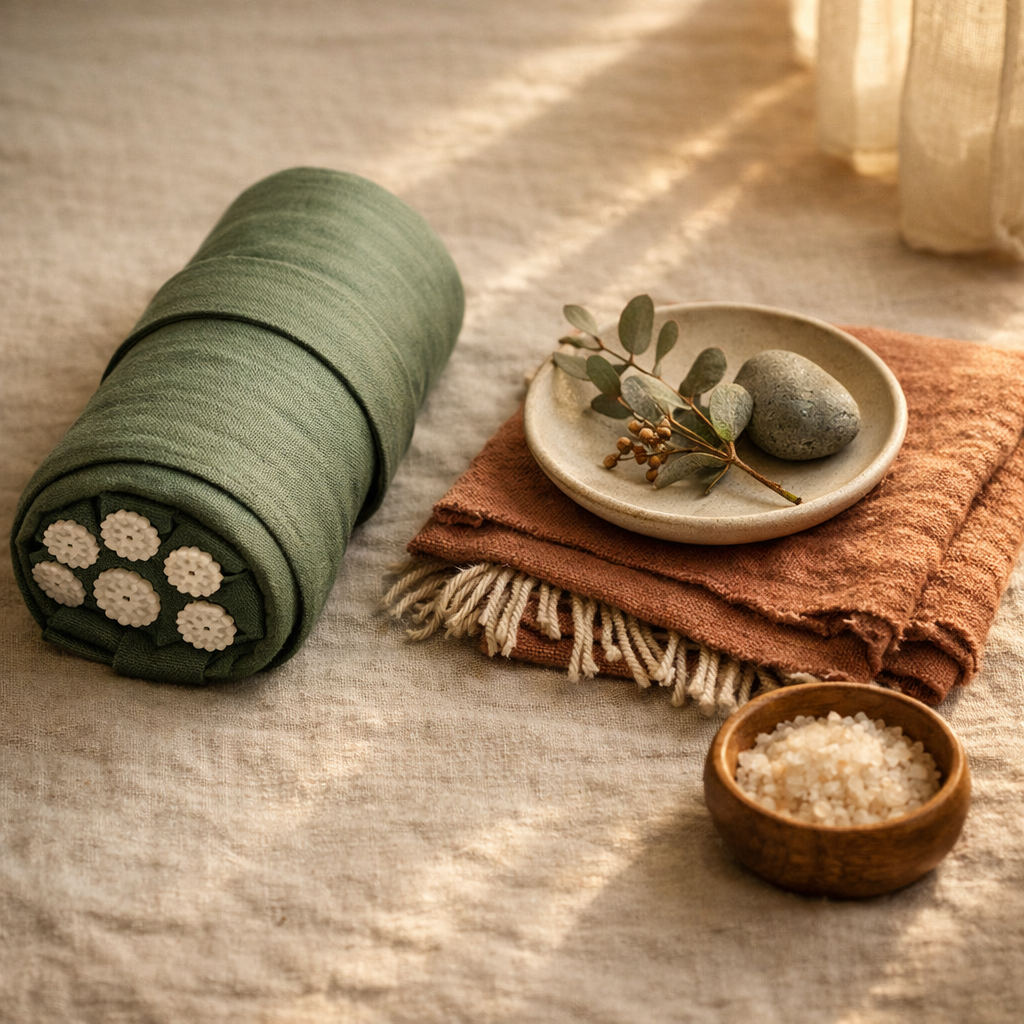
Support under the knees is second. Lying flat puts most people’s lumbar spine into a mild strain that becomes distracting after ten minutes. A yoga bolster under the knees releases the lower back completely, and a rolled blanket works nearly as well if you would rather not buy one.
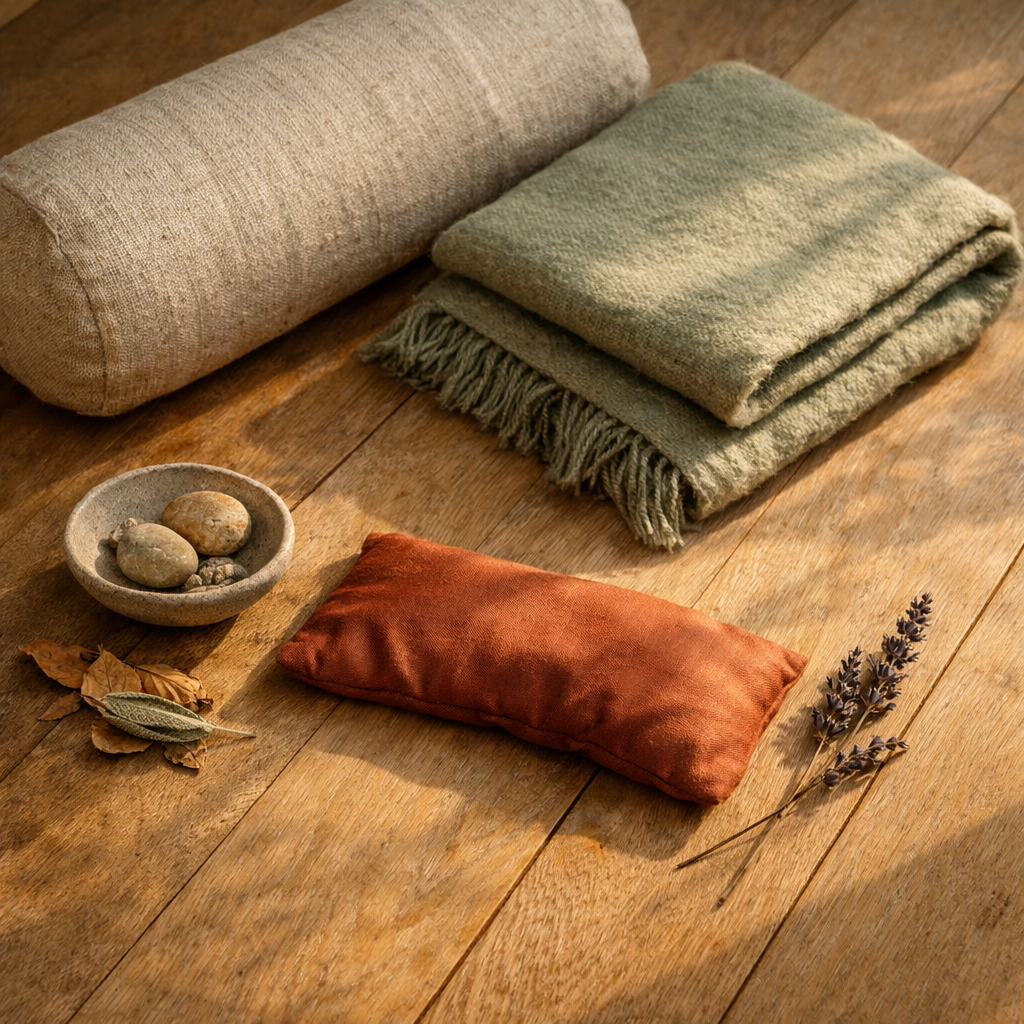
Darkness helps more than I expected. A weighted silk eye pillow does two things at once: it blocks light and applies gentle pressure around the eyes, which seems to shorten the time it takes to settle. Mine is filled with flaxseed and dried lavender and it is fifteen years old.
If you want to go deeper on the tradition rather than just the practice, Satyananda’s original text remains the reference work, and you can find a yoga nidra book without difficulty. I would practise for a month first. The book makes far more sense once your body knows what it is describing.
Everything else, the special mats, the subscription apps, the singing bowl recordings, is optional. Free guided sessions from reputable teachers are plentiful, and the voice matters more than the production value. Find one you can stand listening to twice a week and stay with it.

When Yoga Nidra Is The Right Tool
The practice earns its place for the specific condition of being exhausted and unable to rest. The afternoon slump where a nap would help but you cannot fall asleep. The evening where the body is tired and the mind is still running the day back. The stretch after illness, injury, or a hard season, when your usual practice is out of reach and doing nothing at all feels intolerable.
It is also, quietly, the best on-ramp to meditation I know for people who have decided they are bad at meditating. Nobody is bad at lying down. The skills transfer more than you would expect, and once they do, a dedicated corner helps. I wrote a whole piece on setting up a home meditation space on any budget if you want somewhere the blankets can live permanently.
It is not a treatment for a clinical condition on its own, not a replacement for sleep, and not a shortcut around anything. If you are dealing with persistent insomnia, depression, or trauma, please involve a professional. Nidra sits alongside proper care very well. It does not stand in for it.
For most people leading ordinary overloaded lives, twenty minutes on the floor two or three times a week is one of the highest-return practices available. It costs nothing. It asks nothing except that you stop, which turns out to be the difficult part.
If you try one thing from this article, do this. Tonight, before bed, put a folded blanket under your knees and another over your body, find a twenty minute recording, and lie down. Do not try to do it well. There is nothing to do well. Follow the voice around your right hand, then your left, and notice where you are when it ends.
My sankalpa has not changed in four years, and I am not going to tell you what it is. But I will say that the first time I said it silently into that particular quiet, I understood that I had been repeating the opposite to myself every day for a decade without once saying it out loud.
Frequently Asked Questions
What is yoga nidra and how is it different from meditation?
Yoga nidra is a guided practice done lying down, in which a voice walks you through a structured rotation of attention around the body while you stay on the edge between waking and sleeping. Unlike seated meditation, there is no effort to hold focus and no posture to maintain. You are not trying to concentrate. You are following instructions and letting the body sink. Most people find it dramatically easier than sitting meditation for exactly that reason.
Is it a problem if I fall asleep during yoga nidra?
No, and almost everyone does at first. Falling asleep usually means you are carrying a sleep debt, and the body takes what it needs. Over a few weeks most people start hovering in the in-between state rather than dropping off. If you want to stay awake, practise in the late afternoon rather than at bedtime, keep the room slightly cool, and lie with your forearms raised at the elbow so a hand drops if you slip under.
How long should a yoga nidra session be?
Twenty to thirty minutes is the sweet spot for most people, and that length has the most support in the small research base. Ten minute sessions are genuinely useful as a mid-afternoon reset. Sessions past 45 minutes tend to tip into ordinary napping for beginners. Frequency matters more than duration. Three short sessions a week will do more for you than one long one a month.