Best Acupressure Mats for Stress Relief and Pain Recovery
I bought my first acupressure mat in 2023 because I had thrown my back out lifting a couch by myself, refused on principle to see a chiropractor, and was too cheap for a real massage. A friend had mentioned a thing called a Shakti mat, which she described as “lying on a thousand little spikes for twenty minutes until your body gives up and relaxes.” I ordered one that night. I expected nothing.
The first session was deeply unpleasant for about ninety seconds and then surprisingly fine. By minute fifteen I was nearly asleep. When I stood up, the knot in my lower back had loosened in a way that no amount of stretching had touched in three days. I have been a quiet evangelist ever since.
Three years and four mats later, I am here to give you the honest version of acupressure mats: which ones are worth the money, which ones are surprisingly good for half the price, what no one tells you about the first ten minutes, and where the marketing claims start to outrun the evidence.
What An Acupressure Mat Actually Is
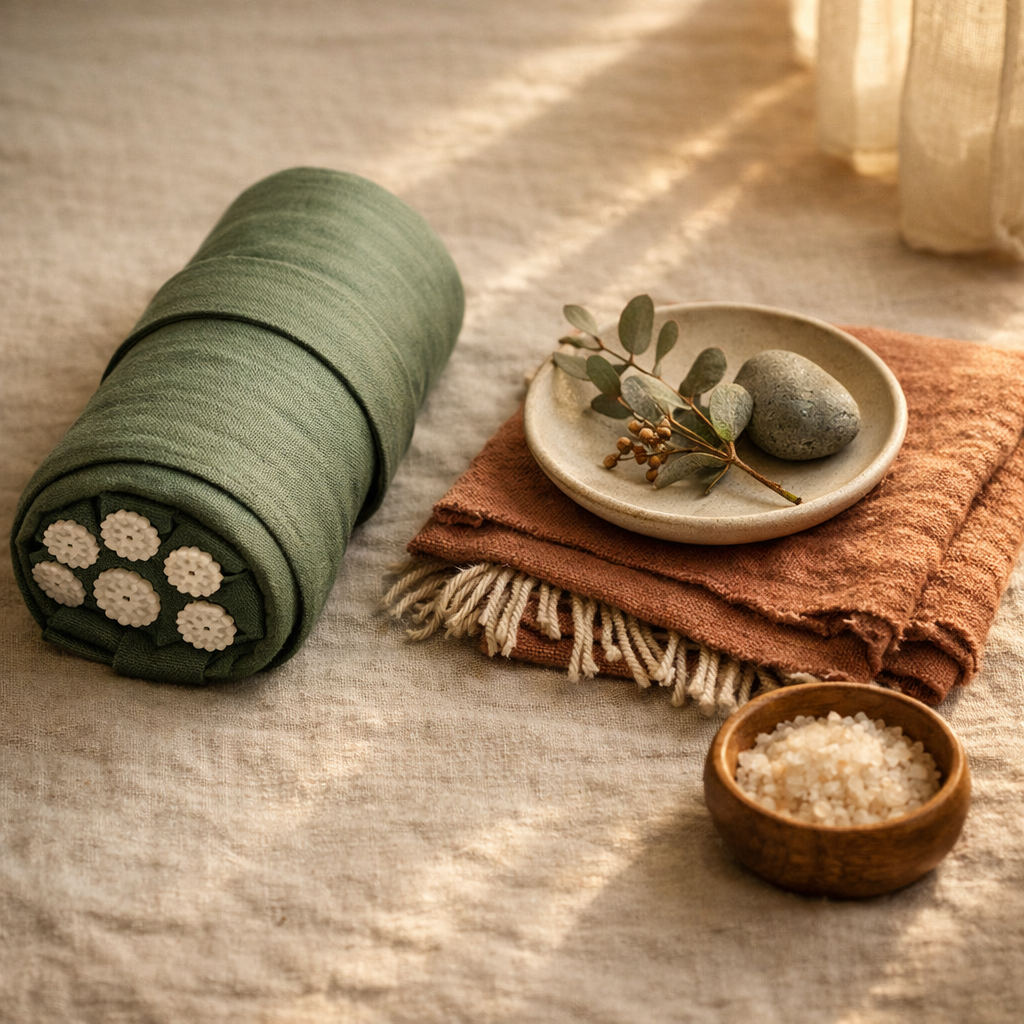
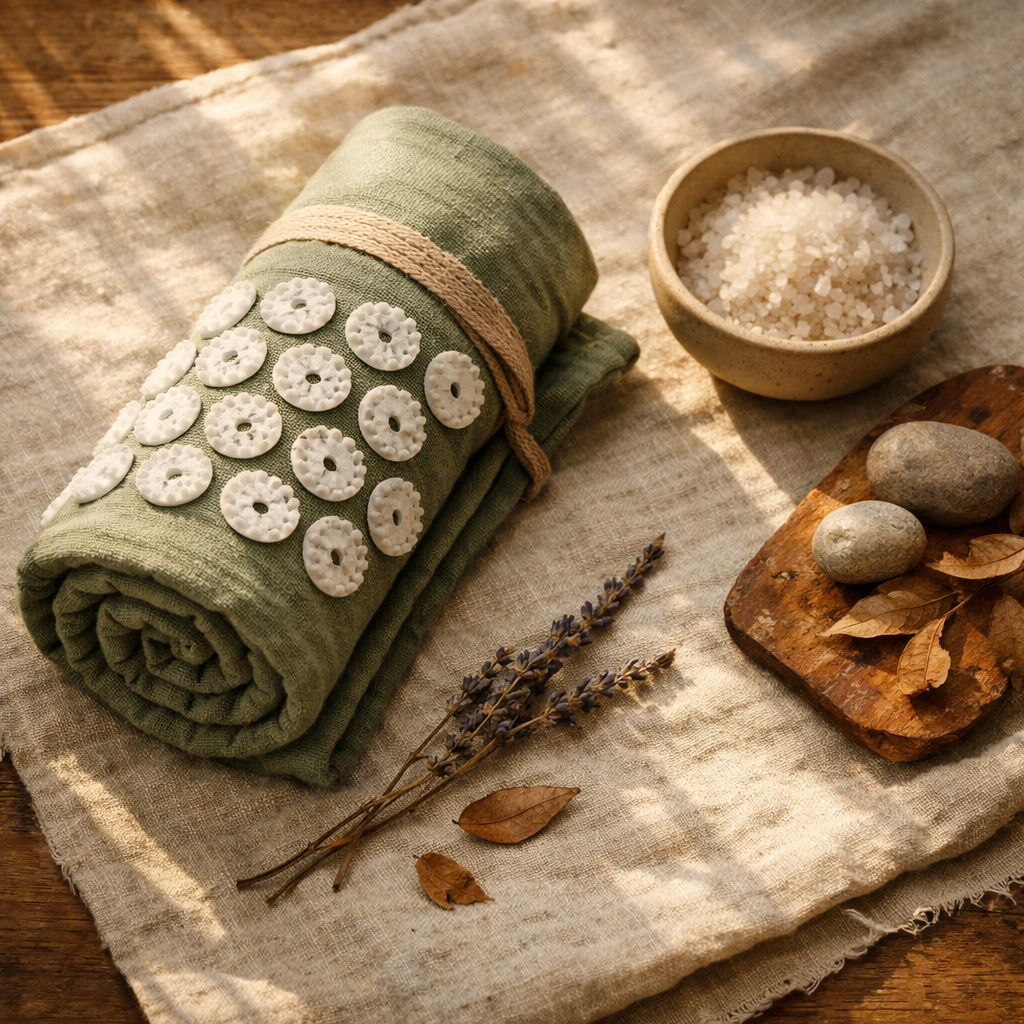
The basic design has barely changed in fifteen years. A foam-filled cotton mat, roughly the size of a yoga mat but thicker, covered in a few thousand small plastic discs. Each disc has a ring of sharp spikes pointing upward. You lie on it, with bare skin or a thin shirt depending on your tolerance, and the spikes press into your back at evenly distributed points.
The mechanism is roughly the same as the principle behind acupuncture without the needles actually breaking the skin. The pressure stimulates nerve endings across a wide area, triggers a localized inflammatory response, prompts the body to release endorphins and oxytocin, and shifts the autonomic nervous system into parasympathetic dominance. That is the technical version. The felt version is that after a few minutes the body simply gives up resisting and starts to relax in a way that feels almost involuntary.
The first time I lay on a mat, I genuinely thought I had wasted my money. The sensation was sharp and prickly and not at all the gentle massage I had imagined. By the third session I started looking forward to it. By the second week I was using it as a wind-down ritual three nights a week. The discomfort was always there for the first minute. After that, the body decided to let go.
What The Research Actually Says
I want to be careful here because the marketing around acupressure mats can drift into territory the science does not support. Let me give you the honest version.
There is moderate evidence that acupressure mats reduce self-reported back pain in people with mild to moderate non-specific back pain. A 2011 randomized study published in The Clinical Journal of Pain found that participants using a nail mat for three weeks reported significant reductions in chronic back pain compared to a control group. Several smaller studies have replicated this for general muscle tension and stress.
There is also reasonable evidence for stress reduction and parasympathetic activation. Heart rate variability tends to improve during and after a session, cortisol levels drop, and many people fall asleep on the mat without intending to.
What there is not strong evidence for is the bigger marketing claims. Acupressure mats do not cure sciatica, fix slipped discs, eliminate fibromyalgia, or rewire your nervous system in some permanent way. They are a useful, affordable tool for general muscle tension and stress relief. They are not a medical device. If you have a specific structural issue, see a physical therapist.
That said, for the price of a mid-range yoga mat, having a tool that reliably puts me into a parasympathetic state in fifteen minutes is genuinely useful. I have not found another piece of recovery equipment that gives me as much return per dollar.
The Mats Worth Considering In 2026
The market has gotten crowded. There are dozens of brands, most of which are essentially the same product with different colors and price tags. Here is what I have actually used long enough to have an opinion on.
Shakti Mat (the original)
This is the brand that started the modern acupressure mat trend, and three years in I still consider it the benchmark. The standard Shakti uses a cotton cover over coconut coir filling, with the spike discs made from recycled plastic. The build quality is noticeably better than the cheap copies. The cotton breathes, the coir holds its shape, the spikes are evenly distributed and consistent.
The price is the catch. A standard Shakti mat costs significantly more than the Amazon clones, and the brand pricing has crept up over the years. If you are on a tight budget, this is not the entry point.
Best for: Long-term users, people who care about natural materials, gift buyers. Skip if: You want to try the concept without committing $80 plus.
ProsourceFit Acupressure Mat (the budget pick)
If you want to try the concept first and decide if it works for you, this is the mat I usually recommend. ProsourceFit makes a perfectly serviceable mat with foam filling and synthetic cover for roughly a third of the price of a Shakti. The spikes are slightly less consistent and the mat compresses faster over the years, but for the first year or two of regular use you would not be able to tell the difference blindfolded.
The synthetic cover is the main downside. It does not breathe as well, and on hot summer nights the mat can feel slightly sticky. Most people will not care.
Best for: First-time buyers, people who want to test before committing, gift wrapping for a friend who is curious. Skip if: You want natural materials or expect to use the mat daily for many years.
Ajna Wellness Mat
The Ajna is in the middle of the price spectrum and includes the pillow, which is the part most cheap kits cut. The pillow is genuinely useful for neck tension and tension headaches, and the difference between a mat-only kit and a mat-plus-pillow kit is bigger than the photos suggest. If you want to address neck tension as well as back tension, get the kit.
The Ajna build quality is solid but not Shakti-level. The cover is cotton, the filling is foam, the spikes are well-distributed, and the carry bag is decent. After eighteen months of regular use, mine has held up well with no flattening of the spikes.
Best for: People with both back and neck tension. Best balance of price and quality in my experience. Skip if: You only want the back mat and not the pillow.
Spoonk Mat (the gentlest option)
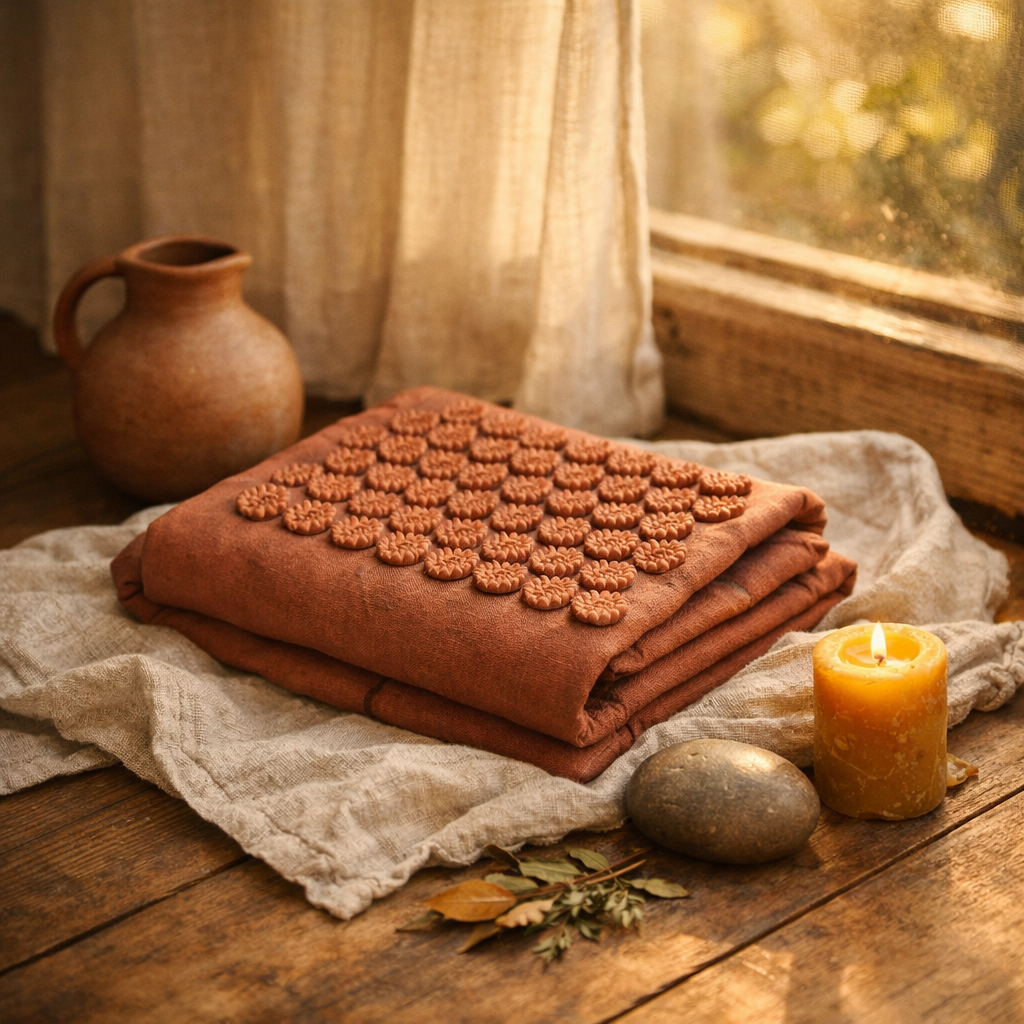
The Spoonk is the only mat I have tried that I would describe as suitable for absolute beginners or people with sensitive skin. The spike density is slightly lower and the points are slightly less sharp, which means the first-minute discomfort is meaningfully reduced. For a first-timer who would otherwise quit after thirty seconds, this is the gentler entry point.
The trade-off is that experienced users may find the Spoonk underpowered. If you have been on a Shakti for a year, the Spoonk feels almost too soft. It is also priced at the higher end of the market, which makes it a strange recommendation for hesitant beginners on a budget.
Best for: Sensitive skin, first-time users who are nervous, gentle daily use. Skip if: You want the strongest possible stimulation or are watching the price.
What To Avoid
The cheapest mats on Amazon, often under twenty dollars, are usually a false economy. The spike discs are sometimes glued rather than sewn into the cover, and after a few months they start coming loose. I have had two of these mats in my time and both started shedding spikes by month four. If a mat seems suspiciously cheap, it usually is.
Also be wary of any mat marketed with extreme medical claims. If the listing promises to cure sciatica, fix herniated discs, or align your chakras, that is marketing copy. The honest mats are the ones that say “may help with stress, muscle tension, and general relaxation.”
How To Actually Use One
The instructions on most mats are perfunctory. Here is what I actually do, refined over three years.
Start with five minutes the first session. The first ninety seconds are the hard part. Breathe slowly through your nose, keep your shoulders relaxed, do not tense up against the spikes. Tensing makes it worse. Let the body find the position where the pressure is evenly distributed.
A thin cotton t-shirt is fine if the bare-skin version is too intense at first. Most people drop the shirt after a week or two as their tolerance builds. Avoid heavy jumpers or fleece - they prevent the spikes from doing their job.
I lie on the mat with a pillow under my knees, which takes the pressure off the lower back and lets the lumbar region relax. Some people prefer a flat surface. Try both.
The optimal session length, in my experience, is fifteen to twenty minutes. Past that, returns diminish and skin irritation risk goes up. Three sessions a week is plenty. Daily use is fine but not strictly necessary.
Standing on the mat is a separate practice. It is more intense than lying because all your weight goes through the soles of the feet. Start with one minute. The plantar fascia gets a remarkable amount of stimulation, and many runners I know swear by a 30-second standing session before bed.
When An Acupressure Mat Is The Right Tool
The mat shines for general muscle tension, sleep wind-down, post-workout recovery, low-grade chronic stress, and what I would describe as nervous-system overdrive after a long day at a screen. If your shoulders live near your ears, if your lower back is constantly tight from sitting, if you cannot get yourself to fall asleep because your body is wired even though you are exhausted, the mat is a remarkably effective intervention for the price.
It is less useful for acute injuries, structural pain, post-surgical recovery, or anything where the underlying issue needs medical attention. I am not a doctor. Please do not use a piece of plastic-spike fabric as a substitute for proper care if you have a real problem.
For most people who lead modern desk-and-screen lives, acupressure mats live somewhere in the middle of the wellness toolkit, between meditation and a real massage. Cheaper than therapy, more reliable than willpower, less effective than a real bodyworker, but available at 11 PM on a Tuesday when you cannot face one more hour of doom-scrolling.
If you are curious, I would not overthink the choice. The ProsourceFit at the lower price point, the Ajna with the pillow at the middle, or the Shakti at the high end. Any of these will tell you within two weeks whether the practice is for you. Most people who try one for two weeks become regular users for years. A few decide it is not for them. Both responses are valid.
The only mistake is buying one of the very cheapest knockoffs and assuming all mats are like that. The cheap ones do not last, the spikes shed, the experience is uncomfortable in the wrong way, and you walk away thinking the whole concept was overhyped. It is not. The real ones, used three nights a week for fifteen minutes, are one of the most reliable nervous-system tools I have found.
If you decide to try one, do me a favor. Lie down. Breathe. Wait the first ninety seconds. Trust the process. The body knows what to do once you stop fighting it.
Frequently Asked Questions
Do acupressure mats actually work?
There is moderate research support for acupressure mats reducing self-reported back pain, neck tension, and stress markers, mostly through stimulating endorphin release and triggering parasympathetic activation. They are not a cure for chronic conditions, but for mild to moderate muscle tension and general stress, the evidence is reasonable and the cost of trying one is low.
How long should you lie on an acupressure mat?
Start with 5 minutes the first time. The discomfort fades within the first 90 seconds in most cases. Most regular users settle into 15 to 20 minute sessions, often before bed. Avoid sessions longer than 40 minutes - past that point most of the benefit has plateaued and you risk skin irritation.
Are acupressure mats safe?
For most healthy adults, yes. They are not recommended if you are pregnant, have a bleeding disorder, are on blood thinners, have very thin or fragile skin, or have any open wounds or skin conditions on your back. Always lie on a clean mat and check your skin afterwards. Mild redness for 30 minutes is normal. Bruising is not.