<?xml version="1.0" encoding="utf-8"?><feed xmlns="http://www.w3.org/2005/Atom" ><generator uri="https://jekyllrb.com/" version="4.4.1">Jekyll</generator><link href="https://puritypeak.org/feed.xml" rel="self" type="application/atom+xml" /><link href="https://puritypeak.org/" rel="alternate" type="text/html" /><updated>2026-07-29T13:41:44+02:00</updated><id>https://puritypeak.org/feed.xml</id><title type="html">PurityPeak | Elevating Spirits, Nurturing Souls</title><subtitle>Dive into a realm where eco‑spirituality, mindful living, and holistic practices converge to uplift and transform. Embrace the wisdom of a balanced life with PurityPeak.</subtitle><author><name>Moonshine Aldai</name></author><entry><title type="html">Cold Water Therapy for Beginners: What Cold Showers and Plunges Actually Do</title><link href="https://puritypeak.org/natural-healing/nature-therapy/cold-water-therapy-for-beginners-what-cold-showers-and-plunges-actually-do/" rel="alternate" type="text/html" title="Cold Water Therapy for Beginners: What Cold Showers and Plunges Actually Do" /><published>2026-07-24T15:00:00+02:00</published><updated>2026-07-24T15:00:00+02:00</updated><id>https://puritypeak.org/natural-healing/nature-therapy/cold-water-therapy-for-beginners-what-cold-showers-and-plunges-actually-do</id><content type="html" xml:base="https://puritypeak.org/natural-healing/nature-therapy/cold-water-therapy-for-beginners-what-cold-showers-and-plunges-actually-do/"><![CDATA[<p>There is a bend in a creek about twenty minutes from my house where the water comes off the ridge and pools deep enough to sit in up to the collarbone. In February it runs around 40 degrees. In August it is a merciful 62. I have been getting into it, in one season or another, for four years, and I have thought a great deal about why.</p>

<p>I did not come to this through the wellness internet. I came to it because I slipped getting out of a canoe in early spring and spent an involuntary ninety seconds in water that cold, and walked back to the car afterwards feeling more awake than I had in months. That sensation was interesting enough that I went back on purpose.</p>

<p>Since then cold exposure has become one of the most oversold practices in wellness, and I want to give you the version I actually believe: what it does, what it does not, the safety rules that are genuinely not optional, and how to start tonight in your own bathroom.</p>

<h2 id="what-cold-water-therapy-actually-is">What Cold Water Therapy Actually Is</h2>

<p>The umbrella covers three fairly different practices, and most confusion comes from treating them as one thing.</p>

<p><strong>Cold showers</strong> are the accessible version. You finish a normal shower with anywhere from 30 seconds to three minutes of cold water. The temperature is whatever your municipal supply gives you, usually somewhere between 50 and 70 degrees depending on season and location. The stimulus is moderate and the risk is close to zero.</p>

<p><strong>Cold water immersion</strong>, the plunge or ice bath, means sitting in water typically between 40 and 59 degrees for two to ten minutes, usually up to the neck. This is a substantially larger stimulus and where nearly all the interesting research and nearly all the risk live.</p>

<p><strong>Open water swimming</strong> in cold conditions is the oldest form and the one with the most cultural depth behind it, from Nordic winter bathing to the sea swimming clubs of the British and Irish coasts. It is also the version with a genuine fatality rate, almost entirely because of cold shock and because people do it alone.</p>

<p>The physiological response is broadly the same across all three, scaled by intensity. Skin cold receptors fire, the sympathetic nervous system spikes hard, peripheral blood vessels clamp shut to protect the core, breathing goes ragged, and the body dumps catecholamines into the bloodstream. Then, if you stay and stop fighting it, something shifts. The breathing settles. The panic drains out. What is left is a strange lucid calm that outlasts the swim by several hours.</p>

<p>That calm is the reason people keep doing this. Everything else is secondary.</p>

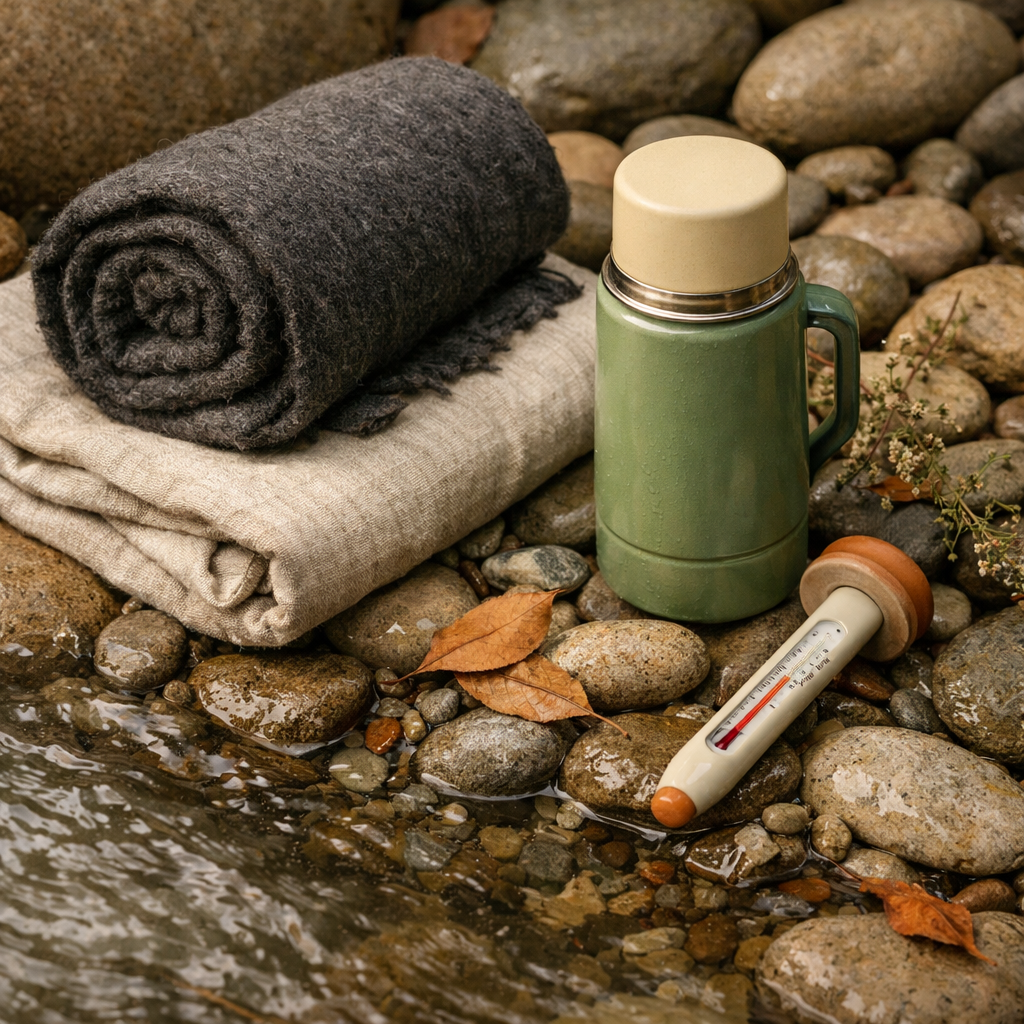
<p><img src="/assets/images/blog/2026-07-24-cold-water-therapy-for-beginners-what-cold-showers-and-plunges-actually-do-01.jpg" alt="An overhead view of a folded oatmeal linen towel and a rolled charcoal wool blanket on smooth wet river stones at a creek edge, a sage enamel thermos and a simple floating thermometer beside them, cold clear water running at the frame's edge under soft overcast light" /></p>

<h2 id="what-the-research-actually-says">What The Research Actually Says</h2>

<p>This is where I want to slow down, because cold exposure has attracted more confident overstatement than almost any practice I write about.</p>

<p><strong>Mood and alertness: the strongest finding.</strong> Cold immersion produces a large, reliable, and reasonably long-lasting rise in circulating norepinephrine and dopamine. The frequently cited figure comes from a small 2000 study by Šrámek and colleagues, where an hour in 57 degree water raised noradrenaline roughly 530 percent and dopamine around 250 percent. The sample was tiny and the exposure far longer than anyone recommends, so I would not treat the numbers as gospel. But the direction is robust and it matches what practitioners report universally: hours of clean, elevated, non-jittery alertness afterwards. This is the effect I get most reliably and the one I would stake something on.</p>

<p><strong>Immune function: one good trial, narrower than advertised.</strong> A 2016 randomized trial published in PLOS ONE by Buijze and colleagues enrolled just over 3,000 Dutch adults, who ended their daily shower with 30, 60, or 90 seconds of cold for 30 days. The cold groups took 29 percent fewer sick days. Notably, they did not report fewer illnesses, just less time knocked out by them. Duration made no difference, which suggests 30 seconds is as good as 90. That is a genuinely interesting result and it is not the same as “cold showers boost your immune system.”</p>

<p><strong>Metabolism and brown fat: real but small.</strong> Cold exposure does activate brown adipose tissue and does raise energy expenditure. Work from Susanna Søberg’s group in Denmark is the reference point here. The effect on body composition in practice is modest to the point of irrelevance for most people. Do not do this to lose weight.</p>

<p><strong>Recovery: genuinely complicated.</strong> This one deserves care, because the popular advice is close to backwards for some people. Cold immersion after endurance exercise does reduce soreness and perceived fatigue. But multiple studies, notably work by Roberts and colleagues in the Journal of Physiology, found that regular post-workout cold immersion blunts the muscle hypertrophy and strength adaptations from resistance training. If you lift weights to get stronger, do not plunge in the hours right after. Plunge on rest days or in the morning instead. I got this wrong for a year.</p>

<p><strong>Inflammation and depression:</strong> early, small, and interesting. There are plausible mechanisms and some encouraging pilot work on cold water swimming for depressive symptoms. I would not present any of it as established.</p>

<p>What cold exposure does not do: cure disease, detoxify anything, permanently rewire your stress response into invulnerability, or substitute for sleep, therapy, or medication. The most honest framing I have is that it is a reliable, cheap, short-acting mood and alertness intervention with a side of mental toughness practice.</p>

<h2 id="the-safety-rules-that-are-not-optional">The Safety Rules That Are Not Optional</h2>

<p>I am going to be blunt here, because this is the section people skip and it is the only one where getting it wrong can kill you.</p>

<p><strong>The cold shock response is the real danger, not hypothermia.</strong> In the first 60 seconds of immersion in cold water, you get an involuntary gasp followed by uncontrolled rapid breathing. If your face is under water when the gasp happens, you inhale water. This kills people every year, and it kills strong swimmers. Enter slowly. Keep your head up. Never dive or jump into cold water.</p>

<p><strong>Never do breath-hold or hyperventilation breathing immediately before entering water.</strong> Some popular cold exposure methods pair heavy breathing exercises with immersion. Done in sequence, this causes shallow water blackout, and there have been deaths. Breathe however you like on dry land, well away from the water, or not at all.</p>

<p><strong>Never plunge alone in open water.</strong> Have someone on the bank. This is non-negotiable and it is the rule I see broken most often.</p>

<p><strong>Understand afterdrop.</strong> Your core temperature continues falling for 10 to 20 minutes after you get out, as cold peripheral blood returns to the centre. This means you can feel fine leaving the water and become genuinely hypothermic in the car. Get dry immediately, layer up from the top down, and do not drive until you have stopped shivering.</p>

<p><strong>Do not warm up in a hot shower straight afterwards.</strong> It dilates peripheral vessels and drives cold blood to the core faster. Warm drinks, dry clothes, and gentle movement are the right sequence.</p>

<p><strong>Skip this entirely, or clear it with a doctor first, if you have</strong> any heart condition or arrhythmia, uncontrolled high blood pressure, Raynaud’s phenomenon, a circulatory disorder, cold urticaria, or are pregnant. The catecholamine spike and the vasoconstriction are a genuine cardiac load. This is not a case where the risk is theoretical.</p>

<p><img src="/assets/images/blog/2026-07-24-cold-water-therapy-for-beginners-what-cold-showers-and-plunges-actually-do-02.jpg" alt="A bare stretch of moss-edged creek bank under overcast light, a charcoal wool blanket and a folded oatmeal towel laid over a flat grey boulder beside a sage enamel thermos, cold clear water moving over pale stones in the foreground" /></p>

<h2 id="how-to-actually-start">How To Actually Start</h2>

<p>Do not buy a tub. Start with the shower you already own, which is free and honest about whether you will keep this up.</p>

<p><strong>Week one.</strong> Finish your normal shower with 30 seconds of full cold. Not lukewarm, not a gradual fade. Turn the dial and stand in it. The 30 seconds will feel considerably longer than 30 seconds.</p>

<p><strong>Weeks two and three.</strong> Extend to 60 or 90 seconds. Somewhere in here the character of the experience changes. The first 20 seconds stay unpleasant forever, in my experience, but you stop dreading them.</p>

<p><strong>Week four onwards.</strong> If you want to progress to immersion, the useful benchmark comes from Søberg’s work: roughly 11 minutes of total cold exposure per week, split across two to four sessions. That means sessions of two to four minutes, not marathon sits. Longer sessions do not scale the benefit and do scale the risk.</p>

<p><strong>Breathing is the whole skill.</strong> The first 30 seconds your body will try to hyperventilate. The practice is a slow nasal inhale and a long, deliberate exhale, over and over, until the breath comes back under your control. This is the same mechanism I described in my piece on <a href="/mindful-living/holistic-health/breathwork-techniques-for-anxiety-calm-your-nervous-system-in-minutes/">breathwork for anxiety</a>, applied under considerably more duress. When the breath settles, the cold stops being an emergency and starts being just information.</p>

<p><strong>Get out on your own terms.</strong> Not when you are numb, not when you are shivering hard, not when someone else says so. Two clean minutes where you kept your breathing is a better session than five where you dissociated to survive it.</p>

<p><strong>Do not stack it after strength training.</strong> Morning sessions or rest days. See the recovery research above.</p>

<h2 id="what-gear-is-actually-worth-it">What Gear Is Actually Worth It</h2>

<p>Almost none of it, for the first few months. Some of the links below are affiliate links, which means PurityPeak earns a small commission if you buy through them at no extra cost to you, and it does not change what I recommend.</p>

<p>The one item I would call genuinely necessary for open water or tub work is a <strong>thermometer</strong>. Knowing you are in 48 degree water rather than guessing changes how you set limits, and the guessing tends to run optimistic. A simple <a href="https://www.amazon.com/s?k=floating+water+thermometer&amp;tag=affilgenie200-20" rel="sponsored nofollow">floating water thermometer</a> costs almost nothing and is the difference between a practice and a gamble.</p>

<p>Second is warmth for afterwards, which matters more than anything you use during. A <a href="https://www.amazon.com/s?k=waterproof+changing+robe+swim+parka&amp;tag=affilgenie200-20" rel="sponsored nofollow">changing robe</a> lets you get out of wet clothes and into insulation in under a minute, which is exactly the window where afterdrop is decided. Before I had one I used two wool blankets and a lot of resolve, and the robe is better.</p>

<p>If you swim in genuinely cold water, <strong>neoprene gloves and booties</strong> are not a comfort item. Hands and feet lose dexterity fast in the low 40s, and losing your grip on a bank is how a swim becomes an incident. A pair of <a href="https://www.amazon.com/s?k=neoprene+swim+gloves+and+booties&amp;tag=affilgenie200-20" rel="sponsored nofollow">neoprene swim gloves and booties</a> extends both the safe season and the safe duration, and no, they are not cheating.</p>

<p>A <a href="https://www.amazon.com/s?k=cold+plunge+tub+ice+bath&amp;tag=affilgenie200-20" rel="sponsored nofollow">cold plunge tub</a> is worth considering only once you have kept a cold shower habit for two or three months and know it is going to stick. A basic insulated barrel plus bagged ice will do everything a chiller unit does for a small fraction of the cost. The expensive circulating models buy convenience, not effect.</p>

<p>Everything else, the supplements, the recovery apps, the branded programmes, I would skip entirely.</p>

<p><img src="/assets/images/blog/2026-07-24-cold-water-therapy-for-beginners-what-cold-showers-and-plunges-actually-do-03.jpg" alt="A close-up of a sage enamel thermos cup steaming on a wet grey boulder beside a folded charcoal wool blanket and a pair of worn leather sandals, the blurred cold shine of moving creek water behind, soft diffused light" /></p>

<h2 id="when-cold-water-is-the-right-tool">When Cold Water Is The Right Tool</h2>

<p>It is exceptional for morning inertia, for the fog that follows a bad night’s sleep, and for breaking a genuinely stuck mood. Three minutes in the creek does something to a low afternoon that no amount of coffee or reasoning touches. It is also, and I think this is underrated, a rehearsal for staying calm inside something unpleasant. You practise choosing your breath while your body screams at you to get out. That skill transfers.</p>

<p>It is not a treatment for depression or anxiety, though it sits alongside proper care perfectly well. It is not a recovery tool if your goal is muscle growth. And it is not something to do on a day when you feel fragile, unwell, or unsteady, because the whole thing depends on being able to stay composed.</p>

<p>It also pairs naturally with the slower practices rather than competing with them. My best mornings are the creek followed by twenty minutes of stillness on the bank, which is essentially the <a href="/nature-therapy/mindful-living/forest-bathing-for-beginners-a-practical-guide-to-shinrin-yoku/">forest bathing</a> I have written about before, just with a colder start and a much clearer head.</p>

<p>If you want to try it, do not buy anything. Tonight, at the end of your shower, turn the dial all the way cold and stand there for 30 seconds. Breathe slow out through the mouth. Count if it helps. Notice what your body does at second five and what it has done by second twenty five.</p>

<p>Then notice how you feel twenty minutes later, drying your hair, thinking about something else entirely. That small unmistakable lift is the whole practice. Everything after it is refinement, and most of it is optional.</p>

<p>The creek was 61 degrees this morning. In four months it will be 41, and I will still be going, and I will still hate the first twenty seconds. That part never changes. It turns out not to matter.</p>]]></content><author><name>Moonshine Aldai</name></author><category term="natural-healing" /><category term="nature-therapy" /><category term="cold water therapy" /><category term="cold plunge" /><category term="cold showers" /><category term="wild swimming" /><category term="nervous system" /><category term="recovery" /><summary type="html"><![CDATA[What cold showers and ice baths actually do for mood, recovery and immunity, how cold and how long to go, and the safety rules that are not optional.]]></summary><media:thumbnail xmlns:media="http://search.yahoo.com/mrss/" url="https://puritypeak.org/assets/images/featured-post/2026-07-24-cold-water-therapy-for-beginners-what-cold-showers-and-plunges-actually-do-featured.jpg" /><media:content medium="image" url="https://puritypeak.org/assets/images/featured-post/2026-07-24-cold-water-therapy-for-beginners-what-cold-showers-and-plunges-actually-do-featured.jpg" xmlns:media="http://search.yahoo.com/mrss/" /></entry><entry><title type="html">Best Weighted Blankets for Anxiety and Deeper Sleep</title><link href="https://puritypeak.org/holistic-health/mindful-living/best-weighted-blankets-for-anxiety-and-deeper-sleep/" rel="alternate" type="text/html" title="Best Weighted Blankets for Anxiety and Deeper Sleep" /><published>2026-07-10T15:00:00+02:00</published><updated>2026-07-10T15:00:00+02:00</updated><id>https://puritypeak.org/holistic-health/mindful-living/best-weighted-blankets-for-anxiety-and-deeper-sleep</id><content type="html" xml:base="https://puritypeak.org/holistic-health/mindful-living/best-weighted-blankets-for-anxiety-and-deeper-sleep/"><![CDATA[<p>I bought my first weighted blanket in the worst month of a career change I had chosen and immediately regretted. I was sleeping about four hours a night, waking at 3 AM with my heart going, and running out of ideas. A colleague mentioned that a weighted blanket had ended a decade of her own bad nights. I ordered a 20 pound one that evening, which, it turns out, was too heavy for me by a comfortable margin.</p>

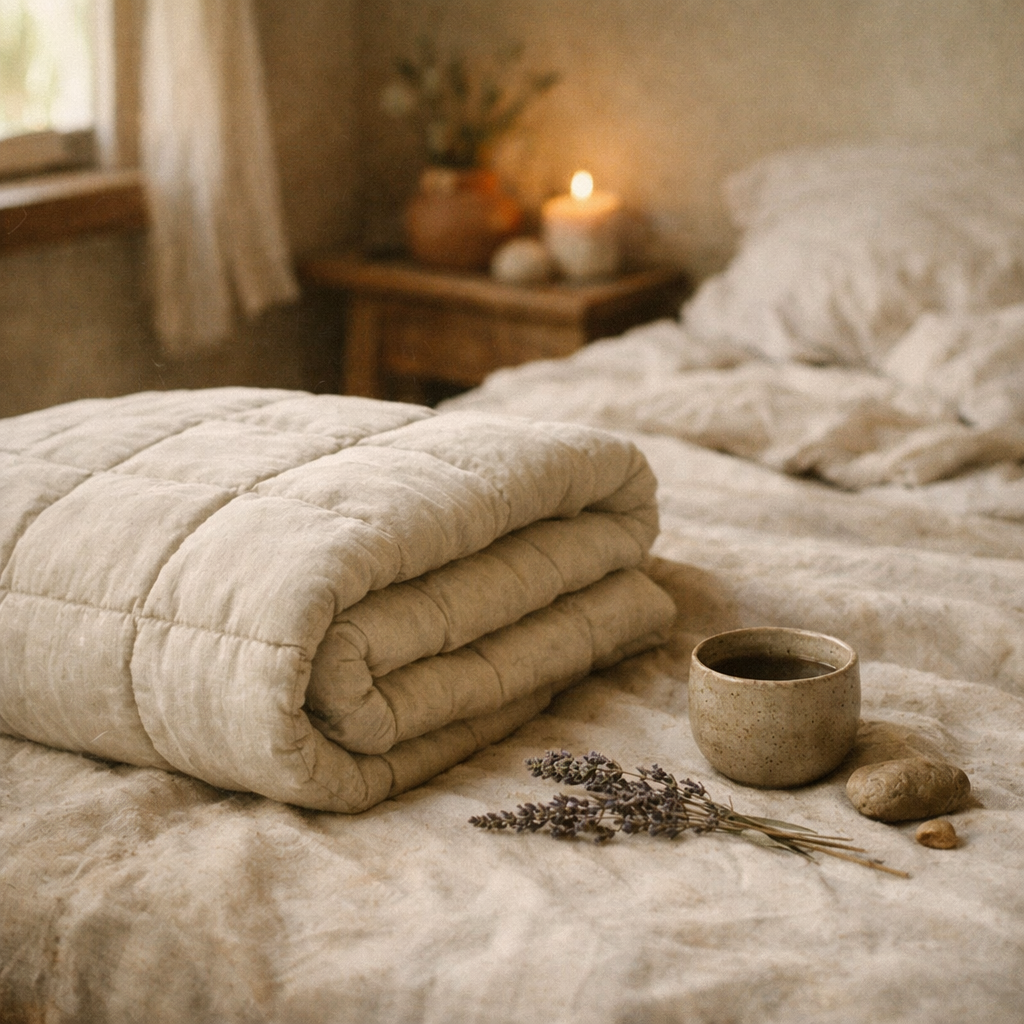
<p>That was the first of four. Three years later I have slept under a chunky knit, a cheap glass-bead quilt, a cooling bamboo model, and the cotton one I have kept. I have learned that most of what determines whether you love or return a weighted blanket comes down to three decisions people make carelessly: weight, fill, and cover.</p>

<p>Here is the honest version. What the research supports, how to pick, which blankets are worth the money in 2026, and the safety rules that matter more than any of the shopping advice.</p>

<h2 id="what-a-weighted-blanket-actually-does">What A Weighted Blanket Actually Does</h2>

<p>A weighted blanket is a duvet-sized textile with weight distributed evenly across it, usually 10 to 25 pounds, held in place by a grid of stitched pockets. The weight comes from small glass beads, plastic poly pellets, or in knitted models from the density of the yarn itself. The grid is the important part. Without sewn baffles the fill migrates to the low corners within a month and you end up sleeping under a lumpy sandbag.</p>

<p>The mechanism is called deep pressure stimulation, and it is the same principle behind swaddling an infant, a firm hug, or the pressure vests used in occupational therapy. Broad, even, sustained pressure across the body stimulates proprioceptive receptors, which appears to reduce sympathetic arousal and push the autonomic nervous system toward parasympathetic dominance. Heart rate settles. Cortisol tends to drop. Many people report the effect as an involuntary exhale about ninety seconds after the blanket goes on.</p>

<p>The first night under a properly fitted one, I noticed I had stopped doing the thing where I shift position every few minutes. That restlessness had been so constant I had stopped registering it as restlessness. The blanket simply made it not worth the effort to move.</p>

<p><img src="/assets/images/blog/2026-07-10-best-weighted-blankets-for-anxiety-and-deeper-sleep-01.jpg" alt="An overhead view of a heavy sage chunky-knit blanket folded in thick loops across rumpled oatmeal linen bedding, a small unglazed ceramic cup and a sprig of dried lavender resting on the sheet, soft early morning light raking across the fabric texture" /></p>

<h2 id="what-the-research-actually-says">What The Research Actually Says</h2>

<p>I want to give you the careful version, because weighted blanket marketing has drifted a long way past the evidence.</p>

<p>The strongest study to date is a 2020 randomized controlled trial published in the Journal of Clinical Sleep Medicine by Ekholm and colleagues, which followed 120 adults with insomnia alongside a psychiatric diagnosis. After four weeks, the group using a weighted chain blanket showed significantly reduced insomnia severity, better sleep maintenance, and lower daytime fatigue, anxiety, and depression scores compared to a light control blanket. The effect held at twelve month follow-up. That is a serious result on a serious sample.</p>

<p>Beyond that, the picture is thinner but consistent in direction. Smaller studies have found reduced self-reported anxiety in patients before dental and chemotherapy procedures. Work by Mullen and colleagues found a majority of adults reported lower anxiety under a 30 pound blanket, with no adverse physiological effects on vital signs. Research in occupational therapy on deep pressure stimulation more broadly goes back decades and is well regarded.</p>

<p>What the evidence does not support is the surrounding claim set. Weighted blankets do not raise melatonin in any way that has been properly demonstrated, do not treat ADHD, do not resolve clinical depression, and do not fix a sleep problem whose cause is apnea, caffeine, a bad mattress, or a phone in bed. If your insomnia has a mechanical cause, a heavy blanket will not out-argue it.</p>

<p>My honest summary: the effect is real, it is modest, and it lands hardest on the specific problem of a body that will not settle. For the wired-and-exhausted 3 AM state I was in, it was the single most useful thing I bought that year. It did not fix the underlying situation. It made the nights survivable while I fixed the underlying situation.</p>

<h2 id="how-to-choose-the-three-decisions-that-matter">How To Choose: The Three Decisions That Matter</h2>

<h3 id="weight">Weight</h3>

<p>The standard rule is 10 percent of your body weight. A 130 pound adult goes to 12 or 13 pounds, a 180 pound adult to 18, a 220 pound adult to 20 or 22. This is a decent starting point and it is where I would begin.</p>

<p>The refinement, learned the expensive way, is that the rule biases heavy. My first blanket was 20 pounds against a rule that said 17, on the theory that more pressure meant more effect. It did not. It meant I woke up with sore shoulders and a vaguely trapped feeling, and I gave the blanket to a much larger friend who loves it to this day.</p>

<p>Size down from the rule if you sleep on your back, run warm, get claustrophobic in tight spaces, have any shoulder or neck issue, or are buying for someone older. Size up only if you are a restless side sleeper who has tried a standard weight and found it insufficient. In three years of recommending these to people, I have never once met someone who wished they had bought heavier.</p>

<h3 id="fill">Fill</h3>

<p>Glass beads or plastic pellets. Glass beads are finer, denser, and quieter, which means a given weight takes up less volume and the blanket drapes over the body rather than sitting on top of it like a board. Plastic poly pellets are cheaper, bulkier, and audibly rattly when you move. After four blankets I will not buy poly pellets again.</p>

<p>Knitted weighted blankets are a third category with no fill at all. The weight is in the yarn, the open weave breathes far better than any quilted model, and they look considerably nicer draped over a sofa. They are also the most expensive option per pound by a wide margin, and the loops snag on jewelry and cat claws.</p>

<h3 id="cover">Cover</h3>

<p>This is the decision most people ignore, and it is the one that decides whether you are still using the blanket in August. Weighted blankets trap heat. All of them, to some degree, because you are sleeping under an extra fifteen pounds of textile.</p>

<p>Cotton is the sane default and what I ended up with. Bamboo viscose covers genuinely do sleep cooler and are worth the premium if you are a hot sleeper. Minky plush is the warmest by a distance, lovely in January, unbearable in July. Whatever you choose, get a model with a removable, washable duvet cover, because the inner blanket is too heavy for most domestic washing machines and you will want to launder something.</p>

<p><img src="/assets/images/blog/2026-07-10-best-weighted-blankets-for-anxiety-and-deeper-sleep-02.jpg" alt="A neatly layered stack of folded blankets on a bare wooden bench beside a low window, quilted cotton in dusty terracotta beneath an open-weave sage knit, a stack of two worn books and a ceramic cup nearby, warm morning light through a sheer linen curtain" /></p>

<h2 id="the-blankets-worth-considering-in-2026">The Blankets Worth Considering In 2026</h2>

<p>The market is saturated and most listings are the same factory product with a different label. Here is what I have actually slept under or handled long enough to have a view. Some of the links below are affiliate links, which means PurityPeak earns a small commission if you buy through them. It costs you nothing extra and does not change what I recommend.</p>

<h3 id="the-cotton-all-rounder">The cotton all-rounder</h3>

<p>If you want one recommendation and no further thought, buy a glass-bead blanket with a 100 percent cotton shell and a removable cotton duvet cover, at 10 percent of your body weight. This is the configuration I have used for two years and the one I suggest to almost everybody. It breathes adequately, it washes, it drapes properly, and it costs a fraction of the boutique brands. A straightforward <a href="https://www.amazon.com/s?k=cotton+weighted+blanket+glass+beads&amp;tag=affilgenie200-20" rel="sponsored nofollow">cotton weighted blanket</a> in the right weight will do 90 percent of what the expensive ones do.</p>

<p><strong>Best for:</strong> Almost everyone. First-time buyers. Year-round use in a temperate bedroom.
<strong>Skip if:</strong> You sleep genuinely hot or share a bed with someone who does.</p>

<h3 id="the-cooling-pick">The cooling pick</h3>

<p>If you wake up sweating, this is not an upgrade, it is the difference between using the blanket and abandoning it. Bamboo viscose covers move heat and moisture noticeably better than cotton, and the good ones pair that with a lower-loft glass bead fill so there is less trapped air. I used a <a href="https://www.amazon.com/s?k=cooling+bamboo+weighted+blanket&amp;tag=affilgenie200-20" rel="sponsored nofollow">cooling bamboo weighted blanket</a> through one southern summer and it was the only reason I kept the practice going past May.</p>

<p>The trade-off is price and durability. Viscose is a softer fiber and shows wear faster than cotton. Expect three or four years rather than eight.</p>

<p><strong>Best for:</strong> Hot sleepers, warm climates, anyone with night sweats.
<strong>Skip if:</strong> You are cold at night anyway and want maximum cosiness.</p>

<h3 id="the-knitted-option">The knitted option</h3>

<p>Chunky knit weighted blankets are the ones that look good enough to leave on the sofa, and the open weave means they sleep cooler than any quilted model regardless of cover material. Mine was a gift and it lives on the reading chair rather than the bed, which I think is their honest best use. A quality <a href="https://www.amazon.com/s?k=chunky+knit+weighted+blanket&amp;tag=affilgenie200-20" rel="sponsored nofollow">chunky knit weighted blanket</a> costs roughly double the cotton equivalent.</p>

<p><strong>Best for:</strong> Living room use, hot sleepers, people who care how it looks.
<strong>Skip if:</strong> You are price sensitive, or you own a cat with opinions about loose yarn.</p>

<h3 id="the-lap-blanket">The lap blanket</h3>

<p>The most underrated version and the one I recommend most often to people who are unsure. A five to eight pound <a href="https://www.amazon.com/s?k=weighted+lap+blanket&amp;tag=affilgenie200-20" rel="sponsored nofollow">weighted lap blanket</a> costs very little, works at a desk or on a plane, and tells you within a week whether deep pressure does anything for your nervous system before you commit to a full-size purchase. It is also, for many people with daytime anxiety rather than nighttime insomnia, the more useful product outright.</p>

<p><strong>Best for:</strong> Testing the concept, desk work, travel, daytime anxiety.
<strong>Skip if:</strong> Your problem is specifically sleep onset.</p>

<h3 id="what-to-avoid">What to avoid</h3>

<p>Anything without sewn baffle pockets. Anything filled with poly pellets if you can afford glass beads. Anything sold with a non-removable cover, because you cannot wash it and you will want to. And any listing that promises to treat a diagnosed condition, which is both false and a reliable marker of a brand cutting corners elsewhere.</p>

<h2 id="the-safety-rules-that-actually-matter">The Safety Rules That Actually Matter</h2>

<p>This is the part of the article I would keep if you cut everything else.</p>

<p>Never use a weighted blanket with a child under two. There have been deaths. For older children, get pediatric or occupational therapy guidance on weight rather than applying the adult rule, and never use one that a child cannot remove without help.</p>

<p>Do not use one if you have obstructive sleep apnea, a respiratory condition, a circulatory condition, low blood pressure, or diabetes with circulation involvement. Chest pressure is exactly the wrong intervention for a body already struggling to move air.</p>

<p>Do not use one if reduced mobility would prevent you throwing it off unaided. The blanket has to be escapable at all times, in the dark, half asleep.</p>

<p>If you are pregnant, ask your midwife or doctor first. Many are fine with it, some are not depending on circumstance, and it is a thirty second conversation.</p>

<p>Mild claustrophobia in the first few nights is common and usually passes. Genuine panic under the blanket does not pass and means the weight is wrong or the tool is wrong for you. Stop.</p>

<p><img src="/assets/images/blog/2026-07-10-best-weighted-blankets-for-anxiety-and-deeper-sleep-03.jpg" alt="A close-up of a folded quilted cotton weighted blanket in warm bone resting at the foot of an unmade linen bed, a sprig of dried lavender and a small ceramic cup on the sheet beside it, soft low evening light from a single window" /></p>

<h2 id="how-to-actually-use-one">How To Actually Use One</h2>

<p>Start on the sofa, not the bed. Twenty minutes under it in the evening while reading tells you a lot and costs you nothing if the weight turns out to be wrong.</p>

<p>Give it a full week of nights before judging. The first two are often mildly strange. By night four most people stop noticing it consciously and start noticing that they woke up in the same position they fell asleep in.</p>

<p>Run it over the body from the shoulders down, not tucked in. The blanket should not be anchored under the mattress. It needs to move with you and come off in one motion.</p>

<p>If you overheat, take the blanket off rather than adding a fan. Half the people who tell me weighted blankets do not work for them are trying to solve a temperature problem with more equipment.</p>

<p>Pair it with the rest of a wind-down rather than treating it as the whole intervention. For me the sequence that worked was a screen cut-off at ten, twenty minutes of something with no plot, and the blanket. If your evenings are the problem, my <a href="/mindful-living/holistic-health/digital-detox-guide-how-to-unplug-without-losing-your-mind/">digital detox guide</a> covers the screen half of that honestly, and the <a href="/natural-remedies/holistic-health/best-essential-oils-for-sleep-natural-remedies-for-restful-nights/">essential oils I use for sleep</a> stack well with the blanket without adding another decision to the night.</p>

<h2 id="when-a-weighted-blanket-is-the-right-tool">When A Weighted Blanket Is The Right Tool</h2>

<p>It shines for the specific state of being tired but too activated to settle. Racing thoughts at bedtime. Restlessness that keeps you shifting. The 3 AM wake-up where the body is clearly alarmed about something the mind cannot name. Also, quietly, for grief and for the stretch after a hard life event, where the physical sensation of being held does something that no amount of reasoning does.</p>

<p>It is not a treatment for a diagnosed sleep disorder, not a substitute for addressing apnea, and not going to out-compete an evening of caffeine and doom-scrolling. It works alongside those things being handled, not instead.</p>

<p>If you are on the fence, buy the lap blanket first. Eight pounds, minimal cost, and within a week you will know whether deep pressure does anything for your particular nervous system. If it does, size up to a full cotton blanket at 10 percent of your body weight and expect to use it for years. If it does not, you have spent very little to find out, which is more than most of the wellness industry can offer.</p>

<p>Three years on, mine comes out around October and goes back in the closet in June. The career change worked out. The 3 AM wake-ups stopped a long time before that, and I still cannot tell you how much of that was the blanket and how much was time. I know which one I was grateful for at the time.</p>]]></content><author><name>Cedar Phoenix</name></author><category term="holistic-health" /><category term="mindful-living" /><category term="weighted blanket" /><category term="anxiety" /><category term="sleep" /><category term="deep pressure stimulation" /><category term="nervous system" /><category term="buyers guide" /><summary type="html"><![CDATA[How to choose a weighted blanket: the right weight for your body, glass beads vs plastic pellets, cooling covers for hot sleepers, and who should avoid one.]]></summary><media:thumbnail xmlns:media="http://search.yahoo.com/mrss/" url="https://puritypeak.org/assets/images/featured-post/2026-07-10-best-weighted-blankets-for-anxiety-and-deeper-sleep-featured.jpg" /><media:content medium="image" url="https://puritypeak.org/assets/images/featured-post/2026-07-10-best-weighted-blankets-for-anxiety-and-deeper-sleep-featured.jpg" xmlns:media="http://search.yahoo.com/mrss/" /></entry><entry><title type="html">Yoga Nidra for Beginners: A Practical Guide to Non-Sleep Deep Rest</title><link href="https://puritypeak.org/yoga/mindful-living/yoga-nidra-for-beginners-a-practical-guide-to-non-sleep-deep-rest/" rel="alternate" type="text/html" title="Yoga Nidra for Beginners: A Practical Guide to Non-Sleep Deep Rest" /><published>2026-06-24T15:00:00+02:00</published><updated>2026-06-24T15:00:00+02:00</updated><id>https://puritypeak.org/yoga/mindful-living/yoga-nidra-for-beginners-a-practical-guide-to-non-sleep-deep-rest</id><content type="html" xml:base="https://puritypeak.org/yoga/mindful-living/yoga-nidra-for-beginners-a-practical-guide-to-non-sleep-deep-rest/"><![CDATA[<p>For most of my adult life I believed rest was something you earned. You practised hard, you worked hard, and then, if there was time left over and nothing more useful to do, you rested. It took a torn hamstring and four months off my mat to notice how strange that belief was, and how deeply it had shaped everything from my teaching to my sleep.</p>

<p>A physiotherapist suggested yoga nidra during that recovery. I remember being faintly insulted. Lying on the floor listening to a recording did not sound like a practice. It sounded like giving up with better lighting. I tried it anyway, because I could not do much else, and the first session undid something in my chest that six years of vinyasa never had.</p>

<p>I have taught it weekly since. Here is the honest version of what yoga nidra is, what the science actually supports, and how to run your first session tonight with a blanket and a phone.</p>

<h2 id="what-yoga-nidra-actually-is">What Yoga Nidra Actually Is</h2>

<p>Yoga nidra translates roughly as “yogic sleep,” which is a slightly misleading name for something you do while awake. The practice is a guided, systematic rotation of attention through the body, done lying flat on your back, usually for twenty to forty minutes, while a voice gives you almost nothing to do except follow.</p>

<p>The form most people encounter today was systematised by Swami Satyananda Saraswati in the 1960s and 1970s from older tantric sources, and it has since been adapted into secular versions, most notably the iRest protocol developed by Richard Miller for clinical settings. The vocabulary differs. The architecture is remarkably consistent.</p>

<p>What makes it distinct from meditation is that there is no concentration to maintain. In seated practice you are quietly working: holding a posture, returning to the breath, catching a wandering mind. In nidra you are not working at all. The guide does the structuring. Your job is to lie still and let attention be led around the body like water finding the low places. If you have tried and abandoned seated practice, or bounced off the apps I reviewed in my <a href="/meditation/mindful-living/best-meditation-apps-2026-calm-vs-headspace-vs-insight-timer-vs-waking-up/">comparison of the major meditation apps</a>, this is the practice I would send you to instead.</p>

<p>The target state is the hypnagogic threshold, the narrow band between waking and sleeping that most of us cross unconsciously every night in about ninety seconds. Yoga nidra parks you there deliberately and keeps you there. The body reaches something close to sleep depth while a thin thread of awareness stays lit. That thread is the whole practice.</p>

<p>The first time I got there properly, I lost track of whether I had heard the last two minutes of instruction. My arms felt like they belonged to somebody heavier. When the guide asked us to begin moving the fingers again, I genuinely resented it.</p>

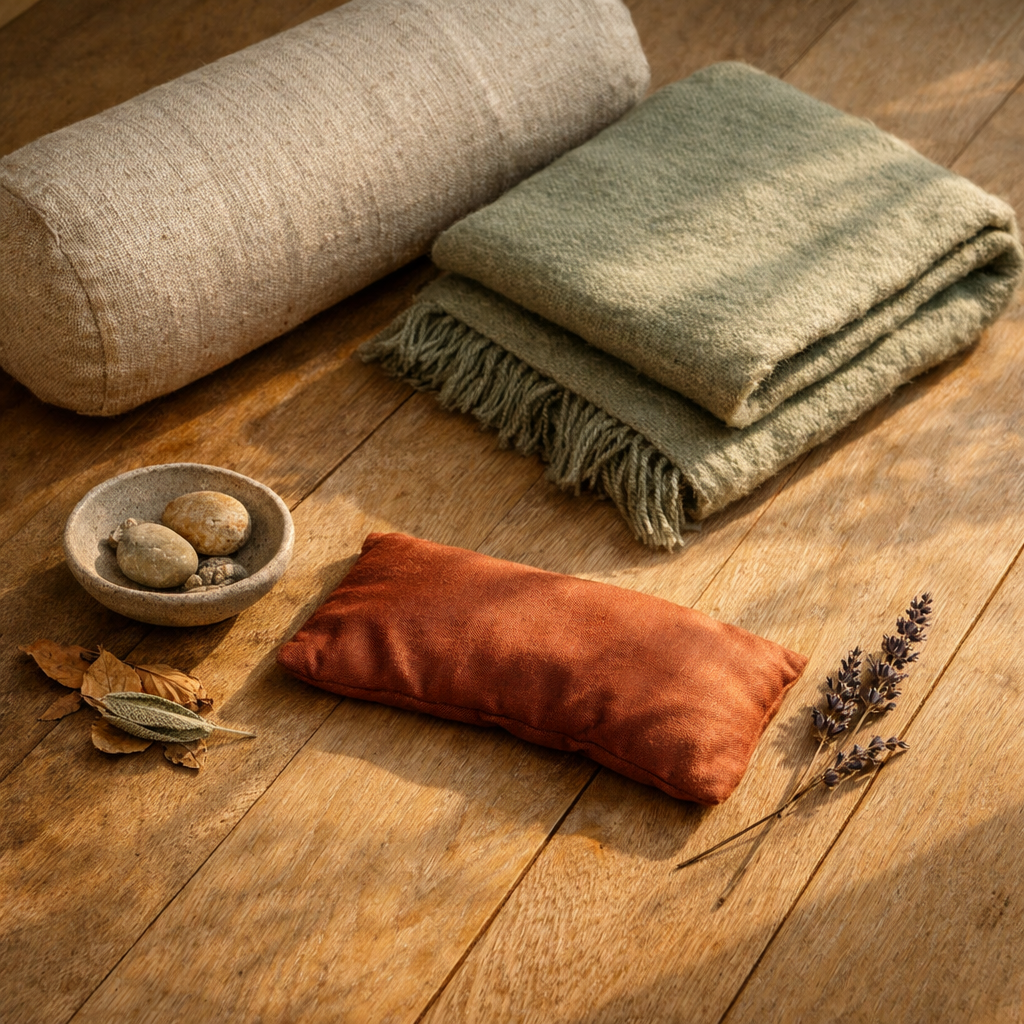
<p><img src="/assets/images/blog/2026-06-24-yoga-nidra-for-beginners-a-practical-guide-to-non-sleep-deep-rest-01.jpg" alt="An overhead view of a rolled oatmeal linen bolster and a folded sage wool blanket resting on a pale oak floor beside a dusty terracotta silk eye pillow and a single sprig of dried lavender, soft late afternoon light casting long shadows across the boards" /></p>

<h2 id="what-the-research-actually-says">What The Research Actually Says</h2>

<p>I want to be careful here, because yoga nidra attracts a claim I hear repeated constantly in studios and almost never with a source attached: that one hour of nidra equals four hours of sleep. There is no good evidence for that. It appears to have come from a loose reading of EEG studies showing delta wave activity during deep nidra, and it has been passed around unexamined ever since. Please do not use it to justify sleeping less. The practice is a supplement to sleep, not a substitute.</p>

<p>What the evidence does support is more modest and more useful.</p>

<p>The strongest signal is stress reduction. Several small controlled trials have found reduced perceived stress and anxiety scores after regular nidra practice, alongside measurable shifts in autonomic markers such as heart rate variability and skin conductance. The mechanism is unsurprising: prolonged stillness with structured attention pushes the nervous system toward parasympathetic dominance and keeps it there long enough for the shift to register.</p>

<p>There is also reasonable evidence around sleep quality. Studies on insomnia and on shift workers have reported improved subjective sleep quality and reduced sleep onset latency after several weeks of practice. The effect sizes are moderate, the sample sizes are small, and much of the work comes from a handful of research groups in India, so I hold these findings loosely.</p>

<p>The most rigorous work has been done on the iRest protocol with military veterans experiencing post-traumatic stress, where it has been used as an adjunct in clinical settings for over a decade with encouraging results. That is a specific protocol delivered by trained practitioners, not a recording off the internet, and the distinction matters.</p>

<p>Neuroscientist Andrew Huberman popularised the term “non-sleep deep rest” as a secular relabelling of essentially this practice, which has brought a lot of people to it who would never have opened a yoga app. The underlying research he points to is real, largely around dopamine replenishment and rest-related learning consolidation, and it is also thinner than the enthusiasm around it suggests.</p>

<p>My honest summary after seven years of practising and teaching: yoga nidra is one of the most reliable nervous system tools I know, it costs nothing, it carries essentially no risk, and its benefits are real but ordinary. It calms you down. It helps you sleep. It does not replace sleep, cure trauma on its own, or unlock anything mystical.</p>

<h2 id="how-to-run-your-first-session">How To Run Your First Session</h2>

<p>The classical structure has eight stages. You do not need to memorise them, but knowing the shape helps you follow a recording without wondering where it is going.</p>

<p><strong>Settling.</strong> You lie flat on your back in savasana, legs a little apart, palms up, and spend a few minutes letting the body find the floor. Most guides ask for a few slow exhalations here.</p>

<p><strong>Sankalpa.</strong> A short intention, phrased in the present tense as though already true, repeated silently three times. Mine has been the same sentence for four years. The traditional teaching is to keep it stable rather than reinventing it each session, which I found irritating at first and now understand.</p>

<p><strong>Rotation of consciousness.</strong> This is the heart of the practice and the part that does the work. The guide names body parts in a fixed sequence, usually starting at the right thumb, and you simply move attention to each one as it is named. Right thumb, second finger, third finger, palm, wrist, elbow, shoulder, armpit, and onward. You do not visualise or tense anything. You just go there. The sequence is fast enough that the analytical mind cannot keep up, which is precisely the point.</p>

<p><strong>Breath awareness.</strong> Usually counting exhalations backwards from a number like 27, which is deliberately awkward enough to occupy the last of your verbal attention. This is the one stage that overlaps with the <a href="/mindful-living/holistic-health/breathwork-techniques-for-anxiety-calm-your-nervous-system-in-minutes/">breathwork techniques I use for acute anxiety</a>, though here the counting is a holding pattern rather than the intervention itself.</p>

<p><strong>Opposites.</strong> Feeling heaviness then lightness, warmth then coolness. This tends to produce the strangest sensations of the whole practice and is where I most often lose the thread entirely.</p>

<p><strong>Visualisation.</strong> Images offered rapidly, one after another, without time to elaborate them. A candle flame. An open field. A door.</p>

<p><strong>Return of the sankalpa.</strong> The same sentence, repeated three times, now delivered into a much quieter mind.</p>

<p><strong>Externalisation.</strong> Slowly coming back. Sound of the room, weight of the body, small movements of fingers and toes, and eventually rolling to one side before sitting up. Do not skip this part. Standing up straight from deep nidra is genuinely disorienting.</p>

<p>For a first session, find a twenty minute recording, lie down somewhere warm, and follow it. That is all. You do not need to understand the architecture to benefit from it.</p>

<p><img src="/assets/images/blog/2026-06-24-yoga-nidra-for-beginners-a-practical-guide-to-non-sleep-deep-rest-02.jpg" alt="A bare pale oak floor beside a low window with a rolled cotton mat in warm bone unfurled across it, a folded sage wool blanket and a small unglazed ceramic cup nearby, golden late-day light filtering through a sheer linen curtain" /></p>

<h2 id="the-problems-everyone-hits">The Problems Everyone Hits</h2>

<p><strong>You fall asleep.</strong> Nearly everyone does for the first several weeks. This is not failure, it is information: you were tired. If you want to stay on the threshold rather than dropping under, practise in the late afternoon instead of at bedtime, keep the room a little cool, and bend your elbows so your forearms point at the ceiling. When you slip into sleep a hand falls and wakes you. It is a crude trick and it works.</p>

<p><strong>You cannot lie still.</strong> Restlessness in the first five minutes is common, particularly for people who come from a movement practice. Fidget as needed early on. It settles. If it does not, the problem is usually physical rather than mental, and a bolster under the knees fixes it more often than willpower does.</p>

<p><strong>You get bored.</strong> Good. Boredom is the doorway. The rotation of consciousness is deliberately monotonous, and the moment when you stop waiting for it to become interesting is usually the moment you drop.</p>

<p><strong>You feel emotional afterwards.</strong> Occasionally people surface with unexpected grief or agitation. This happened to me twice in my first year and unsettled me both times. If it happens once, sit with it. If it happens repeatedly, or if you have a trauma history, work with a trained practitioner rather than a recording. This is the one situation where I would not recommend going it alone.</p>

<p><strong>Nothing happens.</strong> For some people the first three or four sessions feel like lying on the floor listening to somebody talk. Give it two weeks of three sessions before deciding. The state tends to arrive suddenly rather than gradually.</p>

<h2 id="do-you-need-any-gear">Do You Need Any Gear?</h2>

<p>No. A floor, a blanket, and a twenty minute recording will take you the whole way. But a few things genuinely improve the practice, and I want to be honest about which ones matter and which are studio decoration. Some of the links below are affiliate links, which means PurityPeak earns a small commission if you buy through them. It costs you nothing extra and it does not change what I recommend.</p>

<p>Warmth is the one that actually changes outcomes. Body temperature drops noticeably during deep rest, and being cold at minute eighteen will pull you straight out of the state. A proper <a href="https://www.amazon.com/s?k=wool+blanket+throw+natural&amp;tag=affilgenie200-20" rel="sponsored nofollow">wool blanket</a> over the body and a second one folded under the head is the single best investment you can make in this practice. I have taught sessions where simply adding blankets transformed the room.</p>

<p>Support under the knees is second. Lying flat puts most people’s lumbar spine into a mild strain that becomes distracting after ten minutes. A <a href="https://www.amazon.com/s?k=yoga+bolster+cotton+cover&amp;tag=affilgenie200-20" rel="sponsored nofollow">yoga bolster</a> under the knees releases the lower back completely, and a rolled blanket works nearly as well if you would rather not buy one.</p>

<p>Darkness helps more than I expected. A weighted <a href="https://www.amazon.com/s?k=weighted+silk+eye+pillow+lavender&amp;tag=affilgenie200-20" rel="sponsored nofollow">silk eye pillow</a> does two things at once: it blocks light and applies gentle pressure around the eyes, which seems to shorten the time it takes to settle. Mine is filled with flaxseed and dried lavender and it is fifteen years old.</p>

<p>If you want to go deeper on the tradition rather than just the practice, Satyananda’s original text remains the reference work, and you can find a <a href="https://www.amazon.com/s?k=yoga+nidra+book&amp;tag=affilgenie200-20" rel="sponsored nofollow">yoga nidra book</a> without difficulty. I would practise for a month first. The book makes far more sense once your body knows what it is describing.</p>

<p>Everything else, the special mats, the subscription apps, the singing bowl recordings, is optional. Free guided sessions from reputable teachers are plentiful, and the voice matters more than the production value. Find one you can stand listening to twice a week and stay with it.</p>

<p><img src="/assets/images/blog/2026-06-24-yoga-nidra-for-beginners-a-practical-guide-to-non-sleep-deep-rest-03.jpg" alt="A close-up of a dusty terracotta silk eye pillow resting on a folded oatmeal linen cloth beside a small unglazed ceramic cup and a sprig of dried lavender, warm low evening light from a single window, the soft blur of a sage wool blanket behind" /></p>

<h2 id="when-yoga-nidra-is-the-right-tool">When Yoga Nidra Is The Right Tool</h2>

<p>The practice earns its place for the specific condition of being exhausted and unable to rest. The afternoon slump where a nap would help but you cannot fall asleep. The evening where the body is tired and the mind is still running the day back. The stretch after illness, injury, or a hard season, when your usual practice is out of reach and doing nothing at all feels intolerable.</p>

<p>It is also, quietly, the best on-ramp to meditation I know for people who have decided they are bad at meditating. Nobody is bad at lying down. The skills transfer more than you would expect, and once they do, a dedicated corner helps. I wrote a whole piece on <a href="/meditation/mindful-living/how-to-create-a-home-meditation-space-on-any-budget/">setting up a home meditation space on any budget</a> if you want somewhere the blankets can live permanently.</p>

<p>It is not a treatment for a clinical condition on its own, not a replacement for sleep, and not a shortcut around anything. If you are dealing with persistent insomnia, depression, or trauma, please involve a professional. Nidra sits alongside proper care very well. It does not stand in for it.</p>

<p>For most people leading ordinary overloaded lives, twenty minutes on the floor two or three times a week is one of the highest-return practices available. It costs nothing. It asks nothing except that you stop, which turns out to be the difficult part.</p>

<p>If you try one thing from this article, do this. Tonight, before bed, put a folded blanket under your knees and another over your body, find a twenty minute recording, and lie down. Do not try to do it well. There is nothing to do well. Follow the voice around your right hand, then your left, and notice where you are when it ends.</p>

<p>My sankalpa has not changed in four years, and I am not going to tell you what it is. But I will say that the first time I said it silently into that particular quiet, I understood that I had been repeating the opposite to myself every day for a decade without once saying it out loud.</p>]]></content><author><name>Seraphina Grove</name></author><category term="yoga" /><category term="mindful-living" /><category term="yoga nidra" /><category term="non-sleep deep rest" /><category term="guided meditation" /><category term="restorative yoga" /><category term="sleep" /><category term="nervous system" /><summary type="html"><![CDATA[Yoga nidra for beginners: what non-sleep deep rest is, the eight stages of a session, what the research really supports, and the three props worth owning.]]></summary><media:thumbnail xmlns:media="http://search.yahoo.com/mrss/" url="https://puritypeak.org/assets/images/featured-post/2026-06-24-yoga-nidra-for-beginners-a-practical-guide-to-non-sleep-deep-rest-featured.jpg" /><media:content medium="image" url="https://puritypeak.org/assets/images/featured-post/2026-06-24-yoga-nidra-for-beginners-a-practical-guide-to-non-sleep-deep-rest-featured.jpg" xmlns:media="http://search.yahoo.com/mrss/" /></entry><entry><title type="html">Forest Bathing for Beginners: A Practical Guide to Shinrin-Yoku</title><link href="https://puritypeak.org/nature-therapy/mindful-living/forest-bathing-for-beginners-a-practical-guide-to-shinrin-yoku/" rel="alternate" type="text/html" title="Forest Bathing for Beginners: A Practical Guide to Shinrin-Yoku" /><published>2026-06-06T15:00:00+02:00</published><updated>2026-06-06T15:00:00+02:00</updated><id>https://puritypeak.org/nature-therapy/mindful-living/forest-bathing-for-beginners-a-practical-guide-to-shinrin-yoku</id><content type="html" xml:base="https://puritypeak.org/nature-therapy/mindful-living/forest-bathing-for-beginners-a-practical-guide-to-shinrin-yoku/"><![CDATA[<p>I have lived at the edge of the Pisgah forest in western North Carolina for six years now, and there is one patch of woods, maybe a fifteen minute walk from my door, that I have visited several hundred times. The same trail. The same creek crossing. The same leaning poplar that lost a limb in the 2021 ice storm and somehow kept growing sideways. I could not tell you how many miles I have logged there, because the answer is barely any. I go slowly. That is the whole point.</p>

<p>When I first heard the phrase “forest bathing,” I assumed it was a wellness invention, the kind of soft-focus idea that sounds lovely and means nothing. I was wrong about that, and I want to give you the honest version of what it is, what the research does and does not support, and how to actually start, including the part where you do not need to buy a single thing.</p>

<h2 id="what-forest-bathing-actually-is">What Forest Bathing Actually Is</h2>

<p>Forest bathing translates the Japanese term shinrin-yoku, which was coined in 1982 by the Japanese Forestry Agency. It means, roughly, “taking in the forest atmosphere.” The bathing part is metaphorical. There is no water involved. You are bathing your senses in the woods rather than your body in a river.</p>

<p>The practice is simpler than the name suggests and easy to get wrong if you bring your usual habits to it. Forest bathing is not hiking. It is not exercise. It is not a brisk nature walk with a summit at the end and a step count to hit. The defining feature is slowness and attention. You walk, or sit, and you deliberately notice things. The texture of bark. The way light moves through the canopy. The layered sound of wind in different species of leaves. The smell of damp soil after rain, which has its own name, petrichor, and its own particular effect on the nervous system.</p>

<p>The first time I tried to do it properly, I lasted about four minutes before my mind started drafting a grocery list. This is normal. The forest does not demand performance. It simply waits while you remember how to pay attention, which is a skill most of us have quietly lost.</p>

<p><img src="/assets/images/blog/2026-06-06-forest-bathing-for-beginners-a-practical-guide-to-shinrin-yoku-01.jpg" alt="An overhead view of a worn leather field notebook and a small sage-green enamel thermos resting on a folded oatmeal linen cloth atop a mossy forest floor, a sprig of fresh fern and three smooth river stones beside them, soft dappled morning light filtering through the canopy" /></p>

<h2 id="what-the-research-actually-says">What The Research Actually Says</h2>

<p>I want to be careful here, because forest bathing attracts a lot of overstated claims, and I would rather you trust the practice for what it genuinely does than feel cheated when it does not cure something.</p>

<p>The most consistent finding is stress reduction. Multiple studies, many of them conducted in Japan in the 2000s and 2010s, found that participants who spent time in forest environments showed lower salivary cortisol, lower blood pressure, lower pulse rate, and improved heart rate variability compared with people who spent the same time in urban settings. A frequently cited 2010 review by Park and colleagues, drawing on field experiments across dozens of forests, reported these effects with reasonable consistency. The mechanism is what you would expect: the nervous system shifts toward parasympathetic dominance, the rest-and-digest state, away from the low-grade fight-or-flight that modern life keeps simmering.</p>

<p>The more striking, and more cautious, finding involves the immune system. Researcher Qing Li at Nippon Medical School published work in the late 2000s suggesting that forest air increased the activity of natural killer cells, a type of white blood cell, with effects that lingered for days after a multi-day forest trip. The proposed mechanism is phytoncides, the airborne compounds trees release to defend against insects and microbes. This research is genuinely interesting, but the sample sizes were small, and it has not been replicated as widely as the stress findings. I treat it as promising rather than proven.</p>

<p>What forest bathing does not do is equally worth saying. It is not a treatment for clinical depression, an alternative to medication, or a cure for anything. It is a low-cost, low-risk practice that reliably calms the nervous system and lifts mood for most people. For what it costs, which is nothing, that is a remarkable return. I have come to think of it less as medicine and more as maintenance, the way you might think of sleep or sunlight.</p>

<h2 id="how-to-actually-do-it">How To Actually Do It</h2>

<p>The instructions you find online tend to be either vague or weirdly prescriptive. Here is what I have settled into after six years.</p>

<p>Choose somewhere quiet and reachable. The single biggest predictor of whether you keep this up is how easy it is to get to. A modest city park you visit weekly beats a magnificent national forest you reach twice a year. Trees are trees. Your nervous system is not grading the scenery.</p>

<p>Leave the destination behind. This is the hardest part for most people, myself included. Do not set out to reach a particular spot. Walk until somewhere asks you to stop, then stop. I often cover less than half a mile in an hour. The goal is not arrival.</p>

<p>Put the phone away, genuinely. Airplane mode, or better, leave it in the car. Forest bathing and a buzzing pocket cannot coexist. If you want to take a single photograph at the end, fine. During, you are trying to be somewhere, and a phone is a small machine for being elsewhere.</p>

<p>Move through your senses one at a time. I usually start with sound, because it is the easiest to drop into. Stand still and count the distinct sounds you can hear. Then smell. Then sight, but slow sight, the kind where you actually look at one leaf instead of scanning the whole forest like a security camera. Touch comes last for me. Bark, moss, the cool of a stone, the give of soil.</p>

<p>Sit for a while. At some point, sit down. On a log, a rock, a folded blanket. Stillness does something that walking does not. The forest forgets you are there. Birds come back. The small movements resume. You become, briefly, part of the place rather than a visitor passing through.</p>

<p>Give it real time if you can. The research that showed the clearest benefits used sessions of around two hours. I am not always able to manage that, and I doubt you are either. Twenty to thirty minutes done often is far better than two hours done rarely. Start where you are.</p>

<p><img src="/assets/images/blog/2026-06-06-forest-bathing-for-beginners-a-practical-guide-to-shinrin-yoku-02.jpg" alt="A bare patch of mossy ground at the foot of a wide tree trunk, a folded handwoven blanket in dusty terracotta laid out beside a small enamel cup, dappled golden light falling through ferns and the soft blur of the forest beyond" /></p>

<h2 id="the-mistakes-i-made-early-on">The Mistakes I Made Early On</h2>

<p>For my first year I treated forest bathing like a task to complete well, which is precisely the wrong frame. I would check the time. I would wonder if I was doing it right. I would feel a small flush of failure when my mind wandered, then a second flush of failure for noticing the first one. None of that is forest bathing. That is just bringing the office into the woods.</p>

<p>The wandering mind is not a problem to solve. When you notice you have drifted into planning or replaying some conversation, you simply return to a sense, the way you would in meditation. Sound is usually waiting for you. Over months, the gaps between distractions stretch out on their own. You cannot force this. You can only show up often enough that it happens.</p>

<p>The other mistake was thinking I needed the perfect setting. I once drove two hours to a celebrated old-growth grove, arrived tired and faintly resentful about the drive, and got almost nothing from it. The patch of ordinary mixed hardwood fifteen minutes from my house has given me more than that grove ever did, simply because I am there constantly and arrive unburdened. Familiarity is not the enemy of wonder. It is often the door to it.</p>

<h2 id="do-you-need-any-gear">Do You Need Any Gear?</h2>

<p>Honestly, no. The entire point is that the forest is already there and already free. But after six years I have a few things I genuinely reach for, and I will be honest about which actually matter.</p>

<p>A flask of something warm changes a sitting session completely, especially in the colder months. Being able to sit still for forty minutes without getting cold is the difference between a short visit and a long one. A simple insulated <a href="https://www.amazon.com/s?k=insulated+stainless+steel+thermos+flask&amp;tag=affilgenie200-20">thermos or flask</a> is the one piece of gear I would actually call useful.</p>

<p>A small notebook is the other thing I carry, not to journal in any disciplined way, but to jot the occasional observation. A <a href="https://www.amazon.com/s?k=pocket+field+notebook&amp;tag=affilgenie200-20">pocket field notebook</a> lives in my coat. Half the entries are single words. It helps me notice that I am noticing.</p>

<p>If you want to deepen the practice on the science side, Qing Li’s book on forest medicine and the various translated works on shinrin-yoku are worth a read, and you can find a <a href="https://www.amazon.com/s?k=forest+bathing+shinrin-yoku+book&amp;tag=affilgenie200-20">forest bathing guide book</a> easily enough. I would read one only after you have actually been out a few times, though. The practice teaches better than the page.</p>

<p>Everything else, the special shoes, the apps, the guided programs, is optional at best. I have used none of it. A waterproof layer and shoes you do not mind getting muddy will carry you through almost any session.</p>

<p><img src="/assets/images/blog/2026-06-06-forest-bathing-for-beginners-a-practical-guide-to-shinrin-yoku-03.jpg" alt="A close-up of a sage-green enamel thermos cup steaming gently on a mossy log, a worn leather notebook and a sprig of cedar resting beside it, warm low afternoon light filtering through a soft-focus backdrop of trees and fern" /></p>

<h2 id="when-forest-bathing-is-the-right-tool">When Forest Bathing Is The Right Tool</h2>

<p>The practice shines for the particular kind of frazzle that modern life produces, the wired-but-tired state, the inability to settle after a day of screens, the sense of being perpetually braced for the next notification. For that, an hour among trees is one of the most reliable resets I know. It is also genuinely good for sleep when done in the late afternoon, for creative thinking, which seems to loosen when the analytical mind quiets, and for the simple, undervalued act of being unreachable for a while.</p>

<p>It is not a substitute for treatment if you are struggling with something serious. If you are dealing with real depression or anxiety that does not lift, please talk to a professional. Forest bathing can sit alongside proper care, and many therapists in my area now actively recommend it, but it is a companion to treatment, not a replacement for it.</p>

<p>For most people leading ordinary, overstimulated lives, forest bathing occupies a quiet and useful place in the wellness toolkit. Cheaper than almost anything. Available on any afternoon. Asking nothing of you except that you slow down and pay attention, which turns out to be the hardest and most worthwhile thing.</p>

<p>If you want a sharper version of the same nervous-system reset, and you have a creek or a cold tap, my guide to <a href="/natural-healing/nature-therapy/cold-water-therapy-for-beginners-what-cold-showers-and-plunges-actually-do/">cold water therapy for beginners</a> covers the other end of the intensity scale, including the safety rules that genuinely are not optional.</p>

<p>If you are curious, do not overthink the start. Find the nearest patch of trees you can reach on foot or with a short drive. Leave the phone behind. Walk slowly until something asks you to stop. Sit down. Listen. Give it twenty minutes and notice how you feel walking back out. That is the whole practice. Everything else is refinement.</p>

<p>The leaning poplar is still there, by the way. Six years sideways and still putting out leaves every spring. I check on it most weeks. It has taught me more about patience than any book ever did.</p>]]></content><author><name>Moonshine Aldai</name></author><category term="nature-therapy" /><category term="mindful-living" /><category term="forest bathing" /><category term="shinrin-yoku" /><category term="nature therapy" /><category term="mindfulness" /><category term="stress relief" /><category term="grounding" /><summary type="html"><![CDATA[I have lived at the edge of the Pisgah forest in western North Carolina for six years now, and there is one patch of woods, maybe a fifteen minute walk from my door, that I have visited several hundred times. The same trail. The same creek crossing. The same leaning poplar that lost a limb in the 2021 ice storm and somehow kept growing sideways. I could not tell you how many miles I have logged there, because the answer is barely any. I go slowly. That is the whole point.]]></summary><media:thumbnail xmlns:media="http://search.yahoo.com/mrss/" url="https://puritypeak.org/assets/images/featured-post/2026-06-06-forest-bathing-for-beginners-a-practical-guide-to-shinrin-yoku-featured.jpg" /><media:content medium="image" url="https://puritypeak.org/assets/images/featured-post/2026-06-06-forest-bathing-for-beginners-a-practical-guide-to-shinrin-yoku-featured.jpg" xmlns:media="http://search.yahoo.com/mrss/" /></entry><entry><title type="html">Best Acupressure Mats for Stress Relief and Pain Recovery</title><link href="https://puritypeak.org/natural-healing/mindful-living/best-acupressure-mats-for-stress-relief-and-pain-recovery/" rel="alternate" type="text/html" title="Best Acupressure Mats for Stress Relief and Pain Recovery" /><published>2026-05-01T15:00:00+02:00</published><updated>2026-05-01T15:00:00+02:00</updated><id>https://puritypeak.org/natural-healing/mindful-living/best-acupressure-mats-for-stress-relief-and-pain-recovery</id><content type="html" xml:base="https://puritypeak.org/natural-healing/mindful-living/best-acupressure-mats-for-stress-relief-and-pain-recovery/"><![CDATA[<p>I bought my first acupressure mat in 2023 because I had thrown my back out lifting a couch by myself, refused on principle to see a chiropractor, and was too cheap for a real massage. A friend had mentioned a thing called a Shakti mat, which she described as “lying on a thousand little spikes for twenty minutes until your body gives up and relaxes.” I ordered one that night. I expected nothing.</p>

<p>The first session was deeply unpleasant for about ninety seconds and then surprisingly fine. By minute fifteen I was nearly asleep. When I stood up, the knot in my lower back had loosened in a way that no amount of stretching had touched in three days. I have been a quiet evangelist ever since.</p>

<p>Three years and four mats later, I am here to give you the honest version of acupressure mats: which ones are worth the money, which ones are surprisingly good for half the price, what no one tells you about the first ten minutes, and where the marketing claims start to outrun the evidence.</p>

<h2 id="what-an-acupressure-mat-actually-is">What An Acupressure Mat Actually Is</h2>

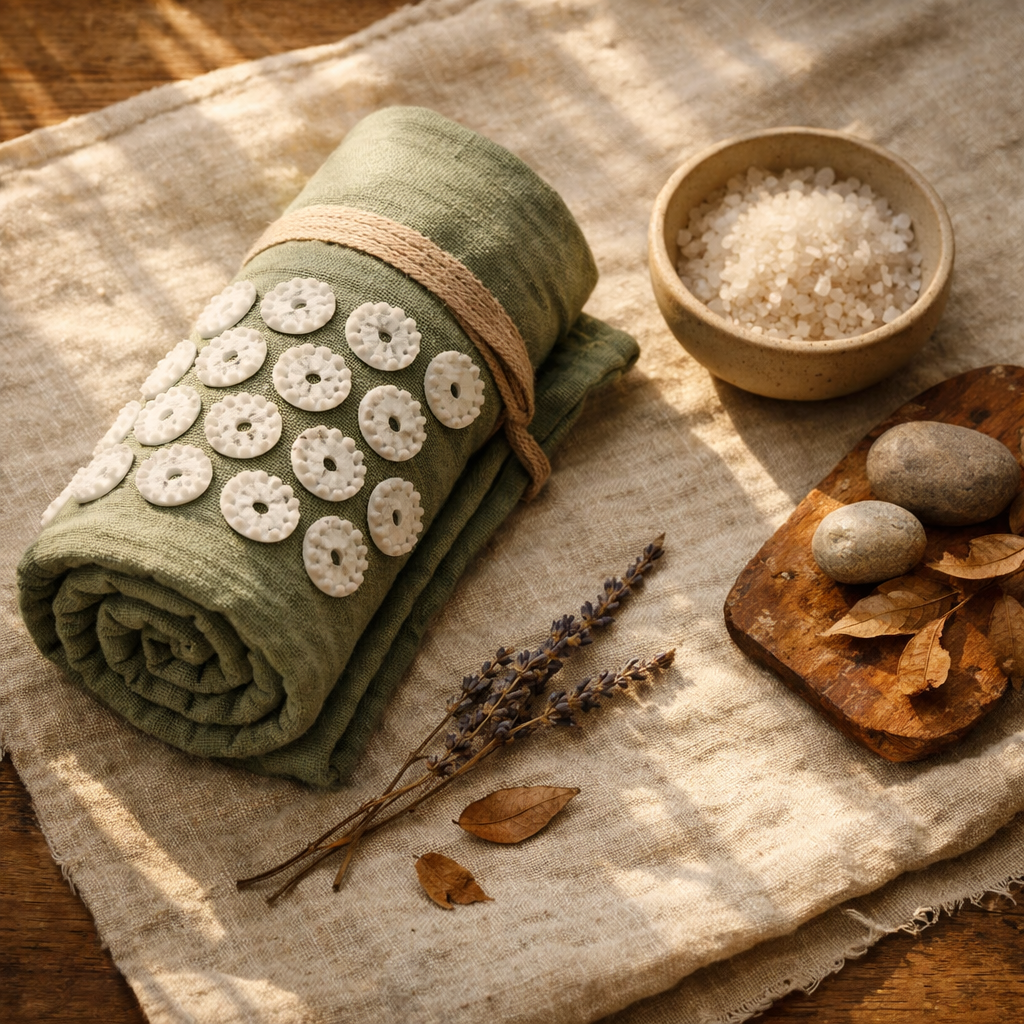
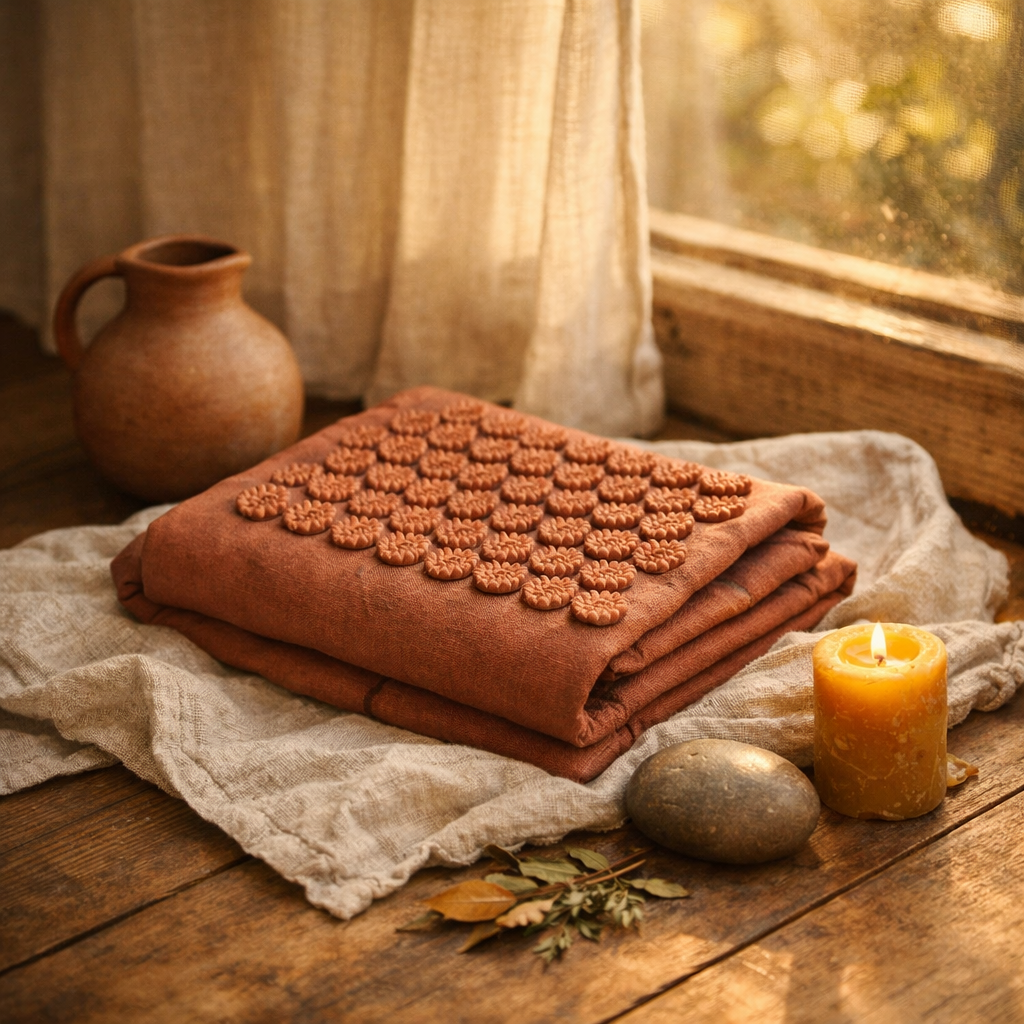
<p>The basic design has barely changed in fifteen years. A foam-filled cotton mat, roughly the size of a yoga mat but thicker, covered in a few thousand small plastic discs. Each disc has a ring of sharp spikes pointing upward. You lie on it, with bare skin or a thin shirt depending on your tolerance, and the spikes press into your back at evenly distributed points.</p>

<p>The mechanism is roughly the same as the principle behind acupuncture without the needles actually breaking the skin. The pressure stimulates nerve endings across a wide area, triggers a localized inflammatory response, prompts the body to release endorphins and oxytocin, and shifts the autonomic nervous system into parasympathetic dominance. That is the technical version. The felt version is that after a few minutes the body simply gives up resisting and starts to relax in a way that feels almost involuntary.</p>

<p>The first time I lay on a mat, I genuinely thought I had wasted my money. The sensation was sharp and prickly and not at all the gentle massage I had imagined. By the third session I started looking forward to it. By the second week I was using it as a wind-down ritual three nights a week. The discomfort was always there for the first minute. After that, the body decided to let go.</p>

<p><img src="/assets/images/blog/2026-05-01-best-acupressure-mats-for-stress-relief-and-pain-recovery-01.jpg" alt="Overhead view of a rolled cotton acupressure mat in muted sage green resting on raw linen beside a small ceramic bowl of sea salt and a sprig of dried lavender, soft morning light casting long gentle shadows across the scene" /></p>

<h2 id="what-the-research-actually-says">What The Research Actually Says</h2>

<p>I want to be careful here because the marketing around acupressure mats can drift into territory the science does not support. Let me give you the honest version.</p>

<p>There is moderate evidence that acupressure mats reduce self-reported back pain in people with mild to moderate non-specific back pain. A 2011 randomized study published in The Clinical Journal of Pain found that participants using a nail mat for three weeks reported significant reductions in chronic back pain compared to a control group. Several smaller studies have replicated this for general muscle tension and stress.</p>

<p>There is also reasonable evidence for stress reduction and parasympathetic activation. Heart rate variability tends to improve during and after a session, cortisol levels drop, and many people fall asleep on the mat without intending to.</p>

<p>What there is not strong evidence for is the bigger marketing claims. Acupressure mats do not cure sciatica, fix slipped discs, eliminate fibromyalgia, or rewire your nervous system in some permanent way. They are a useful, affordable tool for general muscle tension and stress relief. They are not a medical device. If you have a specific structural issue, see a physical therapist.</p>

<p>That said, for the price of a mid-range yoga mat, having a tool that reliably puts me into a parasympathetic state in fifteen minutes is genuinely useful. I have not found another piece of recovery equipment that gives me as much return per dollar.</p>

<h2 id="the-mats-worth-considering-in-2026">The Mats Worth Considering In 2026</h2>

<p>The market has gotten crowded. There are dozens of brands, most of which are essentially the same product with different colors and price tags. Here is what I have actually used long enough to have an opinion on.</p>

<h3 id="shakti-mat-the-original">Shakti Mat (the original)</h3>

<p>This is the brand that started the modern acupressure mat trend, and three years in I still consider it the benchmark. The standard Shakti uses a cotton cover over coconut coir filling, with the spike discs made from recycled plastic. The build quality is noticeably better than the cheap copies. The cotton breathes, the coir holds its shape, the spikes are evenly distributed and consistent.</p>

<p>The price is the catch. A standard Shakti mat costs significantly more than the Amazon clones, and the brand pricing has crept up over the years. If you are on a tight budget, this is not the entry point.</p>

<p><strong>Best for:</strong> Long-term users, people who care about natural materials, gift buyers.
<strong>Skip if:</strong> You want to try the concept without committing $80 plus.</p>

<h3 id="prosourcefit-acupressure-mat-the-budget-pick">ProsourceFit Acupressure Mat (the budget pick)</h3>

<p>If you want to try the concept first and decide if it works for you, this is the mat I usually recommend. ProsourceFit makes a perfectly serviceable mat with foam filling and synthetic cover for roughly a third of the price of a Shakti. The spikes are slightly less consistent and the mat compresses faster over the years, but for the first year or two of regular use you would not be able to tell the difference blindfolded.</p>

<p>The synthetic cover is the main downside. It does not breathe as well, and on hot summer nights the mat can feel slightly sticky. Most people will not care.</p>

<p><strong>Best for:</strong> First-time buyers, people who want to test before committing, gift wrapping for a friend who is curious.
<strong>Skip if:</strong> You want natural materials or expect to use the mat daily for many years.</p>

<h3 id="ajna-wellness-mat">Ajna Wellness Mat</h3>

<p>The Ajna is in the middle of the price spectrum and includes the pillow, which is the part most cheap kits cut. The pillow is genuinely useful for neck tension and tension headaches, and the difference between a mat-only kit and a mat-plus-pillow kit is bigger than the photos suggest. If you want to address neck tension as well as back tension, get the kit.</p>

<p>The Ajna build quality is solid but not Shakti-level. The cover is cotton, the filling is foam, the spikes are well-distributed, and the carry bag is decent. After eighteen months of regular use, mine has held up well with no flattening of the spikes.</p>

<p><strong>Best for:</strong> People with both back and neck tension. Best balance of price and quality in my experience.
<strong>Skip if:</strong> You only want the back mat and not the pillow.</p>

<p><img src="/assets/images/blog/2026-05-01-best-acupressure-mats-for-stress-relief-and-pain-recovery-02.jpg" alt="A bare wooden floor beside a low sun-drenched window with a folded acupressure mat in dusty terracotta resting on a soft natural linen blanket, a clay water vessel, a single river stone, and a lit beeswax candle nearby, all bathed in golden hour light filtering through a sheer linen curtain" /></p>

<h3 id="spoonk-mat-the-gentlest-option">Spoonk Mat (the gentlest option)</h3>

<p>The Spoonk is the only mat I have tried that I would describe as suitable for absolute beginners or people with sensitive skin. The spike density is slightly lower and the points are slightly less sharp, which means the first-minute discomfort is meaningfully reduced. For a first-timer who would otherwise quit after thirty seconds, this is the gentler entry point.</p>

<p>The trade-off is that experienced users may find the Spoonk underpowered. If you have been on a Shakti for a year, the Spoonk feels almost too soft. It is also priced at the higher end of the market, which makes it a strange recommendation for hesitant beginners on a budget.</p>

<p><strong>Best for:</strong> Sensitive skin, first-time users who are nervous, gentle daily use.
<strong>Skip if:</strong> You want the strongest possible stimulation or are watching the price.</p>

<h3 id="what-to-avoid">What To Avoid</h3>

<p>The cheapest mats on Amazon, often under twenty dollars, are usually a false economy. The spike discs are sometimes glued rather than sewn into the cover, and after a few months they start coming loose. I have had two of these mats in my time and both started shedding spikes by month four. If a mat seems suspiciously cheap, it usually is.</p>

<p>Also be wary of any mat marketed with extreme medical claims. If the listing promises to cure sciatica, fix herniated discs, or align your chakras, that is marketing copy. The honest mats are the ones that say “may help with stress, muscle tension, and general relaxation.”</p>

<h2 id="how-to-actually-use-one">How To Actually Use One</h2>

<p>The instructions on most mats are perfunctory. Here is what I actually do, refined over three years.</p>

<p>Start with five minutes the first session. The first ninety seconds are the hard part. Breathe slowly through your nose, keep your shoulders relaxed, do not tense up against the spikes. Tensing makes it worse. Let the body find the position where the pressure is evenly distributed.</p>

<p>A thin cotton t-shirt is fine if the bare-skin version is too intense at first. Most people drop the shirt after a week or two as their tolerance builds. Avoid heavy jumpers or fleece - they prevent the spikes from doing their job.</p>

<p>I lie on the mat with a pillow under my knees, which takes the pressure off the lower back and lets the lumbar region relax. Some people prefer a flat surface. Try both.</p>

<p>The optimal session length, in my experience, is fifteen to twenty minutes. Past that, returns diminish and skin irritation risk goes up. Three sessions a week is plenty. Daily use is fine but not strictly necessary.</p>

<p>Standing on the mat is a separate practice. It is more intense than lying because all your weight goes through the soles of the feet. Start with one minute. The plantar fascia gets a remarkable amount of stimulation, and many runners I know swear by a 30-second standing session before bed.</p>

<p><img src="/assets/images/blog/2026-05-01-best-acupressure-mats-for-stress-relief-and-pain-recovery-03.jpg" alt="A close-up of a softly glowing beeswax candle on a low wooden table next to a folded handwoven throw blanket in dusty terracotta and a small ceramic bowl of unrefined sea salt, with the corner of a sage-green textile fabric softly out of focus, all lit by warm low evening light from a single window" /></p>

<h2 id="when-an-acupressure-mat-is-the-right-tool">When An Acupressure Mat Is The Right Tool</h2>

<p>The mat shines for general muscle tension, sleep wind-down, post-workout recovery, low-grade chronic stress, and what I would describe as nervous-system overdrive after a long day at a screen. If your shoulders live near your ears, if your lower back is constantly tight from sitting, if you cannot get yourself to fall asleep because your body is wired even though you are exhausted, the mat is a remarkably effective intervention for the price.</p>

<p>It is less useful for acute injuries, structural pain, post-surgical recovery, or anything where the underlying issue needs medical attention. I am not a doctor. Please do not use a piece of plastic-spike fabric as a substitute for proper care if you have a real problem.</p>

<p>For most people who lead modern desk-and-screen lives, acupressure mats live somewhere in the middle of the wellness toolkit, between meditation and a real massage. Cheaper than therapy, more reliable than willpower, less effective than a real bodyworker, but available at 11 PM on a Tuesday when you cannot face one more hour of doom-scrolling.</p>

<p>If you are curious, I would not overthink the choice. The ProsourceFit at the lower price point, the Ajna with the pillow at the middle, or the Shakti at the high end. Any of these will tell you within two weeks whether the practice is for you. Most people who try one for two weeks become regular users for years. A few decide it is not for them. Both responses are valid.</p>

<p>The only mistake is buying one of the very cheapest knockoffs and assuming all mats are like that. The cheap ones do not last, the spikes shed, the experience is uncomfortable in the wrong way, and you walk away thinking the whole concept was overhyped. It is not. The real ones, used three nights a week for fifteen minutes, are one of the most reliable nervous-system tools I have found.</p>

<p>If you decide to try one, do me a favor. Lie down. Breathe. Wait the first ninety seconds. Trust the process. The body knows what to do once you stop fighting it.</p>]]></content><author><name>Orion Sage</name></author><category term="natural-healing" /><category term="mindful-living" /><category term="acupressure mat" /><category term="stress relief" /><category term="back pain" /><category term="natural pain relief" /><category term="recovery tools" /><category term="shakti mat" /><summary type="html"><![CDATA[I bought my first acupressure mat in 2023 because I had thrown my back out lifting a couch by myself, refused on principle to see a chiropractor, and was too cheap for a real massage. A friend had mentioned a thing called a Shakti mat, which she described as “lying on a thousand little spikes for twenty minutes until your body gives up and relaxes.” I ordered one that night. I expected nothing.]]></summary><media:thumbnail xmlns:media="http://search.yahoo.com/mrss/" url="https://puritypeak.org/assets/images/featured-post/2026-05-01-best-acupressure-mats-for-stress-relief-and-pain-recovery-featured.jpg" /><media:content medium="image" url="https://puritypeak.org/assets/images/featured-post/2026-05-01-best-acupressure-mats-for-stress-relief-and-pain-recovery-featured.jpg" xmlns:media="http://search.yahoo.com/mrss/" /></entry><entry><title type="html">Best Meditation Apps 2026: Calm vs Headspace vs Insight Timer vs Waking Up</title><link href="https://puritypeak.org/meditation/mindful-living/best-meditation-apps-2026-calm-vs-headspace-vs-insight-timer-vs-waking-up/" rel="alternate" type="text/html" title="Best Meditation Apps 2026: Calm vs Headspace vs Insight Timer vs Waking Up" /><published>2026-04-21T15:00:00+02:00</published><updated>2026-04-21T15:00:00+02:00</updated><id>https://puritypeak.org/meditation/mindful-living/best-meditation-apps-2026-calm-vs-headspace-vs-insight-timer-vs-waking-up</id><content type="html" xml:base="https://puritypeak.org/meditation/mindful-living/best-meditation-apps-2026-calm-vs-headspace-vs-insight-timer-vs-waking-up/"><![CDATA[<p>I have a confession. For a person who writes about meditation for a living, I am embarrassingly bad at sticking with one app. Over the past six months I rotated through all four of the most popular meditation apps on the market, switching every few weeks, sometimes running two in parallel just to compare the experience side by side. My phone has held all four at the same time. My screen-time report is a mess. My partner thinks I have lost it.</p>

<p>But I learned something useful in the process. These apps are not interchangeable. They look similar from the outside, but they are designed for very different people, with very different goals, and choosing the wrong one is one of the most common reasons people quit meditation after two weeks. So I want to walk you through what each app is actually good at, what it is not, and how to pick the one that matches who you are right now.</p>

<h2 id="the-quick-comparison-table">The Quick Comparison Table</h2>

<p>If you are short on time, this is the summary I wish someone had handed me a year ago.</p>

<table>
  <thead>
    <tr>
      <th>App</th>
      <th>Best for</th>
      <th>Monthly price</th>
      <th>Free tier</th>
      <th>Standout feature</th>
    </tr>
  </thead>
  <tbody>
    <tr>
      <td>Calm</td>
      <td>Sleep, stress, gentle wind-down</td>
      <td>$14.99 / month, $69.99 / year</td>
      <td>Limited (a few free meditations)</td>
      <td>Sleep stories with celebrity narrators</td>
    </tr>
    <tr>
      <td>Headspace</td>
      <td>Beginners, structured learning</td>
      <td>$12.99 / month, $69.99 / year</td>
      <td>30-day basics course free</td>
      <td>Animated explainers, behavior-change focus</td>
    </tr>
    <tr>
      <td>Insight Timer</td>
      <td>Variety seekers, no-budget practitioners</td>
      <td>Free, $9.99 / month for Plus</td>
      <td>Genuinely huge free library</td>
      <td>200,000+ free meditations from many teachers</td>
    </tr>
    <tr>
      <td>Waking Up</td>
      <td>Philosophy lovers, serious practitioners</td>
      <td>$14.99 / month, $99.99 / year</td>
      <td>7-day trial, free on request</td>
      <td>Sam Harris plus deep philosophy and theory</td>
    </tr>
  </tbody>
</table>

<p>Now let me unpack what those numbers actually feel like in daily use.</p>

<p><img src="/assets/images/blog/2026-04-21-best-meditation-apps-2026-calm-vs-headspace-vs-insight-timer-vs-waking-up-01.jpg" alt="A weathered hand cradles a softly glowing tea light candle on a linen cloth, with a sprig of dried lavender and a small ceramic bowl of loose tea nearby, lit by a single warm window beam in a quiet morning room" /></p>

<h2 id="calm-the-sleep-and-stress-app-that-looks-like-a-spa">Calm: The Sleep and Stress App That Looks Like a Spa</h2>

<p>Calm is the app I open at the end of the day when my brain feels like a tab I forgot to close. The whole experience is built around atmosphere. The home screen opens to a slowly shifting scene of mountain lakes or rainforest canopies. The default soundscape is gentle water. Every interface element seems designed to lower your shoulders by half an inch.</p>

<p>The flagship content is the Sleep Story collection, which now runs to several hundred narrated stories read by the kind of voices people pay a lot of money for. There are familiar narrators reading dreamy travelogues, soft-spoken nature writers describing alpine meadows, and the occasional surprise like a former football coach reading a long meditation about train journeys. I have fallen asleep to most of them. I cannot tell you how any of them end.</p>

<p>Where Calm falls short is in the actual teaching. The guided meditations are pleasant, but they often feel like spa treatments rather than real instruction. A typical Calm session will tell you to notice your breath and let your thoughts pass like clouds, then layer on soft music. That is fine if you already know how to meditate. It is less helpful if you are trying to learn what meditation actually is and why anyone bothers.</p>

<p><strong>Best for:</strong> People who already meditate occasionally and want help with sleep, stress, and gentle daily reset. Calm is a wellness atmosphere, not a school.</p>

<p><strong>Skip if:</strong> You are completely new to meditation and want to understand why each technique works.</p>

<h2 id="headspace-the-app-that-actually-teaches-you">Headspace: The App That Actually Teaches You</h2>

<p>Headspace is the meditation app that taught me what meditation is. I mean that literally. When I first started, I had vague ideas about emptying my mind and not thinking, both of which are wrong. Headspace’s signature 30-day basics course corrected those misconceptions one bite-sized session at a time, and it did so with a warmth that did not feel like a lecture.</p>

<p>The defining voice of Headspace is its founder, who narrates most of the foundational courses with the unhurried calm of someone who spent ten years as a Buddhist monk before starting an app, which is exactly what happened. The animations between meditations are useful. They explain concepts like a wandering mind, the role of attention, and why discomfort during meditation is data, not failure.</p>

<p>What Headspace gets uniquely right is structure. You do not browse a vast library wondering which session to pick. You move through a sequence designed for behavior change. After basics there are themed courses for anxiety, sleep, focus, grief, parenting, and athletic performance. The progression has the feeling of a curriculum, which is exactly what most beginners need and almost never get from a meditation app.</p>

<p>The catch is that the same structure can feel constraining once you are past the beginner stage. There is less room to roam and discover new teachers, and the catalog of advanced material is smaller than Insight Timer’s by orders of magnitude.</p>

<p><img src="/assets/images/blog/2026-04-21-best-meditation-apps-2026-calm-vs-headspace-vs-insight-timer-vs-waking-up-02.jpg" alt="A pair of cupped hands rests gently in a lap, palms upward, with soft amber sunlight filtering through a sheer curtain to one side, casting warm diagonal shadows across a folded linen throw and a small woven meditation cushion in muted earth tones" /></p>

<p><strong>Best for:</strong> True beginners who want to learn the actual mechanics of meditation, not just feel relaxed.</p>

<p><strong>Skip if:</strong> You have been meditating for years and want depth, variety, or philosophy.</p>

<h2 id="insight-timer-the-free-library-that-outclasses-most-paid-apps">Insight Timer: The Free Library That Outclasses Most Paid Apps</h2>

<p>Insight Timer is, in my opinion, the most underrated meditation app on the market. I almost dismissed it the first time I tried it because the home screen felt cluttered, the design language is less polished than Calm’s, and there are so many teachers and so many tracks that it took me a week to even understand what was there.</p>

<p>What is there is a library of over 200,000 free guided meditations, talks, music tracks, and yoga nidras from thousands of teachers around the world. Some of the teachers on Insight Timer are the same names you would find headlining a paid retreat at a Buddhist monastery in Asia. Others are weekend instructors who recorded a session in their kitchen. The quality is uneven, but the ceiling is incredibly high, and once you find a few teachers whose voices you trust, the app becomes a kind of personal radio station.</p>

<p>I use Insight Timer for two things. First, for variety, because I genuinely cannot listen to the same narrator every day for years. Second, for the meditation timer itself, which is the cleanest, most thoughtfully designed silent meditation timer of any app I have used. It even rings a real Tibetan singing bowl at the start and end of each silent session, and tracks your streak the way fitness apps track runs.</p>

<p>The downside of Insight Timer is the same as its strength. There is too much. New meditators often feel lost. The structured courses, which would help, are paywalled behind Insight Timer Plus.</p>

<p><strong>Best for:</strong> Curious meditators who want variety, free silent timers, and access to many traditions and teachers.</p>

<p><strong>Skip if:</strong> You want a tightly guided journey from absolute beginner to intermediate practitioner.</p>

<h2 id="waking-up-the-most-intellectually-serious-app">Waking Up: The Most Intellectually Serious App</h2>

<p>Waking Up is different from the other three in a way that took me a while to articulate. The other apps treat meditation primarily as a tool for stress reduction, sleep, and emotional regulation. Waking Up treats it as a method of philosophical investigation into the nature of consciousness, which it then frames as also being good for stress and sleep almost as a side effect.</p>

<p>The app’s flagship is a 50-day introductory course narrated by Sam Harris, which lays out a particular tradition of meditation rooted in Theravada Buddhism, Dzogchen, and Western philosophy. The teaching is precise. Harris uses unusually clear language to point at experiences most teachers gesture at vaguely, like the difference between the contents of consciousness and consciousness itself, or what it actually means to look for the self and not find one.</p>

<p>Beyond the introductory course, Waking Up has a Theory section that includes essays and dialogues with teachers and philosophers ranging from neuroscientists to long-term Tibetan retreatants. There is a Lessons section with rotating teachers, and a Practice section with daily meditations. The whole app feels less like a wellness product and more like a graduate seminar that happens to also lower your blood pressure.</p>

<p>The price is the highest of the four, at almost $100 per year. To Waking Up’s credit, the company has a public policy of giving the app away free to anyone who genuinely cannot afford it, no questions asked. You email them and they unlock a free year. I have never seen another wellness app do this.</p>

<p><img src="/assets/images/blog/2026-04-21-best-meditation-apps-2026-calm-vs-headspace-vs-insight-timer-vs-waking-up-03.jpg" alt="A simple desk meditation setup at golden hour with a closed leather journal, a single river stone, a small ceramic bowl of dried herbs, and a softly glowing beeswax candle, all arranged on raw linen with a sage plant softly out of focus in the background" /></p>

<p><strong>Best for:</strong> People interested in meditation as a serious philosophical practice. Long-term meditators wanting depth.</p>

<p><strong>Skip if:</strong> You mostly want help falling asleep or surviving a stressful Tuesday.</p>

<h2 id="how-to-actually-pick-one">How to Actually Pick One</h2>

<p>After six months of switching, here is the framework I would give a friend.</p>

<p>If you have never meditated and want to learn properly, start with <strong>Headspace</strong>. The 30-day basics course is the best beginner curriculum I have used in any app, and the structure prevents the most common beginner mistake, which is trying to do too much too fast and giving up.</p>

<p>If you mostly want help falling asleep and lowering daily anxiety, <strong>Calm</strong> is the right tool. The Sleep Stories alone are worth the price, and you do not need to learn anything to get value from the app on day one.</p>

<p>If you are budget-conscious or you bristle at being told what to do, <strong>Insight Timer</strong> is genuinely incredible. The free tier is a complete meditation app on its own. Pair it with one outside book or course and you will have everything most practitioners need.</p>

<p>If you have been meditating for at least a few months and want to understand what is actually happening when you do it, <strong>Waking Up</strong> will reward the price. Plan to listen carefully. The content is dense.</p>

<p>You can also do what I did, which is rotate. Calm at night, Headspace in the morning, Insight Timer for silent sits, and Waking Up for theory on long walks. It is more expensive than picking one, but it taught me more about meditation than any single app could on its own.</p>

<h2 id="what-these-apps-cannot-do">What These Apps Cannot Do</h2>

<p>A meditation app is a tool, not a teacher. None of these apps replaces a real teacher, a real sangha, or a real retreat. The deepest changes I have seen in my own practice came from a five-day silent retreat that cost less than a year of Calm and produced more lasting effects than a year of any of these apps could.</p>

<p>If you find that meditation is starting to do something to you, that there are layers opening up that the app cannot quite address, take that seriously. Find a local meditation group, a teacher whose lineage you trust, a residential retreat. The apps are excellent on-ramps. They are not the destination.</p>

<p>That said, an on-ramp is exactly what most people need. If one of these four gets you on the cushion three or four times a week for the next year, your nervous system will thank you, your sleep will improve, and the small moments of your daily life will start to feel a little more spacious. That is more than enough reason to pay for one.</p>

<p>For most people reading this article, my honest recommendation is Headspace if you are starting out, Insight Timer if you cannot or will not pay, and Waking Up if you are ready to go deep. Calm is the lifestyle pick. All four are good. There is no wrong answer if you actually use the thing.</p>

<p>Just please, for your own sake, pick one and stick with it for at least 30 days before you decide it is not working. The slow cashier, the rude driver, the patience that surprises you in the grocery store - those changes do not show up in week one. They show up in week three, when you have almost forgotten you were trying.</p>]]></content><author><name>Seraphina Grove</name></author><category term="meditation" /><category term="mindful-living" /><category term="meditation apps" /><category term="meditation app comparison" /><category term="calm vs headspace" /><category term="insight timer" /><category term="waking up app" /><category term="mindfulness apps" /><summary type="html"><![CDATA[I have a confession. For a person who writes about meditation for a living, I am embarrassingly bad at sticking with one app. Over the past six months I rotated through all four of the most popular meditation apps on the market, switching every few weeks, sometimes running two in parallel just to compare the experience side by side. My phone has held all four at the same time. My screen-time report is a mess. My partner thinks I have lost it.]]></summary><media:thumbnail xmlns:media="http://search.yahoo.com/mrss/" url="https://puritypeak.org/assets/images/featured-post/2026-04-21-best-meditation-apps-2026-calm-vs-headspace-vs-insight-timer-vs-waking-up-featured.jpg" /><media:content medium="image" url="https://puritypeak.org/assets/images/featured-post/2026-04-21-best-meditation-apps-2026-calm-vs-headspace-vs-insight-timer-vs-waking-up-featured.jpg" xmlns:media="http://search.yahoo.com/mrss/" /></entry><entry><title type="html">Loving-Kindness Meditation: A Beginner’s Guide to the Metta Practice That Changes Your Brain</title><link href="https://puritypeak.org/meditation/mindful-living/loving-kindness-meditation-a-beginners-guide-to-the-metta-practice/" rel="alternate" type="text/html" title="Loving-Kindness Meditation: A Beginner’s Guide to the Metta Practice That Changes Your Brain" /><published>2026-04-10T15:00:00+02:00</published><updated>2026-04-10T15:00:00+02:00</updated><id>https://puritypeak.org/meditation/mindful-living/loving-kindness-meditation-a-beginners-guide-to-the-metta-practice</id><content type="html" xml:base="https://puritypeak.org/meditation/mindful-living/loving-kindness-meditation-a-beginners-guide-to-the-metta-practice/"><![CDATA[<p>The first time I tried loving-kindness meditation, I felt ridiculous. Sitting on a cushion, silently wishing a stranger well, seemed like the sort of thing that would only appeal to people who also owned crystal bracelets and talked about their auras. I almost quit after five minutes.</p>

<p>But something strange happened on day three. Waiting in line at a coffee shop, I noticed I wasn’t annoyed with the slow cashier. When a driver cut me off on the drive home, I didn’t swear under my breath. The woman ahead of me at the grocery store fumbled through her coupons, and I just stood there, patient, without resentment bubbling up. It was as if someone had turned down the volume on my low-grade irritation with the world.</p>

<p>That was metta starting to work. I had no idea then that this 2,500-year-old practice had more scientific evidence behind it than almost any other form of meditation. I just knew it was doing something.</p>

<h2 id="what-loving-kindness-meditation-actually-is">What Loving-Kindness Meditation Actually Is</h2>

<p>Metta is a Pali word. It translates roughly as “loving-kindness,” “benevolence,” or “goodwill.” The practice originated in early Buddhist tradition, where it was considered one of the four fundamental states of mind worth cultivating, alongside compassion, sympathetic joy, and equanimity.</p>

<p>The core technique is simple. You silently repeat phrases of goodwill, directed first toward yourself, then toward loved ones, then toward neutral people, then toward difficult people, and finally toward all beings everywhere. The phrases are short, intentional, and repeated until they begin to feel less like recitation and more like a genuine wish.</p>

<p>Traditional phrases include:</p>

<ul>
  <li>May you be happy.</li>
  <li>May you be healthy.</li>
  <li>May you be safe.</li>
  <li>May you live with ease.</li>
</ul>

<p>That’s it. You sit, you breathe, you repeat the phrases, you move through the categories of people. Ten to twenty minutes. Done.</p>

<p>On the surface it sounds almost silly. How could repeating a few kind sentences change anything? But this is where the research gets interesting.</p>

<p><img src="/assets/images/blog/2026-04-10-loving-kindness-meditation-a-beginners-guide-to-the-metta-practice-01.jpg" alt="Person sitting in meditation with hands on heart in a peaceful garden with soft morning light" /></p>

<h2 id="the-research-why-this-practice-gets-so-much-scientific-attention">The Research: Why This Practice Gets So Much Scientific Attention</h2>

<p>Loving-kindness meditation has attracted unusual interest from neuroscientists and psychologists, partly because the changes it produces are both subjective and measurable.</p>

<p>Barbara Fredrickson, a psychologist at the University of North Carolina, ran a landmark study in 2008 where 139 working adults practiced metta for seven weeks. Compared to a control group, the practitioners showed significant increases in positive emotions, life satisfaction, sense of purpose, social support, and even physical health markers. The effects accumulated over time and persisted after the study ended.</p>

<p>A 2013 study by Helen Weng at the University of Wisconsin used brain imaging to show that just two weeks of compassion meditation training increased activity in brain regions associated with understanding others’ suffering and regulating negative emotions. Participants who practiced were more likely to donate money to a stranger in a generosity task afterward.</p>

<p>Research from Tania Singer’s lab in Germany has consistently shown that compassion-based practices like metta produce different neural and physiological signatures than mindfulness alone. Where mindfulness trains present-moment awareness, metta trains warmth, connection, and care.</p>

<p>Other documented effects include reduced symptoms of PTSD and depression, decreased implicit bias toward outgroups, lower chronic pain scores, slowed cellular aging (measured by telomere length), and increased vagal tone, which is associated with better emotional regulation.</p>

<p>This isn’t a gentle suggestion to be nicer. It’s a specific neural training protocol with replicable outcomes.</p>

<h2 id="how-the-practice-works-mechanistically">How the Practice Works Mechanistically</h2>

<p>Your brain has specific circuits for processing different emotional states. Areas like the insula, anterior cingulate cortex, and temporoparietal junction handle empathy and social connection. These circuits can be strengthened through deliberate practice, the same way muscles respond to exercise.</p>

<p>When you repeatedly generate warm, benevolent feelings toward specific people, you’re not just feeling good in the moment. You’re reinforcing the neural pathways involved in compassion, which makes those responses more accessible in daily life. Over weeks and months, the default emotional stance shifts.</p>

<p>There’s also a social feedback loop. People who feel more warmth tend to behave more warmly. Others respond in kind. Positive interactions accumulate. Relationships improve. Life circumstances begin to shift in ways that further reinforce the emotional state.</p>

<p>And then there’s the self-compassion dimension. The practice begins with directing goodwill toward yourself, which is genuinely difficult for most people. The sustained practice of treating yourself kindly gradually interrupts the harsh internal critic that runs in the background of most people’s minds. This alone has major implications for depression, anxiety, and self-esteem.</p>

<h2 id="the-traditional-structure-five-categories-of-people">The Traditional Structure: Five Categories of People</h2>

<p>The classical form of metta moves through five categories, spending roughly equal time on each:</p>

<ol>
  <li>Yourself</li>
  <li>A beloved person (a close friend, family member, or mentor)</li>
  <li>A neutral person (someone you see often but don’t know well, like a cashier or neighbor)</li>
  <li>A difficult person (someone you have conflict or tension with)</li>
  <li>All beings everywhere</li>
</ol>

<p>Each category presents its own challenges. Self-love is harder than it sounds. Generating warmth for strangers feels abstract. Extending kindness to someone who has hurt you is genuinely difficult. The structure is intentional. It stretches the capacity for compassion incrementally, expanding the circle of care.</p>

<p>For beginners, a common variation is to stay with the first two categories for the first few weeks before adding the others. There’s no hurry. Building a stable sense of warmth toward yourself and your loved ones is a meaningful foundation.</p>

<p><img src="/assets/images/blog/2026-04-10-loving-kindness-meditation-a-beginners-guide-to-the-metta-practice-02.jpg" alt="Close-up of hands resting gently on knees in meditation posture with natural light" /></p>

<h2 id="a-complete-15-minute-practice">A Complete 15-Minute Practice</h2>

<p>Sit comfortably. Close your eyes. Take three slow breaths to settle.</p>

<p><strong>Minutes 1 to 3: Yourself.</strong> Bring your attention to your own heart area. Silently offer yourself the phrases: May I be happy. May I be healthy. May I be safe. May I live with ease. Repeat slowly, allowing each phrase to land. Notice whatever arises, even if it’s resistance or doubt. Keep returning to the phrases.</p>

<p><strong>Minutes 3 to 6: A beloved person.</strong> Call to mind someone you love easily. A partner, a close friend, a grandparent, a child, even a beloved pet. See their face clearly. Direct the same phrases toward them: May you be happy. May you be healthy. May you be safe. May you live with ease.</p>

<p><strong>Minutes 6 to 9: A neutral person.</strong> Bring to mind someone you encounter regularly but don’t know well. The person at the gas station. A coworker you barely speak to. Your neighbor three houses down. Offer them the same phrases. This is often the most revealing category. Noticing that a stranger becomes a real person when you wish them well is quietly powerful.</p>

<p><strong>Minutes 9 to 12: A difficult person.</strong> Choose someone you have tension with. Start easy. Not your deepest wound. Someone mildly annoying, perhaps. Offer them the phrases. If strong resistance arises, notice it without judgment. The point isn’t to force feelings you don’t have. It’s to practice intending their well-being despite the difficulty. This is where the practice does its deepest work.</p>

<p><strong>Minutes 12 to 15: All beings.</strong> Expand your attention outward. Your neighborhood, your city, your country, the entire world. May all beings be happy. May all beings be healthy. May all beings be safe. May all beings live with ease. Feel the intention radiating outward without boundaries.</p>

<p>Close by returning to your own heart. Take three breaths. Open your eyes when you’re ready.</p>

<h2 id="common-obstacles-and-how-to-work-with-them">Common Obstacles and How to Work With Them</h2>

<p><strong>Feeling nothing.</strong> This is the most common complaint. The phrases feel hollow. You’re just saying words. This is normal, especially early on. The practice works even when the feeling isn’t there. Your brain is building the pattern. Eventually the feeling follows the words, but it takes consistent practice.</p>

<p><strong>Self-criticism during the self-love category.</strong> Many people find it hardest to offer metta to themselves. Voices arise: I don’t deserve this. This is fake. I’m a fraud. Notice these thoughts without arguing with them. Return to the phrases. The persistence matters more than the conviction.</p>

<p><strong>Struggle with the difficult person.</strong> If you pick someone who has caused deep harm, the practice can become retraumatizing. Start small. Someone moderately annoying. Build your capacity gradually. A seasoned teacher can help if you want to work with significant trauma through metta practice.</p>

<p><strong>Mind wandering.</strong> Inevitable. When you notice, gently return to the phrases. The noticing is the practice, not the uninterrupted focus.</p>

<p><strong>Feeling sad or tender.</strong> Metta often softens emotional defenses. Sadness, grief, or tenderness may arise. This is working, not failing. Let the feelings move through without trying to fix them.</p>

<p><img src="/assets/images/blog/2026-04-10-loving-kindness-meditation-a-beginners-guide-to-the-metta-practice-03.jpg" alt="Person meditating outdoors with eyes closed in a peaceful natural setting with warm light" /></p>

<h2 id="how-to-build-a-sustainable-practice">How to Build a Sustainable Practice</h2>

<p>Start with five minutes. You don’t need a full fifteen-minute session to benefit. Five minutes of directing kindness toward yourself and one loved one is enough to begin rewiring the pattern.</p>

<p>Anchor it to an existing habit. Right after morning coffee. Before bed. Immediately after brushing your teeth. Pairing the new habit with an established one makes it stick.</p>

<p>Practice daily, even briefly. Consistency beats duration. Five minutes every day for a month produces more change than an hour once a week.</p>

<p>Expect the shift to be subtle at first. You won’t wake up on day three transformed. You’ll notice small things. Less reactivity in traffic. Slightly more patience with a child or colleague. Unexpected moments of warmth toward yourself. These accumulate.</p>

<p>Consider the 7-week protocol. Barbara Fredrickson’s research used seven weeks of daily practice as the observed threshold for meaningful behavioral and emotional change. Give yourself that runway before evaluating the practice.</p>

<h2 id="why-this-matters-beyond-personal-benefit">Why This Matters Beyond Personal Benefit</h2>

<p>Loving-kindness meditation has an unusual quality among wellness practices. It’s fundamentally relational. The benefits to the practitioner are real, but the practice is oriented outward, toward others, toward connection, toward the relief of suffering beyond oneself.</p>

<p>In a cultural moment that increasingly pushes us toward isolation, outrage, and tribal division, a daily practice of deliberately generating goodwill toward strangers and difficult people is quietly radical. It doesn’t solve systemic problems. It doesn’t replace political engagement. But it does something that feels increasingly rare: it expands the circle of care, even just a little, in a world that often shrinks it.</p>

<p>That’s worth fifteen minutes a day.</p>

<p>The bench you sit on doesn’t matter. The cushion doesn’t matter. The teacher doesn’t matter, though a good one helps. What matters is the willingness to sit down, close your eyes, and practice wishing well, over and over, until something in you begins to believe it.</p>]]></content><author><name>Seraphina Grove</name></author><category term="meditation" /><category term="mindful-living" /><category term="loving kindness meditation" /><category term="metta" /><category term="compassion meditation" /><category term="buddhist meditation" /><category term="mental health" /><summary type="html"><![CDATA[The first time I tried loving-kindness meditation, I felt ridiculous. Sitting on a cushion, silently wishing a stranger well, seemed like the sort of thing that would only appeal to people who also owned crystal bracelets and talked about their auras. I almost quit after five minutes.]]></summary><media:thumbnail xmlns:media="http://search.yahoo.com/mrss/" url="https://puritypeak.org/assets/images/featured-post/2026-04-10-loving-kindness-meditation-a-beginners-guide-to-the-metta-practice-featured.jpg" /><media:content medium="image" url="https://puritypeak.org/assets/images/featured-post/2026-04-10-loving-kindness-meditation-a-beginners-guide-to-the-metta-practice-featured.jpg" xmlns:media="http://search.yahoo.com/mrss/" /></entry><entry><title type="html">Digital Detox Guide: How to Unplug Without Losing Your Mind</title><link href="https://puritypeak.org/mindful-living/holistic-health/digital-detox-guide-how-to-unplug-without-losing-your-mind/" rel="alternate" type="text/html" title="Digital Detox Guide: How to Unplug Without Losing Your Mind" /><published>2026-04-05T15:00:00+02:00</published><updated>2026-04-05T15:00:00+02:00</updated><id>https://puritypeak.org/mindful-living/holistic-health/digital-detox-guide-how-to-unplug-without-losing-your-mind</id><content type="html" xml:base="https://puritypeak.org/mindful-living/holistic-health/digital-detox-guide-how-to-unplug-without-losing-your-mind/"><![CDATA[<p>I tracked my screen time one week without changing any habits. Just observed. The number was 6 hours and 43 minutes per day. Not counting work. Six hours and forty-three minutes of scrolling, tapping, refreshing, and staring at a rectangle that was slowly dissolving my ability to sit with my own thoughts.</p>

<p>I wasn’t even enjoying most of it. Half the time I picked up my phone, I couldn’t tell you why. It was reflex  -  a tic, a micro-escape from the smallest moment of boredom or discomfort. Feel a pause in conversation? Check phone. Waiting for coffee? Check phone. Lying in bed at 11 PM knowing I should sleep? Phone.</p>

<p>If this sounds familiar, you don’t need a lecture about screen addiction. You need a plan that actually works in real life  -  not a “throw your phone in a lake” fantasy, but a realistic strategy for reclaiming your attention without quitting modern life entirely.</p>

<h2 id="the-problem-isnt-technology-its-the-relationship">The Problem Isn’t Technology. It’s the Relationship.</h2>

<p>Let me be clear: technology itself isn’t the enemy. The internet connects you to knowledge, community, and opportunity. Your phone is a genuinely useful tool. The problem isn’t that you use technology  -  it’s that technology uses you.</p>

<p>Every app on your phone was designed by teams of behavioral psychologists to maximize your engagement. Infinite scroll removes natural stopping points. Pull-to-refresh mimics slot machine mechanics. Notifications trigger dopamine responses. Variable reward schedules  -  the same principle that makes gambling addictive  -  keep you checking for new content.</p>

<p>You’re not weak for being hooked. You’re responding exactly as designed. The first step is recognizing that this isn’t a willpower problem  -  it’s a design problem. And the solution isn’t white-knuckling your way through deprivation. It’s redesigning your environment and habits.</p>

<p><img src="/assets/images/blog/2026-04-05-digital-detox-guide-how-to-unplug-without-losing-your-mind-01.jpg" alt="Person sitting peacefully on a porch reading a physical book with phone put away in a drawer" /></p>

<h2 id="the-science-of-digital-overload">The Science of Digital Overload</h2>

<h3 id="attention-fragmentation">Attention Fragmentation</h3>
<p>A University of California study found that it takes an average of 23 minutes to fully refocus after a digital interruption. If you check your phone 50 times a day (the average), you’re fragmenting your attention so constantly that deep focus becomes nearly impossible.</p>

<h3 id="dopamine-dysregulation">Dopamine Dysregulation</h3>
<p>Each notification, like, and new piece of content triggers a small dopamine release. Over time, this constant stimulation raises your brain’s baseline expectation for novelty. The result: real life feels boring. A walk without a podcast feels empty. A meal without scrolling feels incomplete. Your brain has been trained to need constant input.</p>

<h3 id="sleep-disruption">Sleep Disruption</h3>
<p>Blue light from screens suppresses melatonin production, but that’s only part of the story. The mental stimulation from content consumption  -  especially social media and news  -  activates your sympathetic nervous system, making it harder to transition into sleep mode. A 2019 study in JAMA Pediatrics found that each additional hour of screen time was associated with significantly poorer sleep quality.</p>

<h3 id="social-comparison">Social Comparison</h3>
<p>Social media presents a curated highlight reel of other people’s lives. Your brain doesn’t distinguish between curated content and reality. The result is a persistent feeling that everyone else is doing better, looking better, and living more fully  -  a feeling that correlates directly with increased anxiety and decreased life satisfaction.</p>

<h2 id="the-realistic-digital-detox-framework">The Realistic Digital Detox Framework</h2>

<p>Forget the all-or-nothing approach. Here’s a graduated framework that builds sustainable habits.</p>

<h3 id="level-1-boundaries-week-1-2">Level 1: Boundaries (Week 1-2)</h3>

<p>These are small changes to your existing routine that create immediate relief:</p>

<p>Phone-free first hour. Don’t check your phone for the first 60 minutes after waking. Charge it in another room overnight if needed. Use an analog alarm clock. This single change is transformative  -  your morning sets the tone for your entire day, and starting with your own thoughts instead of other people’s demands is profoundly different.</p>

<p>Phone-free last hour. No screens for 60 minutes before bed. Read a physical book, journal, stretch, or talk to someone you live with. Your sleep quality will improve noticeably within days.</p>

<p>Notification audit. Go through every app on your phone and disable notifications for everything except calls, texts from real humans, and calendar reminders. Everything else can wait until you choose to check it.</p>

<p><strong>Remove social media from your home screen.</strong> Don’t delete the apps (yet). Just move them to a folder on the last screen of your phone. The extra taps create friction, which is enough to break the reflexive check.</p>

<h3 id="level-2-spaces-week-3-4">Level 2: Spaces (Week 3-4)</h3>

<p>Designate physical spaces where phones don’t exist:</p>

<p>The bedroom. No phone in the bedroom. Period. Buy a $10 alarm clock and charge your phone in the kitchen or living room. This eliminates both the pre-sleep scroll and the first-thing-in-the-morning check.</p>

<p>The dining table. Meals are phone-free. Whether you’re eating alone or with others, food deserves your full attention. You’ll eat more mindfully, taste more, and  -  if sharing meals  -  actually connect with the people across from you.</p>

<p>Nature. When you go for a walk, leave the phone behind or put it on airplane mode. Let the walk be just a walk. Notice what happens to your attention when there’s no escape hatch to digital stimulation.</p>

<p><img src="/assets/images/blog/2026-04-05-digital-detox-guide-how-to-unplug-without-losing-your-mind-02.jpg" alt="Minimalist desk setup with a notebook, pen, and plant  -  no phone or laptop visible" /></p>

<h3 id="level-3-time-blocks-month-2">Level 3: Time Blocks (Month 2)</h3>

<p>Structure your digital use intentionally:</p>

<p>Batch your social media. Instead of checking throughout the day, designate two 15-minute windows  -  maybe 12 PM and 6 PM. Open the apps, engage intentionally, then close them. This shifts you from reactive consumption to intentional use.</p>

<p>Email twice daily. Check email at 10 AM and 3 PM. Not first thing in the morning. Not continuously. Twice. You’ll discover that almost nothing is as urgent as the notification made it seem.</p>

<p>Device-free weekends (or half-days). Start with Saturday morning until noon. No phone, no laptop, no tablet. Just you and the physical world. Gradually extend if it feels good.</p>

<h3 id="level-4-the-full-reset-optional">Level 4: The Full Reset (Optional)</h3>

<p>For those ready for a deeper experience:</p>

<p>48-hour digital fast. A full weekend without any screens. Tell people in advance. Set up an emergency contact path (one person who can reach you by calling a landline or showing up). Then put everything in a drawer.</p>

<p>The first few hours are uncomfortable. You’ll reach for your phone dozens of times. By hour 8-10, something loosens. By hour 24, you notice things  -  sounds, textures, the quality of light  -  that you’ve been unconsciously filtering out. By hour 48, your internal monologue has quieted significantly.</p>

<p>This isn’t for everyone, and it’s not necessary. But if you’re curious about what your mind feels like without digital input, it’s revelatory.</p>

<h2 id="what-to-do-instead">What to Do Instead</h2>

<p>The most common objection to digital detox is “but what will I do?” Here’s the honest answer: you’ll be bored. And that’s the point.</p>

<p>Boredom is the birthplace of creativity, reflection, and genuine rest. Your brain needs unstimulated downtime to consolidate memories, process emotions, and generate new ideas. Every time you fill a moment of boredom with your phone, you’re stealing that processing time.</p>

<p>But if you need concrete alternatives:</p>

<ul>
  <li>Read a physical book</li>
  <li>Write by hand (journal, letters, lists)</li>
  <li>Cook something from scratch</li>
  <li>Walk without earbuds</li>
  <li>Sit on your porch and do nothing</li>
  <li>Have a conversation without checking your phone</li>
  <li>Draw, paint, or make something with your hands</li>
  <li>Garden</li>
  <li>Play a physical game or puzzle</li>
  <li>Stretch or do yoga</li>
  <li>Take a bath</li>
  <li>Clean or organize one small area of your home</li>
  <li>Lie on the floor and stare at the ceiling (seriously  -  try it)</li>
</ul>

<p><img src="/assets/images/blog/2026-04-05-digital-detox-guide-how-to-unplug-without-losing-your-mind-03.jpg" alt="Person walking on a nature trail without headphones, looking up at trees with a peaceful expression" /></p>

<h2 id="maintaining-the-balance-long-term">Maintaining the Balance Long-Term</h2>

<p>A digital detox isn’t a one-time event. It’s an ongoing practice of intentional technology use. Here’s what sustainable digital wellness looks like:</p>

<ol>
  <li>
    <p>Keep the phone out of the bedroom. This is non-negotiable. The sleep and morning benefits are too significant to give up.</p>
  </li>
  <li>
    <p>Audit your apps quarterly. Delete anything you haven’t intentionally opened in 30 days. If you need it later, you can re-download it. You won’t miss most of them.</p>
  </li>
  <li>
    <p><strong>Use technology as a tool, not a companion.</strong> Open apps with a purpose, accomplish that purpose, then close them. The mindless drift from app to app is where time disappears.</p>
  </li>
  <li>
    <p><strong>Protect your attention like the valuable resource it is.</strong> Your attention is the most precious thing you have. Companies spend billions trying to capture it. Guard it accordingly.</p>
  </li>
  <li>
    <p>Practice boredom regularly. Sit without stimulation for five minutes each day. Just sit. It’s uncomfortable at first and essential in the long run.</p>
  </li>
</ol>

<h2 id="the-bottom-line">The Bottom Line</h2>

<p>You don’t need to become a Luddite. You don’t need to move off the grid. You just need to put the phone down more often and notice what happens in the space that opens up.</p>

<p>Start with the first hour of your morning. One week. No phone until you’ve been awake for 60 minutes. That’s it. See how it feels. See what you notice. See who you are without the constant input.</p>

<p>You might discover that the person underneath all that scrolling has been waiting to be heard.</p>]]></content><author><name>Cedar Phoenix</name></author><category term="mindful-living" /><category term="holistic-health" /><category term="digital detox" /><category term="screen time" /><category term="mindfulness" /><category term="mental health" /><category term="phone addiction" /><summary type="html"><![CDATA[I tracked my screen time one week without changing any habits. Just observed. The number was 6 hours and 43 minutes per day. Not counting work. Six hours and forty-three minutes of scrolling, tapping, refreshing, and staring at a rectangle that was slowly dissolving my ability to sit with my own thoughts.]]></summary><media:thumbnail xmlns:media="http://search.yahoo.com/mrss/" url="https://puritypeak.org/assets/images/featured-post/2026-04-05-digital-detox-guide-how-to-unplug-without-losing-your-mind-featured.jpg" /><media:content medium="image" url="https://puritypeak.org/assets/images/featured-post/2026-04-05-digital-detox-guide-how-to-unplug-without-losing-your-mind-featured.jpg" xmlns:media="http://search.yahoo.com/mrss/" /></entry><entry><title type="html">Best Incense for Meditation: Complete Guide to Scents and Rituals</title><link href="https://puritypeak.org/mindful-living/meditation/best-incense-for-meditation-complete-guide-to-scents-and-rituals/" rel="alternate" type="text/html" title="Best Incense for Meditation: Complete Guide to Scents and Rituals" /><published>2026-04-01T15:00:00+02:00</published><updated>2026-04-01T15:00:00+02:00</updated><id>https://puritypeak.org/mindful-living/meditation/best-incense-for-meditation-complete-guide-to-scents-and-rituals</id><content type="html" xml:base="https://puritypeak.org/mindful-living/meditation/best-incense-for-meditation-complete-guide-to-scents-and-rituals/"><![CDATA[<p>The first time I lit sandalwood incense before meditation, something shifted. Not dramatically  -  no visions, no revelations. Just a subtle signal to my brain: we’re doing this now. The scent became an anchor, a sensory bookmark that separated ordinary sitting from intentional practice.</p>

<p>That’s the real power of incense in meditation. It’s not about the fragrance being mystically potent. It’s about creating a ritual trigger  -  a consistent sensory cue that tells your nervous system it’s time to settle. Meditators have understood this for thousands of years. Temples across Asia, churches throughout Europe, and indigenous ceremonial spaces worldwide all use aromatic smoke for the same reason: scent bypasses the thinking mind and speaks directly to the limbic system.</p>

<p>But walk into any shop selling incense and you’ll face dozens of options, from cheap synthetic sticks that smell like a car air freshener to premium Japanese incense that costs more per gram than good coffee. Let me help you navigate.</p>

<h2 id="how-incense-enhances-meditation">How Incense Enhances Meditation</h2>

<h3 id="the-neuroscience-of-scent-and-focus">The Neuroscience of Scent and Focus</h3>

<p>Your olfactory system connects directly to the amygdala and hippocampus  -  brain regions governing emotion and memory. This is why a single whiff of a familiar scent can instantly transport you to a specific moment in your past. It’s also why certain aromas can shift your mental state faster than any cognitive technique.</p>

<p>Research published in the journal Flavour and Fragrance found that sandalwood’s primary compound, alpha-santalol, has measurable sedative effects on the central nervous system. Frankincense’s key compound, incensole acetate, activates TRPV3 channels in the brain, producing feelings of warmth and reduced anxiety.</p>

<p>These aren’t placebo effects. These are molecular compounds interacting with neural receptors.</p>

<h3 id="the-ritual-anchor-effect">The Ritual Anchor Effect</h3>

<p>Beyond neurochemistry, incense serves a practical purpose: it creates a ritual. Lighting incense, watching the smoke curl, noticing the first wave of scent  -  these small acts transition you from doing mode to being mode. Over time, the scent itself becomes a conditioned cue. Your brain associates it with calm, and the transition into meditation becomes faster and easier.</p>

<p>Many experienced meditators report that even catching the scent of their practice incense outside of meditation produces an immediate sense of relaxation. That’s classical conditioning working in your favor.</p>

<p><img src="/assets/images/blog/2026-04-01-best-incense-for-meditation-complete-guide-to-scents-and-rituals-01.jpg" alt="Incense stick burning on a ceramic holder next to a meditation cushion in a calm room with soft light" /></p>

<h2 id="the-best-scents-for-meditation">The Best Scents for Meditation</h2>

<h3 id="sandalwood-----the-universal-meditator">Sandalwood  -  The Universal Meditator</h3>

<p>Profile: Warm, creamy, woody with a subtle sweetness.</p>

<p>Sandalwood has been the meditation incense of choice across Buddhist, Hindu, and Jain traditions for centuries. Its scent promotes a calm alertness  -  relaxed but focused, which is exactly the mental state you want in meditation. It doesn’t make you drowsy the way lavender can, and it doesn’t energize the way citrus does.</p>

<p>Best for: Seated meditation, mindfulness practice, any session where focus is the goal.</p>

<p>Quality note: Authentic Indian sandalwood (Santalum album) is increasingly rare and expensive due to overharvesting. Australian sandalwood is a good sustainable alternative with a slightly drier scent profile.</p>

<h3 id="frankincense-----the-ancient-temple-scent">Frankincense  -  The Ancient Temple Scent</h3>

<p>Profile: Resinous, slightly citrusy, warm with balsamic undertones.</p>

<p>Used in spiritual ceremonies for over 5,000 years across Egyptian, Christian, Islamic, and Jewish traditions. Frankincense has the most research behind its calming effects, particularly the compound incensole acetate. It creates an atmosphere of reverence  -  the kind of scent that makes any room feel like sacred space.</p>

<p>Best for: Contemplative meditation, prayer, spiritual practice, evening sessions.</p>

<h3 id="nag-champa-----the-ashram-classic">Nag Champa  -  The Ashram Classic</h3>

<p>Profile: Sweet, floral, earthy with sandalwood and champaca flower.</p>

<p>If you’ve ever walked into a yoga studio, you’ve probably smelled nag champa. It’s the signature scent of Indian ashrams and has been synonymous with spiritual practice since the 1960s. The blend of sandalwood, halmaddi resin, and champaca flower creates a rich, complex aroma that’s instantly recognizable.</p>

<p>Best for: Yoga, movement meditation, group practice, creating a devotional atmosphere.</p>

<h3 id="palo-santo-----the-cleansing-wood">Palo Santo  -  The Cleansing Wood</h3>

<p>Profile: Sweet, warm, piney with hints of mint and citrus.</p>

<p>Palo santo (“holy wood”) comes from a tree native to South America and has been used in Amazonian shamanic traditions for centuries. The scent is lighter and brighter than most meditation incense  -  less smoke, more sweetness. Many people use it for energetic cleansing before meditation rather than during.</p>

<p>Best for: Pre-meditation space clearing, intention setting, morning practice.</p>

<p>Sustainability note: Authentic palo santo comes from naturally fallen trees, not harvested live wood. Buy from suppliers who can verify sustainable sourcing.</p>

<h3 id="cedarwood-----the-grounding-earth-scent">Cedarwood  -  The Grounding Earth Scent</h3>

<p>Profile: Dry, woody, slightly smoky with a clean finish.</p>

<p>Cedarwood has a grounding quality that roots you in the present moment. It’s less sweet than sandalwood, more austere, and particularly good for practices focused on stability and presence. Used extensively in Native American smudging traditions and Japanese temple incense.</p>

<p>Best for: Grounding meditation, body scan practice, sessions focused on stability.</p>

<h3 id="white-sage-----the-purifier">White Sage  -  The Purifier</h3>

<p>Profile: Herbaceous, slightly sharp, cleansing.</p>

<p>Sage smudging is a practice from Indigenous North American traditions used for energetic cleansing. The scent is distinctive and polarizing  -  some people love it, others find it too sharp. It’s typically burned before meditation to cleanse the space, then extinguished before practice begins.</p>

<p>Best for: Space clearing before meditation, transition rituals, seasonal practice.</p>

<p>Cultural consideration: White sage smudging is a sacred practice in many Indigenous cultures. Approach it with respect, buy from Indigenous-owned businesses when possible, and learn about the tradition behind the practice.</p>

<p><img src="/assets/images/blog/2026-04-01-best-incense-for-meditation-complete-guide-to-scents-and-rituals-02.jpg" alt="Variety of incense types including sticks, cones, resin, and palo santo arranged on a wooden tray" /></p>

<h2 id="types-of-incense-sticks-cones-and-resin">Types of Incense: Sticks, Cones, and Resin</h2>

<h3 id="incense-sticks-agarbatti">Incense Sticks (Agarbatti)</h3>

<p>The most accessible form. A thin bamboo stick coated with aromatic paste. Light the tip, blow out the flame, and let it smolder. Burns for 20-45 minutes depending on length.</p>

<p>Pros: Easy to use, consistent burn, widely available, minimal setup.
Cons: Bamboo core can add a slightly woody note to the scent. Some cheap sticks use synthetic fragrances.</p>

<p>Tip: Look for “masala” sticks (hand-rolled with natural ingredients) rather than “charcoal” sticks (dipped in synthetic fragrance). The difference in quality is dramatic.</p>

<h3 id="incense-cones">Incense Cones</h3>

<p>Cone-shaped compressed incense that sits on a heat-proof dish. Burns from the top down, producing more concentrated smoke than sticks.</p>

<p>Pros: No bamboo core, more concentrated scent, attractive smoke patterns (especially with backflow cones).
Cons: Shorter burn time (15-20 minutes), can produce more smoke than sticks.</p>

<h3 id="resin-on-charcoal">Resin on Charcoal</h3>

<p>The most traditional method. Place a charcoal disc in a heat-proof burner, light it, and sprinkle loose resin granules on top. The resin melts and releases aromatic smoke.</p>

<p>Pros: Most authentic, purest scent, you control the intensity, beautiful ritual.
Cons: More preparation needed, charcoal can produce its own smell until fully lit, requires a proper burner with sand or ash.</p>

<h3 id="japanese-incense-koh">Japanese Incense (Koh)</h3>

<p>Premium quality, typically without a bamboo core. Japanese incense is subtler and more refined than Indian varieties  -  less smoke, more nuanced scent profiles. Brands from Kyoto have been making incense for centuries.</p>

<p>Pros: Subtle, refined, minimal smoke, excellent quality control.
Cons: More expensive, scent may be too subtle for those used to Indian-style incense.</p>

<h2 id="setting-up-your-incense-practice">Setting Up Your Incense Practice</h2>

<ol>
  <li>
    <p>Choose one scent to start. Don’t buy five varieties. Pick one  -  sandalwood is the safest choice  -  and use it consistently for at least two weeks. Let your brain build the association.</p>
  </li>
  <li>
    <p>Light it before you sit. Give the incense 30-60 seconds to establish the scent before beginning meditation. Use the lighting ritual itself as a transition  -  a deliberate act that marks the beginning of practice.</p>
  </li>
  <li>
    <p>Ventilate. Crack a window or leave a door ajar. You want to smell the incense, not suffocate in it. Fresh air circulation also prevents the room from becoming hazy.</p>
  </li>
  <li>
    <p>Position it safely. Use a proper incense holder on a heat-proof surface, away from curtains, paper, or anything flammable. Ash falls  -  plan for it.</p>
  </li>
  <li>
    <p>Match scent to practice. As you develop your practice, you might find that different scents suit different sessions. Sandalwood for morning focus, frankincense for evening contemplation, palo santo for intention-setting.</p>
  </li>
</ol>

<p><img src="/assets/images/blog/2026-04-01-best-incense-for-meditation-complete-guide-to-scents-and-rituals-03.jpg" alt="Person lighting incense in a peaceful meditation corner with cushions and plants" /></p>

<h2 id="quality-matters-what-to-avoid">Quality Matters: What to Avoid</h2>

<p>The incense market is flooded with cheap synthetic products. Here’s how to identify quality:</p>

<p>Avoid: Incense with ingredient lists that include “fragrance oil,” “parfum,” or “artificial fragrance.” These produce headaches and don’t offer the therapeutic benefits of natural compounds.</p>

<p>Look for: Natural ingredients listed specifically  -  sandalwood powder, frankincense resin, essential oils, natural binders (makko powder, halmaddi). The fewer ingredients, generally the better.</p>

<p>Price indicator: If a pack of 100 incense sticks costs $3, they’re almost certainly synthetic. Quality natural incense costs more  -  $8-$15 for a pack of 20-30 sticks is reasonable.</p>

<h2 id="the-bottom-line">The Bottom Line</h2>

<p>Incense isn’t essential for meditation. Plenty of people meditate beautifully without it. But as a ritual anchor  -  a sensory cue that deepens your transition into practice  -  it’s remarkably effective.</p>

<p>Start with sandalwood sticks. Burn one before each session for two weeks. Notice whether your meditation feels different with the scent as an anchor.</p>

<p>If it does, you’ve found a tool that costs pennies per session and has been enhancing contemplative practice for five millennia. That’s a pretty good deal.</p>]]></content><author><name>Seraphina Grove</name></author><category term="mindful-living" /><category term="meditation" /><category term="incense" /><category term="meditation" /><category term="sandalwood" /><category term="palo santo" /><category term="sacred space" /><summary type="html"><![CDATA[The first time I lit sandalwood incense before meditation, something shifted. Not dramatically - no visions, no revelations. Just a subtle signal to my brain: we’re doing this now. The scent became an anchor, a sensory bookmark that separated ordinary sitting from intentional practice.]]></summary><media:thumbnail xmlns:media="http://search.yahoo.com/mrss/" url="https://puritypeak.org/assets/images/featured-post/2026-04-01-best-incense-for-meditation-complete-guide-to-scents-and-rituals-featured.jpg" /><media:content medium="image" url="https://puritypeak.org/assets/images/featured-post/2026-04-01-best-incense-for-meditation-complete-guide-to-scents-and-rituals-featured.jpg" xmlns:media="http://search.yahoo.com/mrss/" /></entry><entry><title type="html">How to Create a Home Meditation Space on Any Budget</title><link href="https://puritypeak.org/meditation/mindful-living/how-to-create-a-home-meditation-space-on-any-budget/" rel="alternate" type="text/html" title="How to Create a Home Meditation Space on Any Budget" /><published>2026-03-25T14:00:00+01:00</published><updated>2026-03-25T14:00:00+01:00</updated><id>https://puritypeak.org/meditation/mindful-living/how-to-create-a-home-meditation-space-on-any-budget</id><content type="html" xml:base="https://puritypeak.org/meditation/mindful-living/how-to-create-a-home-meditation-space-on-any-budget/"><![CDATA[<p>I meditated for my first two years on a folded blanket in the corner of my bedroom between a laundry basket and a bookshelf. There were no candles. No incense. No Tibetan singing bowl or carefully curated altar. Just a blanket, a wall to lean against, and a timer on my phone.</p>

<p>It worked perfectly.</p>

<p>The meditation space industry wants you to believe you need a dedicated room with bamboo flooring, a water feature, and $200 worth of cushions. You don’t. What you need is a consistent spot where you feel comfortable sitting still for a few minutes. Everything else is optional.</p>

<p>That said, intentionally creating a space  -  even a tiny one  -  does something meaningful. It signals to your brain that this place is different. This is where you slow down. This is where the noise stops. Over time, simply walking to your meditation spot begins the transition into calm before you even sit down.</p>

<p>Here’s how to create that space at every budget level.</p>

<p><img src="/assets/images/blog/2026-03-25-how-to-create-a-home-meditation-space-on-any-budget-01.jpg" alt="Simple meditation corner with a cushion, small plant, and candle in a bedroom corner" /></p>

<h2 id="the-0-meditation-space">The $0 Meditation Space</h2>

<p>You already have everything you need.</p>

<p>Choose a spot. Any quiet corner will do. The foot of your bed. A spot on the living room floor. A kitchen chair facing a window. The only requirement is that you can sit there without being in the way of household traffic.</p>

<p>Sit on what you have. A folded blanket, a couch cushion on the floor, a regular pillow, or just the carpet. If sitting on the floor is uncomfortable, use a chair. Meditation doesn’t require a specific posture  -  it requires stillness and attention.</p>

<p>Face a wall or window. A blank wall reduces visual distraction. A window provides natural light and something gentle to rest your gaze on before closing your eyes. Both work.</p>

<p>Use it consistently. Same spot, same time, every day. That’s your meditation space. The consistency does the work that accessories can’t.</p>

<h2 id="the-under-50-meditation-space">The Under-$50 Meditation Space</h2>

<p>A small investment that makes the practice more inviting.</p>

<p>A meditation cushion ($20-$40). A zafu (round cushion) or a buckwheat-filled meditation pillow elevates your hips above your knees, which makes sitting cross-legged dramatically more comfortable. This is the single most impactful purchase for anyone who sits on the floor.</p>

<p>A candle ($3-$5). A simple candle provides a focal point for concentration and creates a ritual  -  lighting it signals the beginning of practice. Unscented is fine. The flame itself is the point.</p>

<p>A small plant ($5-$10). A living element in your space adds a sense of vitality and connection to nature. A small pothos, succulent, or peace lily requires minimal care and thrives in low light.</p>

<p>A timer. Your phone works, but if you want to keep screens out of your space, a basic kitchen timer or a small meditation timer eliminates the temptation to check the time during practice.</p>

<h2 id="the-under-150-space">The Under-$150 Space</h2>

<p>Enough to create something genuinely beautiful and functional.</p>

<p><strong>Meditation cushion + zabuton mat ($50-$80).</strong> The zabuton is the flat mat that goes under your cushion, providing padding for your knees and ankles. The combination transforms floor sitting from tolerable to comfortable.</p>

<p><strong>Incense or essential oil diffuser ($10-$25).</strong> Scent is a powerful ritual anchor. A simple incense holder and a box of sandalwood sticks, or a small ultrasonic diffuser with lavender oil, adds a sensory dimension to your practice.</p>

<p>A meaningful object ($0-$20). A stone from a meaningful place, a small statue, a photo of a teacher or loved one, a word or phrase written on a card. Something that represents your intention for practice. This becomes the seed of an altar  -  not for worship, but for focus and reminder.</p>

<p>Soft lighting ($10-$20). A string of warm fairy lights, a salt lamp, or a small LED candle. Soft, warm light signals the brain that it’s time to rest, making the transition into meditation smoother.</p>

<p>A small rug or mat ($15-$25). Defines the space visually. Even in a shared room, a distinct rug says “this area is different.”</p>

<p><img src="/assets/images/blog/2026-03-25-how-to-create-a-home-meditation-space-on-any-budget-02.jpg" alt="A beautifully arranged meditation altar with candles, crystals, incense holder, and a small plant" /></p>

<h2 id="design-principles-that-actually-matter">Design Principles That Actually Matter</h2>

<h3 id="1-minimize-visual-noise">1. Minimize Visual Noise</h3>

<p>Your meditation space should feel simpler than the rest of your home. Remove clutter from the immediate area. You don’t need to redecorate the room  -  just clear the sightline from where you sit. A clean visual field reduces cognitive stimulation and makes settling into stillness easier.</p>

<h3 id="2-consistent-temperature">2. Consistent Temperature</h3>

<p>Cold makes the body tense. Heat makes it sluggish. Aim for a comfortable temperature in your meditation spot. If you meditate early in the morning, keep a blanket or shawl nearby to drape over your shoulders.</p>

<h3 id="3-natural-elements">3. Natural Elements</h3>

<p>Plants, stones, wood, water  -  natural materials have a calming effect that’s well-documented in environmental psychology research. Even a single houseplant or a wooden incense holder introduces organic texture into the space.</p>

<h3 id="4-sound-consideration">4. Sound Consideration</h3>

<p>Complete silence isn’t necessary (or even possible in most homes). But reducing controllable noise helps. Close the door if you have one. If noise is constant (traffic, neighbors), consider a small white noise machine or soft background sounds.</p>

<h3 id="5-accessibility">5. Accessibility</h3>

<p>Your meditation space should be easy to get to. If it requires moving furniture, climbing stairs, or any setup beyond sitting down, you’ll skip sessions. The best space is the one you’ll actually use.</p>

<h2 id="small-space-solutions">Small Space Solutions</h2>

<h3 id="the-closet-sanctuary">The Closet Sanctuary</h3>
<p>A walk-in closet can become a surprisingly effective meditation space. It’s naturally enclosed, quiet, and visually simple. Add a cushion, a battery-powered candle, and close the door. Instant sanctuary.</p>

<h3 id="the-window-seat">The Window Seat</h3>
<p>If you have a window with a sill or a nearby chair, this becomes your spot. Natural light is the best lighting for meditation. Face the window during morning sessions and let the changing sky be your gentle backdrop.</p>

<h3 id="the-corner-screen">The Corner Screen</h3>
<p>A folding screen or room divider ($20-$40) can section off a corner of any room. Behind the screen is your meditation space. In front is the rest of your life. The visual boundary creates psychological separation even in a studio apartment.</p>

<h3 id="the-portable-kit">The Portable Kit</h3>
<p>If you don’t have a consistent spot, create a portable meditation kit: a travel cushion or folded blanket, a candle, and your grounding object, all in a small bag or basket. Set it up wherever works, then put it away. The ritual of unpacking and setting up becomes part of the practice.</p>

<h2 id="building-an-altar-if-that-resonates">Building an Altar (If That Resonates)</h2>

<p>An altar is simply a small collection of meaningful objects that represent your intentions, values, or connection to something larger. It doesn’t require religious belief  -  it’s a focus point.</p>

<p>Common altar elements:</p>
<ul>
  <li>A candle  -  representing light, awareness, or warmth</li>
  <li>A natural object  -  stone, shell, feather, dried flowers  -  connection to earth</li>
  <li>An image  -  a photo, a card, a printed word or quote  -  representing your intention</li>
  <li>Incense  -  representing the element of air and the act of letting go</li>
  <li>A small bowl of water  -  representing clarity and flow</li>
</ul>

<p>Keep it simple. Three to five objects is plenty. Change them seasonally or when your practice shifts focus. The altar should feel alive, not museum-like.</p>

<p><img src="/assets/images/blog/2026-03-25-how-to-create-a-home-meditation-space-on-any-budget-03.jpg" alt="Minimalist meditation space in a small apartment using a corner with a floor cushion and soft lighting" /></p>

<h2 id="the-bottom-line">The Bottom Line</h2>

<p>The perfect meditation space is the one you sit in. A corner of your bedroom with a folded towel is infinitely better than a beautiful room you never enter. Start with what you have, where you are. Add elements gradually as your practice develops.</p>

<p>The space doesn’t create the practice. The practice creates the space. Sit down. Close your eyes. Everything else is decoration.</p>]]></content><author><name>Seraphina Grove</name></author><category term="meditation" /><category term="mindful-living" /><category term="meditation space" /><category term="home meditation" /><category term="meditation room" /><category term="sacred space" /><category term="meditation setup" /><summary type="html"><![CDATA[I meditated for my first two years on a folded blanket in the corner of my bedroom between a laundry basket and a bookshelf. There were no candles. No incense. No Tibetan singing bowl or carefully curated altar. Just a blanket, a wall to lean against, and a timer on my phone.]]></summary><media:thumbnail xmlns:media="http://search.yahoo.com/mrss/" url="https://puritypeak.org/assets/images/featured-post/2026-03-25-how-to-create-a-home-meditation-space-on-any-budget-featured.jpg" /><media:content medium="image" url="https://puritypeak.org/assets/images/featured-post/2026-03-25-how-to-create-a-home-meditation-space-on-any-budget-featured.jpg" xmlns:media="http://search.yahoo.com/mrss/" /></entry></feed>