Best Weighted Blankets for Anxiety and Deeper Sleep
I bought my first weighted blanket in the worst month of a career change I had chosen and immediately regretted. I was sleeping about four hours a night, waking at 3 AM with my heart going, and running out of ideas. A colleague mentioned that a weighted blanket had ended a decade of her own bad nights. I ordered a 20 pound one that evening, which, it turns out, was too heavy for me by a comfortable margin.
That was the first of four. Three years later I have slept under a chunky knit, a cheap glass-bead quilt, a cooling bamboo model, and the cotton one I have kept. I have learned that most of what determines whether you love or return a weighted blanket comes down to three decisions people make carelessly: weight, fill, and cover.
Here is the honest version. What the research supports, how to pick, which blankets are worth the money in 2026, and the safety rules that matter more than any of the shopping advice.
What A Weighted Blanket Actually Does
A weighted blanket is a duvet-sized textile with weight distributed evenly across it, usually 10 to 25 pounds, held in place by a grid of stitched pockets. The weight comes from small glass beads, plastic poly pellets, or in knitted models from the density of the yarn itself. The grid is the important part. Without sewn baffles the fill migrates to the low corners within a month and you end up sleeping under a lumpy sandbag.
The mechanism is called deep pressure stimulation, and it is the same principle behind swaddling an infant, a firm hug, or the pressure vests used in occupational therapy. Broad, even, sustained pressure across the body stimulates proprioceptive receptors, which appears to reduce sympathetic arousal and push the autonomic nervous system toward parasympathetic dominance. Heart rate settles. Cortisol tends to drop. Many people report the effect as an involuntary exhale about ninety seconds after the blanket goes on.
The first night under a properly fitted one, I noticed I had stopped doing the thing where I shift position every few minutes. That restlessness had been so constant I had stopped registering it as restlessness. The blanket simply made it not worth the effort to move.

What The Research Actually Says
I want to give you the careful version, because weighted blanket marketing has drifted a long way past the evidence.
The strongest study to date is a 2020 randomized controlled trial published in the Journal of Clinical Sleep Medicine by Ekholm and colleagues, which followed 120 adults with insomnia alongside a psychiatric diagnosis. After four weeks, the group using a weighted chain blanket showed significantly reduced insomnia severity, better sleep maintenance, and lower daytime fatigue, anxiety, and depression scores compared to a light control blanket. The effect held at twelve month follow-up. That is a serious result on a serious sample.
Beyond that, the picture is thinner but consistent in direction. Smaller studies have found reduced self-reported anxiety in patients before dental and chemotherapy procedures. Work by Mullen and colleagues found a majority of adults reported lower anxiety under a 30 pound blanket, with no adverse physiological effects on vital signs. Research in occupational therapy on deep pressure stimulation more broadly goes back decades and is well regarded.
What the evidence does not support is the surrounding claim set. Weighted blankets do not raise melatonin in any way that has been properly demonstrated, do not treat ADHD, do not resolve clinical depression, and do not fix a sleep problem whose cause is apnea, caffeine, a bad mattress, or a phone in bed. If your insomnia has a mechanical cause, a heavy blanket will not out-argue it.
My honest summary: the effect is real, it is modest, and it lands hardest on the specific problem of a body that will not settle. For the wired-and-exhausted 3 AM state I was in, it was the single most useful thing I bought that year. It did not fix the underlying situation. It made the nights survivable while I fixed the underlying situation.
How To Choose: The Three Decisions That Matter
Weight
The standard rule is 10 percent of your body weight. A 130 pound adult goes to 12 or 13 pounds, a 180 pound adult to 18, a 220 pound adult to 20 or 22. This is a decent starting point and it is where I would begin.
The refinement, learned the expensive way, is that the rule biases heavy. My first blanket was 20 pounds against a rule that said 17, on the theory that more pressure meant more effect. It did not. It meant I woke up with sore shoulders and a vaguely trapped feeling, and I gave the blanket to a much larger friend who loves it to this day.
Size down from the rule if you sleep on your back, run warm, get claustrophobic in tight spaces, have any shoulder or neck issue, or are buying for someone older. Size up only if you are a restless side sleeper who has tried a standard weight and found it insufficient. In three years of recommending these to people, I have never once met someone who wished they had bought heavier.
Fill
Glass beads or plastic pellets. Glass beads are finer, denser, and quieter, which means a given weight takes up less volume and the blanket drapes over the body rather than sitting on top of it like a board. Plastic poly pellets are cheaper, bulkier, and audibly rattly when you move. After four blankets I will not buy poly pellets again.
Knitted weighted blankets are a third category with no fill at all. The weight is in the yarn, the open weave breathes far better than any quilted model, and they look considerably nicer draped over a sofa. They are also the most expensive option per pound by a wide margin, and the loops snag on jewelry and cat claws.
Cover
This is the decision most people ignore, and it is the one that decides whether you are still using the blanket in August. Weighted blankets trap heat. All of them, to some degree, because you are sleeping under an extra fifteen pounds of textile.
Cotton is the sane default and what I ended up with. Bamboo viscose covers genuinely do sleep cooler and are worth the premium if you are a hot sleeper. Minky plush is the warmest by a distance, lovely in January, unbearable in July. Whatever you choose, get a model with a removable, washable duvet cover, because the inner blanket is too heavy for most domestic washing machines and you will want to launder something.

The Blankets Worth Considering In 2026
The market is saturated and most listings are the same factory product with a different label. Here is what I have actually slept under or handled long enough to have a view. Some of the links below are affiliate links, which means PurityPeak earns a small commission if you buy through them. It costs you nothing extra and does not change what I recommend.
The cotton all-rounder
If you want one recommendation and no further thought, buy a glass-bead blanket with a 100 percent cotton shell and a removable cotton duvet cover, at 10 percent of your body weight. This is the configuration I have used for two years and the one I suggest to almost everybody. It breathes adequately, it washes, it drapes properly, and it costs a fraction of the boutique brands. A straightforward cotton weighted blanket in the right weight will do 90 percent of what the expensive ones do.
Best for: Almost everyone. First-time buyers. Year-round use in a temperate bedroom. Skip if: You sleep genuinely hot or share a bed with someone who does.
The cooling pick
If you wake up sweating, this is not an upgrade, it is the difference between using the blanket and abandoning it. Bamboo viscose covers move heat and moisture noticeably better than cotton, and the good ones pair that with a lower-loft glass bead fill so there is less trapped air. I used a cooling bamboo weighted blanket through one southern summer and it was the only reason I kept the practice going past May.
The trade-off is price and durability. Viscose is a softer fiber and shows wear faster than cotton. Expect three or four years rather than eight.
Best for: Hot sleepers, warm climates, anyone with night sweats. Skip if: You are cold at night anyway and want maximum cosiness.
The knitted option
Chunky knit weighted blankets are the ones that look good enough to leave on the sofa, and the open weave means they sleep cooler than any quilted model regardless of cover material. Mine was a gift and it lives on the reading chair rather than the bed, which I think is their honest best use. A quality chunky knit weighted blanket costs roughly double the cotton equivalent.
Best for: Living room use, hot sleepers, people who care how it looks. Skip if: You are price sensitive, or you own a cat with opinions about loose yarn.
The lap blanket
The most underrated version and the one I recommend most often to people who are unsure. A five to eight pound weighted lap blanket costs very little, works at a desk or on a plane, and tells you within a week whether deep pressure does anything for your nervous system before you commit to a full-size purchase. It is also, for many people with daytime anxiety rather than nighttime insomnia, the more useful product outright.
Best for: Testing the concept, desk work, travel, daytime anxiety. Skip if: Your problem is specifically sleep onset.
What to avoid
Anything without sewn baffle pockets. Anything filled with poly pellets if you can afford glass beads. Anything sold with a non-removable cover, because you cannot wash it and you will want to. And any listing that promises to treat a diagnosed condition, which is both false and a reliable marker of a brand cutting corners elsewhere.
The Safety Rules That Actually Matter
This is the part of the article I would keep if you cut everything else.
Never use a weighted blanket with a child under two. There have been deaths. For older children, get pediatric or occupational therapy guidance on weight rather than applying the adult rule, and never use one that a child cannot remove without help.
Do not use one if you have obstructive sleep apnea, a respiratory condition, a circulatory condition, low blood pressure, or diabetes with circulation involvement. Chest pressure is exactly the wrong intervention for a body already struggling to move air.
Do not use one if reduced mobility would prevent you throwing it off unaided. The blanket has to be escapable at all times, in the dark, half asleep.
If you are pregnant, ask your midwife or doctor first. Many are fine with it, some are not depending on circumstance, and it is a thirty second conversation.
Mild claustrophobia in the first few nights is common and usually passes. Genuine panic under the blanket does not pass and means the weight is wrong or the tool is wrong for you. Stop.
How To Actually Use One
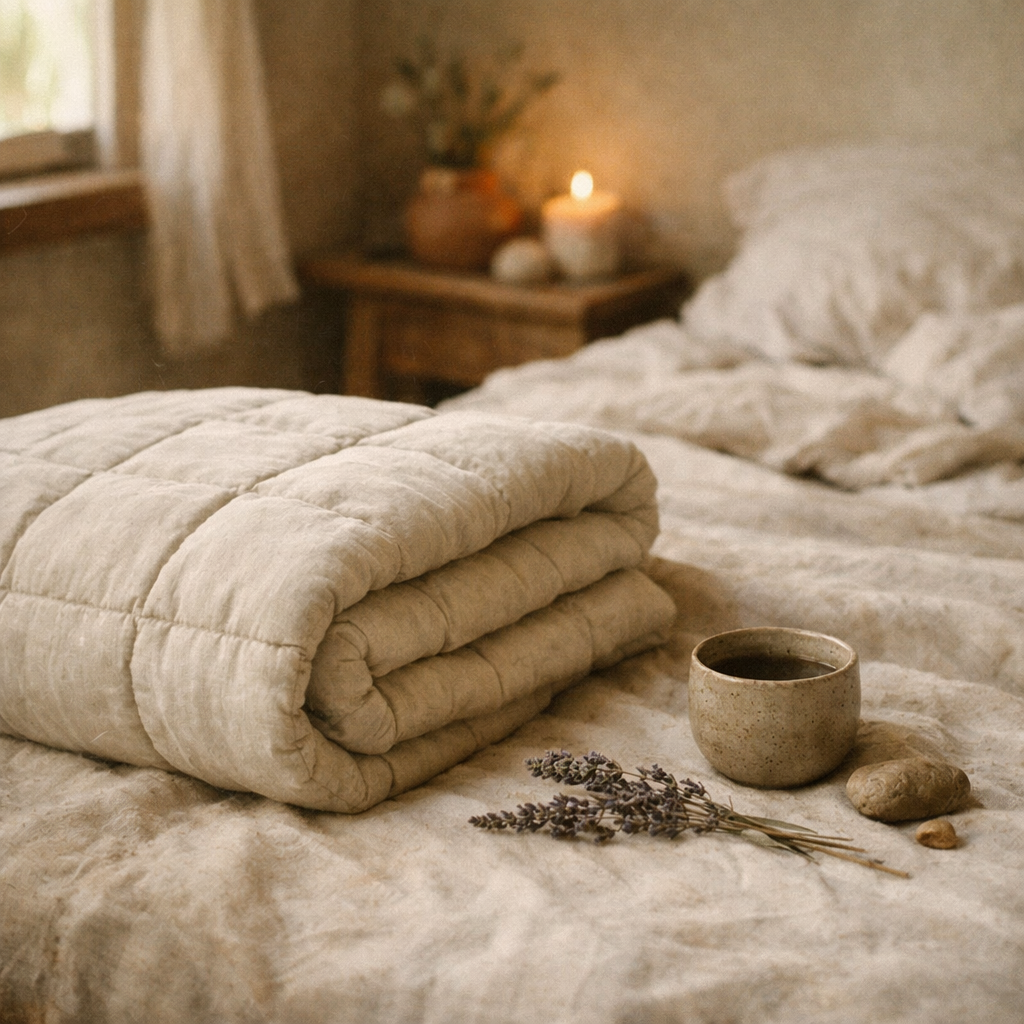
Start on the sofa, not the bed. Twenty minutes under it in the evening while reading tells you a lot and costs you nothing if the weight turns out to be wrong.
Give it a full week of nights before judging. The first two are often mildly strange. By night four most people stop noticing it consciously and start noticing that they woke up in the same position they fell asleep in.
Run it over the body from the shoulders down, not tucked in. The blanket should not be anchored under the mattress. It needs to move with you and come off in one motion.
If you overheat, take the blanket off rather than adding a fan. Half the people who tell me weighted blankets do not work for them are trying to solve a temperature problem with more equipment.
Pair it with the rest of a wind-down rather than treating it as the whole intervention. For me the sequence that worked was a screen cut-off at ten, twenty minutes of something with no plot, and the blanket. If your evenings are the problem, my digital detox guide covers the screen half of that honestly, and the essential oils I use for sleep stack well with the blanket without adding another decision to the night.
When A Weighted Blanket Is The Right Tool
It shines for the specific state of being tired but too activated to settle. Racing thoughts at bedtime. Restlessness that keeps you shifting. The 3 AM wake-up where the body is clearly alarmed about something the mind cannot name. Also, quietly, for grief and for the stretch after a hard life event, where the physical sensation of being held does something that no amount of reasoning does.
It is not a treatment for a diagnosed sleep disorder, not a substitute for addressing apnea, and not going to out-compete an evening of caffeine and doom-scrolling. It works alongside those things being handled, not instead.
If you are on the fence, buy the lap blanket first. Eight pounds, minimal cost, and within a week you will know whether deep pressure does anything for your particular nervous system. If it does, size up to a full cotton blanket at 10 percent of your body weight and expect to use it for years. If it does not, you have spent very little to find out, which is more than most of the wellness industry can offer.
Three years on, mine comes out around October and goes back in the closet in June. The career change worked out. The 3 AM wake-ups stopped a long time before that, and I still cannot tell you how much of that was the blanket and how much was time. I know which one I was grateful for at the time.
Frequently Asked Questions
What weight should a weighted blanket be?
The standard guidance is roughly 10 percent of your body weight, so a 150 pound adult lands around 15 pounds. That rule works for most people, but treat it as a starting point rather than a law. If you are claustrophobic, run hot, or have any shoulder or breathing issues, size down. If you are between two sizes and sleep on your back, size down as well. Almost nobody who regrets their purchase bought one that was too light.
Do weighted blankets actually help with anxiety and insomnia?
The evidence is moderate and genuinely encouraging. A 2020 Swedish randomized controlled trial in the Journal of Clinical Sleep Medicine found that adults with insomnia alongside psychiatric conditions had significantly better sleep and lower daytime anxiety after four weeks with a weighted chain blanket. Smaller studies have found reduced self-reported anxiety before stressful procedures. The mechanism, deep pressure stimulation shifting the nervous system toward parasympathetic dominance, is well established. It is a real effect on a real mechanism, not a cure for a clinical condition.
Who should not use a weighted blanket?
Do not use one for children under two years old, ever, and use caution with any child without pediatric guidance. Avoid weighted blankets if you have obstructive sleep apnea, any respiratory or circulatory condition, low blood pressure, type 2 diabetes with circulation problems, claustrophobia, or limited mobility that would stop you throwing the blanket off unaided. If you are unsure, ask your doctor. This is one of the few wellness products where the safety notes are not boilerplate.