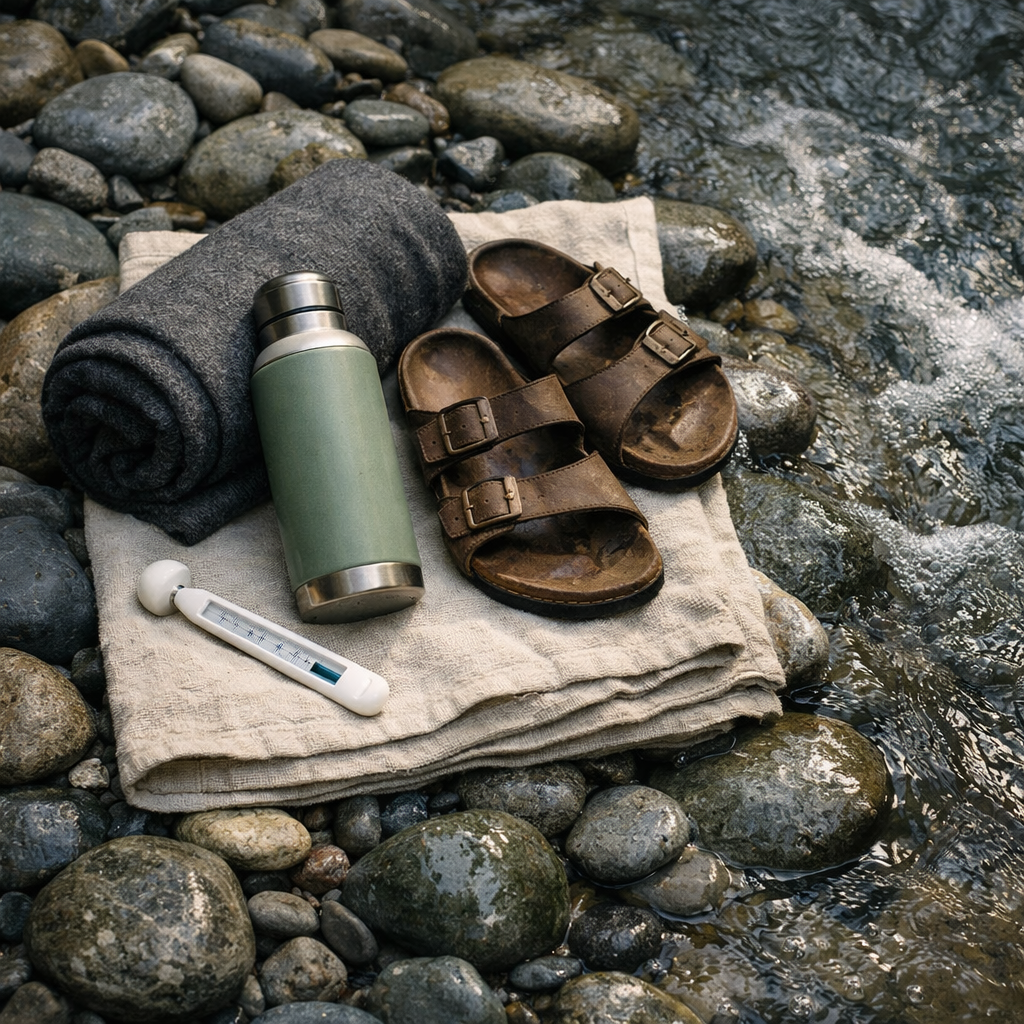
Cold Water Therapy for Beginners: What Cold Showers and Plunges Actually Do
There is a bend in a creek about twenty minutes from my house where the water comes off the ridge and pools deep enough to sit in up to the collarbone. In February it runs around 40 degrees. In August it is a merciful 62. I have been getting into it, in one season or another, for four years, and I have thought a great deal about why.
I did not come to this through the wellness internet. I came to it because I slipped getting out of a canoe in early spring and spent an involuntary ninety seconds in water that cold, and walked back to the car afterwards feeling more awake than I had in months. That sensation was interesting enough that I went back on purpose.
Since then cold exposure has become one of the most oversold practices in wellness, and I want to give you the version I actually believe: what it does, what it does not, the safety rules that are genuinely not optional, and how to start tonight in your own bathroom.
What Cold Water Therapy Actually Is
The umbrella covers three fairly different practices, and most confusion comes from treating them as one thing.
Cold showers are the accessible version. You finish a normal shower with anywhere from 30 seconds to three minutes of cold water. The temperature is whatever your municipal supply gives you, usually somewhere between 50 and 70 degrees depending on season and location. The stimulus is moderate and the risk is close to zero.
Cold water immersion, the plunge or ice bath, means sitting in water typically between 40 and 59 degrees for two to ten minutes, usually up to the neck. This is a substantially larger stimulus and where nearly all the interesting research and nearly all the risk live.
Open water swimming in cold conditions is the oldest form and the one with the most cultural depth behind it, from Nordic winter bathing to the sea swimming clubs of the British and Irish coasts. It is also the version with a genuine fatality rate, almost entirely because of cold shock and because people do it alone.
The physiological response is broadly the same across all three, scaled by intensity. Skin cold receptors fire, the sympathetic nervous system spikes hard, peripheral blood vessels clamp shut to protect the core, breathing goes ragged, and the body dumps catecholamines into the bloodstream. Then, if you stay and stop fighting it, something shifts. The breathing settles. The panic drains out. What is left is a strange lucid calm that outlasts the swim by several hours.
That calm is the reason people keep doing this. Everything else is secondary.
What The Research Actually Says
This is where I want to slow down, because cold exposure has attracted more confident overstatement than almost any practice I write about.
Mood and alertness: the strongest finding. Cold immersion produces a large, reliable, and reasonably long-lasting rise in circulating norepinephrine and dopamine. The frequently cited figure comes from a small 2000 study by Šrámek and colleagues, where an hour in 57 degree water raised noradrenaline roughly 530 percent and dopamine around 250 percent. The sample was tiny and the exposure far longer than anyone recommends, so I would not treat the numbers as gospel. But the direction is robust and it matches what practitioners report universally: hours of clean, elevated, non-jittery alertness afterwards. This is the effect I get most reliably and the one I would stake something on.
Immune function: one good trial, narrower than advertised. A 2016 randomized trial published in PLOS ONE by Buijze and colleagues enrolled just over 3,000 Dutch adults, who ended their daily shower with 30, 60, or 90 seconds of cold for 30 days. The cold groups took 29 percent fewer sick days. Notably, they did not report fewer illnesses, just less time knocked out by them. Duration made no difference, which suggests 30 seconds is as good as 90. That is a genuinely interesting result and it is not the same as “cold showers boost your immune system.”
Metabolism and brown fat: real but small. Cold exposure does activate brown adipose tissue and does raise energy expenditure. Work from Susanna Søberg’s group in Denmark is the reference point here. The effect on body composition in practice is modest to the point of irrelevance for most people. Do not do this to lose weight.
Recovery: genuinely complicated. This one deserves care, because the popular advice is close to backwards for some people. Cold immersion after endurance exercise does reduce soreness and perceived fatigue. But multiple studies, notably work by Roberts and colleagues in the Journal of Physiology, found that regular post-workout cold immersion blunts the muscle hypertrophy and strength adaptations from resistance training. If you lift weights to get stronger, do not plunge in the hours right after. Plunge on rest days or in the morning instead. I got this wrong for a year.
Inflammation and depression: early, small, and interesting. There are plausible mechanisms and some encouraging pilot work on cold water swimming for depressive symptoms. I would not present any of it as established.
What cold exposure does not do: cure disease, detoxify anything, permanently rewire your stress response into invulnerability, or substitute for sleep, therapy, or medication. The most honest framing I have is that it is a reliable, cheap, short-acting mood and alertness intervention with a side of mental toughness practice.
The Safety Rules That Are Not Optional
I am going to be blunt here, because this is the section people skip and it is the only one where getting it wrong can kill you.
The cold shock response is the real danger, not hypothermia. In the first 60 seconds of immersion in cold water, you get an involuntary gasp followed by uncontrolled rapid breathing. If your face is under water when the gasp happens, you inhale water. This kills people every year, and it kills strong swimmers. Enter slowly. Keep your head up. Never dive or jump into cold water.
Never do breath-hold or hyperventilation breathing immediately before entering water. Some popular cold exposure methods pair heavy breathing exercises with immersion. Done in sequence, this causes shallow water blackout, and there have been deaths. Breathe however you like on dry land, well away from the water, or not at all.
Never plunge alone in open water. Have someone on the bank. This is non-negotiable and it is the rule I see broken most often.
Understand afterdrop. Your core temperature continues falling for 10 to 20 minutes after you get out, as cold peripheral blood returns to the centre. This means you can feel fine leaving the water and become genuinely hypothermic in the car. Get dry immediately, layer up from the top down, and do not drive until you have stopped shivering.
Do not warm up in a hot shower straight afterwards. It dilates peripheral vessels and drives cold blood to the core faster. Warm drinks, dry clothes, and gentle movement are the right sequence.
Skip this entirely, or clear it with a doctor first, if you have any heart condition or arrhythmia, uncontrolled high blood pressure, Raynaud’s phenomenon, a circulatory disorder, cold urticaria, or are pregnant. The catecholamine spike and the vasoconstriction are a genuine cardiac load. This is not a case where the risk is theoretical.
How To Actually Start
Do not buy a tub. Start with the shower you already own, which is free and honest about whether you will keep this up.
Week one. Finish your normal shower with 30 seconds of full cold. Not lukewarm, not a gradual fade. Turn the dial and stand in it. The 30 seconds will feel considerably longer than 30 seconds.
Weeks two and three. Extend to 60 or 90 seconds. Somewhere in here the character of the experience changes. The first 20 seconds stay unpleasant forever, in my experience, but you stop dreading them.
Week four onwards. If you want to progress to immersion, the useful benchmark comes from Søberg’s work: roughly 11 minutes of total cold exposure per week, split across two to four sessions. That means sessions of two to four minutes, not marathon sits. Longer sessions do not scale the benefit and do scale the risk.
Breathing is the whole skill. The first 30 seconds your body will try to hyperventilate. The practice is a slow nasal inhale and a long, deliberate exhale, over and over, until the breath comes back under your control. This is the same mechanism I described in my piece on breathwork for anxiety, applied under considerably more duress. When the breath settles, the cold stops being an emergency and starts being just information.
Get out on your own terms. Not when you are numb, not when you are shivering hard, not when someone else says so. Two clean minutes where you kept your breathing is a better session than five where you dissociated to survive it.
Do not stack it after strength training. Morning sessions or rest days. See the recovery research above.
What Gear Is Actually Worth It
Almost none of it, for the first few months. Some of the links below are affiliate links, which means PurityPeak earns a small commission if you buy through them at no extra cost to you, and it does not change what I recommend.
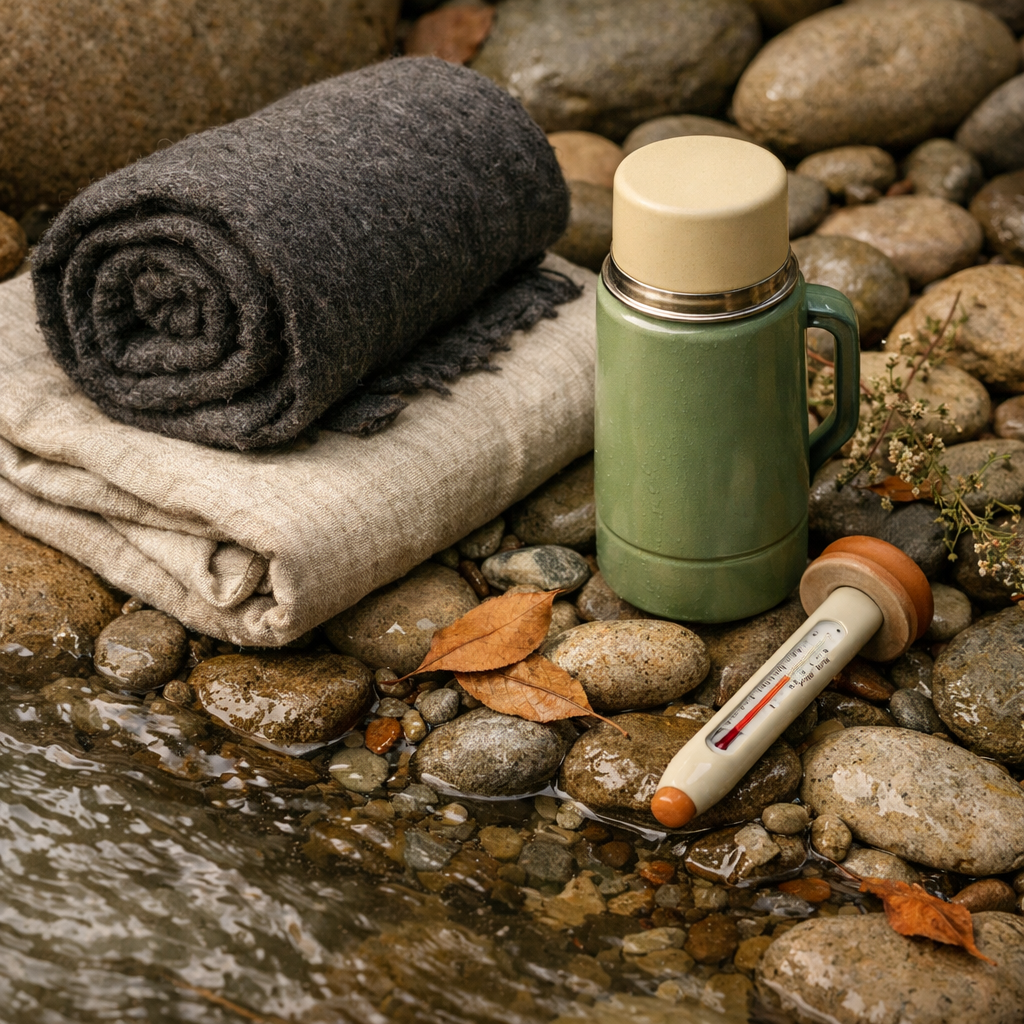
The one item I would call genuinely necessary for open water or tub work is a thermometer. Knowing you are in 48 degree water rather than guessing changes how you set limits, and the guessing tends to run optimistic. A simple floating water thermometer costs almost nothing and is the difference between a practice and a gamble.
Second is warmth for afterwards, which matters more than anything you use during. A changing robe lets you get out of wet clothes and into insulation in under a minute, which is exactly the window where afterdrop is decided. Before I had one I used two wool blankets and a lot of resolve, and the robe is better.
If you swim in genuinely cold water, neoprene gloves and booties are not a comfort item. Hands and feet lose dexterity fast in the low 40s, and losing your grip on a bank is how a swim becomes an incident. A pair of neoprene swim gloves and booties extends both the safe season and the safe duration, and no, they are not cheating.
A cold plunge tub is worth considering only once you have kept a cold shower habit for two or three months and know it is going to stick. A basic insulated barrel plus bagged ice will do everything a chiller unit does for a small fraction of the cost. The expensive circulating models buy convenience, not effect.
Everything else, the supplements, the recovery apps, the branded programmes, I would skip entirely.
When Cold Water Is The Right Tool
It is exceptional for morning inertia, for the fog that follows a bad night’s sleep, and for breaking a genuinely stuck mood. Three minutes in the creek does something to a low afternoon that no amount of coffee or reasoning touches. It is also, and I think this is underrated, a rehearsal for staying calm inside something unpleasant. You practise choosing your breath while your body screams at you to get out. That skill transfers.
It is not a treatment for depression or anxiety, though it sits alongside proper care perfectly well. It is not a recovery tool if your goal is muscle growth. And it is not something to do on a day when you feel fragile, unwell, or unsteady, because the whole thing depends on being able to stay composed.
It also pairs naturally with the slower practices rather than competing with them. My best mornings are the creek followed by twenty minutes of stillness on the bank, which is essentially the forest bathing I have written about before, just with a colder start and a much clearer head.
If you want to try it, do not buy anything. Tonight, at the end of your shower, turn the dial all the way cold and stand there for 30 seconds. Breathe slow out through the mouth. Count if it helps. Notice what your body does at second five and what it has done by second twenty five.
Then notice how you feel twenty minutes later, drying your hair, thinking about something else entirely. That small unmistakable lift is the whole practice. Everything after it is refinement, and most of it is optional.
The creek was 61 degrees this morning. In four months it will be 41, and I will still be going, and I will still hate the first twenty seconds. That part never changes. It turns out not to matter.
Frequently Asked Questions
How cold and how long should a cold plunge be?
For general wellbeing, most of the useful research clusters around water between 50 and 59 degrees Fahrenheit for two to five minutes per session, with roughly 11 minutes of total cold exposure spread across a week. Colder is not better past a point, and longer is where the real risk sits. If you are starting from nothing, 30 seconds at the end of a normal shower is a legitimate first session. Build the frequency before you build the duration.
Do cold showers actually boost your immune system?
There is one good trial worth knowing about. A 2016 Dutch study published in PLOS ONE randomized just over 3,000 people to end their daily shower with 30, 60, or 90 seconds of cold water for a month. The cold groups took 29 percent fewer sick days than the control group, though they reported the same number of illnesses. So people were not getting sick less often, they were coping better. That is a real and useful finding, and it is narrower than the claims made about it.
Is cold water therapy safe?
For healthy adults, with sensible limits, yes. The serious risks are the cold shock response in the first 60 seconds, which causes an involuntary gasp and can be fatal if your face goes under, and afterdrop, where core temperature keeps falling after you exit. Never plunge alone in open water. Never hyperventilate or do breath-hold breathing immediately before entering water. Avoid cold immersion entirely if you have a heart condition, uncontrolled high blood pressure, Raynaud’s, are pregnant, or have any circulatory disorder without clearing it with your doctor first.