Forest Bathing for Beginners: A Practical Guide to Shinrin-Yoku
I have lived at the edge of the Pisgah forest in western North Carolina for six years now, and there is one patch of woods, maybe a fifteen minute walk from my door, that I have visited several hundred times. The same trail. The same creek crossing. The same leaning poplar that lost a limb in the 2021 ice storm and somehow kept growing sideways. I could not tell you how many miles I have logged there, because the answer is barely any. I go slowly. That is the whole point.
When I first heard the phrase “forest bathing,” I assumed it was a wellness invention, the kind of soft-focus idea that sounds lovely and means nothing. I was wrong about that, and I want to give you the honest version of what it is, what the research does and does not support, and how to actually start, including the part where you do not need to buy a single thing.
What Forest Bathing Actually Is
Forest bathing translates the Japanese term shinrin-yoku, which was coined in 1982 by the Japanese Forestry Agency. It means, roughly, “taking in the forest atmosphere.” The bathing part is metaphorical. There is no water involved. You are bathing your senses in the woods rather than your body in a river.
The practice is simpler than the name suggests and easy to get wrong if you bring your usual habits to it. Forest bathing is not hiking. It is not exercise. It is not a brisk nature walk with a summit at the end and a step count to hit. The defining feature is slowness and attention. You walk, or sit, and you deliberately notice things. The texture of bark. The way light moves through the canopy. The layered sound of wind in different species of leaves. The smell of damp soil after rain, which has its own name, petrichor, and its own particular effect on the nervous system.
The first time I tried to do it properly, I lasted about four minutes before my mind started drafting a grocery list. This is normal. The forest does not demand performance. It simply waits while you remember how to pay attention, which is a skill most of us have quietly lost.
What The Research Actually Says
I want to be careful here, because forest bathing attracts a lot of overstated claims, and I would rather you trust the practice for what it genuinely does than feel cheated when it does not cure something.
The most consistent finding is stress reduction. Multiple studies, many of them conducted in Japan in the 2000s and 2010s, found that participants who spent time in forest environments showed lower salivary cortisol, lower blood pressure, lower pulse rate, and improved heart rate variability compared with people who spent the same time in urban settings. A frequently cited 2010 review by Park and colleagues, drawing on field experiments across dozens of forests, reported these effects with reasonable consistency. The mechanism is what you would expect: the nervous system shifts toward parasympathetic dominance, the rest-and-digest state, away from the low-grade fight-or-flight that modern life keeps simmering.
The more striking, and more cautious, finding involves the immune system. Researcher Qing Li at Nippon Medical School published work in the late 2000s suggesting that forest air increased the activity of natural killer cells, a type of white blood cell, with effects that lingered for days after a multi-day forest trip. The proposed mechanism is phytoncides, the airborne compounds trees release to defend against insects and microbes. This research is genuinely interesting, but the sample sizes were small, and it has not been replicated as widely as the stress findings. I treat it as promising rather than proven.
What forest bathing does not do is equally worth saying. It is not a treatment for clinical depression, an alternative to medication, or a cure for anything. It is a low-cost, low-risk practice that reliably calms the nervous system and lifts mood for most people. For what it costs, which is nothing, that is a remarkable return. I have come to think of it less as medicine and more as maintenance, the way you might think of sleep or sunlight.
How To Actually Do It
The instructions you find online tend to be either vague or weirdly prescriptive. Here is what I have settled into after six years.
Choose somewhere quiet and reachable. The single biggest predictor of whether you keep this up is how easy it is to get to. A modest city park you visit weekly beats a magnificent national forest you reach twice a year. Trees are trees. Your nervous system is not grading the scenery.
Leave the destination behind. This is the hardest part for most people, myself included. Do not set out to reach a particular spot. Walk until somewhere asks you to stop, then stop. I often cover less than half a mile in an hour. The goal is not arrival.
Put the phone away, genuinely. Airplane mode, or better, leave it in the car. Forest bathing and a buzzing pocket cannot coexist. If you want to take a single photograph at the end, fine. During, you are trying to be somewhere, and a phone is a small machine for being elsewhere.
Move through your senses one at a time. I usually start with sound, because it is the easiest to drop into. Stand still and count the distinct sounds you can hear. Then smell. Then sight, but slow sight, the kind where you actually look at one leaf instead of scanning the whole forest like a security camera. Touch comes last for me. Bark, moss, the cool of a stone, the give of soil.
Sit for a while. At some point, sit down. On a log, a rock, a folded blanket. Stillness does something that walking does not. The forest forgets you are there. Birds come back. The small movements resume. You become, briefly, part of the place rather than a visitor passing through.
Give it real time if you can. The research that showed the clearest benefits used sessions of around two hours. I am not always able to manage that, and I doubt you are either. Twenty to thirty minutes done often is far better than two hours done rarely. Start where you are.
The Mistakes I Made Early On
For my first year I treated forest bathing like a task to complete well, which is precisely the wrong frame. I would check the time. I would wonder if I was doing it right. I would feel a small flush of failure when my mind wandered, then a second flush of failure for noticing the first one. None of that is forest bathing. That is just bringing the office into the woods.
The wandering mind is not a problem to solve. When you notice you have drifted into planning or replaying some conversation, you simply return to a sense, the way you would in meditation. Sound is usually waiting for you. Over months, the gaps between distractions stretch out on their own. You cannot force this. You can only show up often enough that it happens.
The other mistake was thinking I needed the perfect setting. I once drove two hours to a celebrated old-growth grove, arrived tired and faintly resentful about the drive, and got almost nothing from it. The patch of ordinary mixed hardwood fifteen minutes from my house has given me more than that grove ever did, simply because I am there constantly and arrive unburdened. Familiarity is not the enemy of wonder. It is often the door to it.
Do You Need Any Gear?
Honestly, no. The entire point is that the forest is already there and already free. But after six years I have a few things I genuinely reach for, and I will be honest about which actually matter.
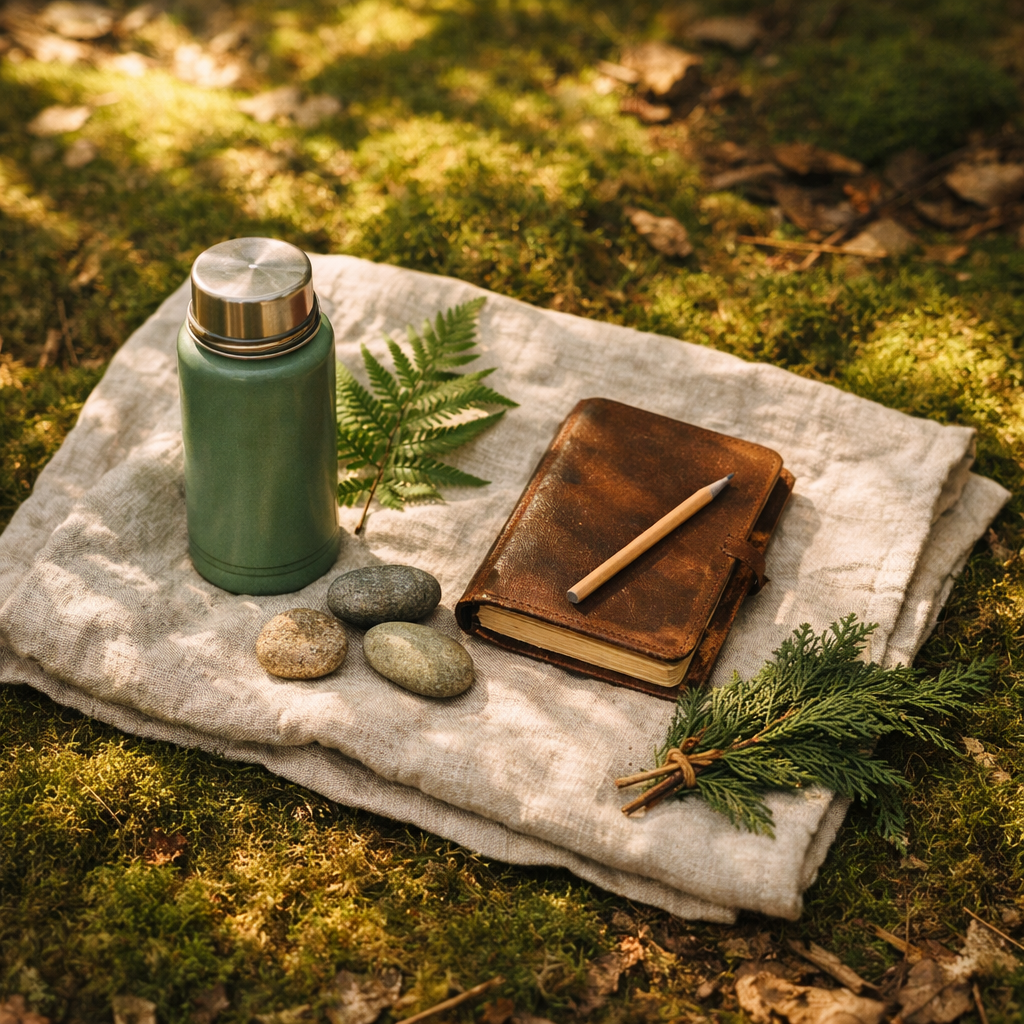
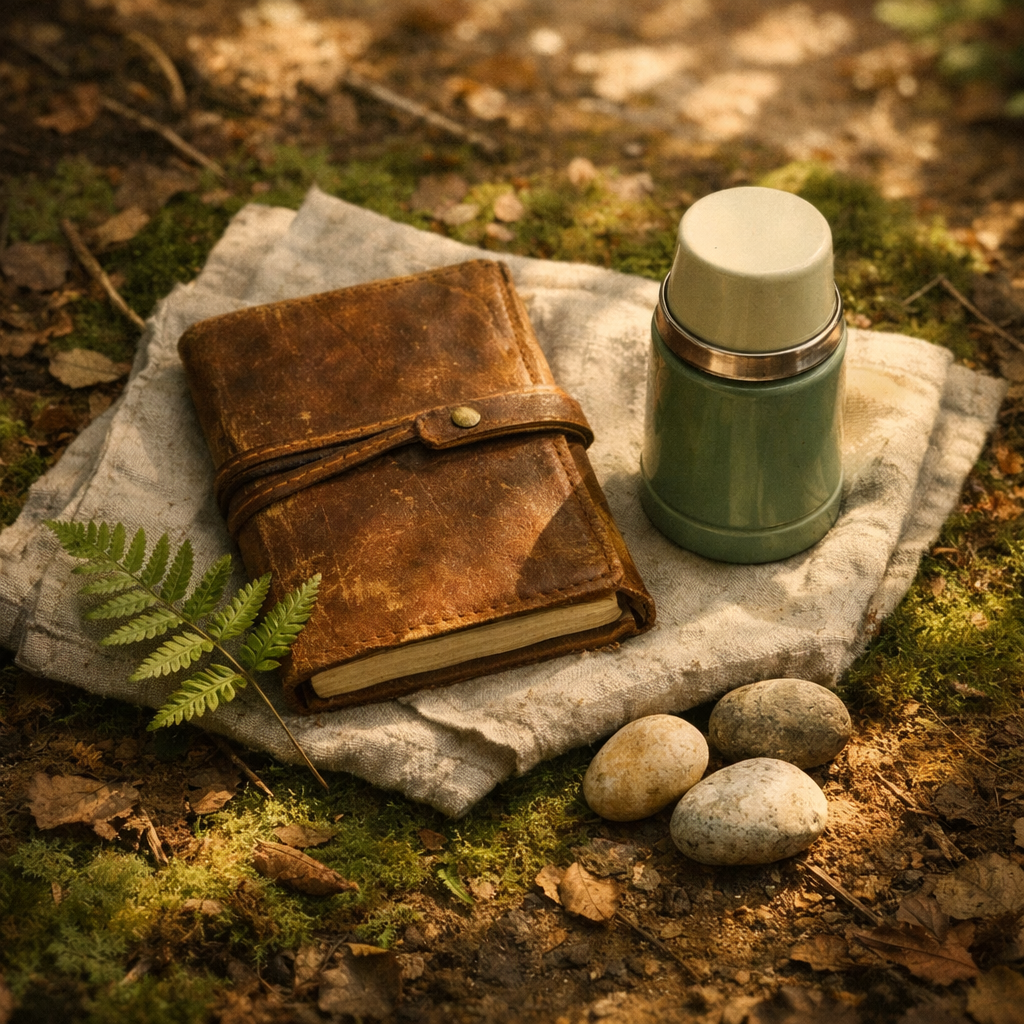
A flask of something warm changes a sitting session completely, especially in the colder months. Being able to sit still for forty minutes without getting cold is the difference between a short visit and a long one. A simple insulated thermos or flask is the one piece of gear I would actually call useful.
A small notebook is the other thing I carry, not to journal in any disciplined way, but to jot the occasional observation. A pocket field notebook lives in my coat. Half the entries are single words. It helps me notice that I am noticing.
If you want to deepen the practice on the science side, Qing Li’s book on forest medicine and the various translated works on shinrin-yoku are worth a read, and you can find a forest bathing guide book easily enough. I would read one only after you have actually been out a few times, though. The practice teaches better than the page.
Everything else, the special shoes, the apps, the guided programs, is optional at best. I have used none of it. A waterproof layer and shoes you do not mind getting muddy will carry you through almost any session.

When Forest Bathing Is The Right Tool
The practice shines for the particular kind of frazzle that modern life produces, the wired-but-tired state, the inability to settle after a day of screens, the sense of being perpetually braced for the next notification. For that, an hour among trees is one of the most reliable resets I know. It is also genuinely good for sleep when done in the late afternoon, for creative thinking, which seems to loosen when the analytical mind quiets, and for the simple, undervalued act of being unreachable for a while.
It is not a substitute for treatment if you are struggling with something serious. If you are dealing with real depression or anxiety that does not lift, please talk to a professional. Forest bathing can sit alongside proper care, and many therapists in my area now actively recommend it, but it is a companion to treatment, not a replacement for it.
For most people leading ordinary, overstimulated lives, forest bathing occupies a quiet and useful place in the wellness toolkit. Cheaper than almost anything. Available on any afternoon. Asking nothing of you except that you slow down and pay attention, which turns out to be the hardest and most worthwhile thing.
If you want a sharper version of the same nervous-system reset, and you have a creek or a cold tap, my guide to cold water therapy for beginners covers the other end of the intensity scale, including the safety rules that genuinely are not optional.
If you are curious, do not overthink the start. Find the nearest patch of trees you can reach on foot or with a short drive. Leave the phone behind. Walk slowly until something asks you to stop. Sit down. Listen. Give it twenty minutes and notice how you feel walking back out. That is the whole practice. Everything else is refinement.
The leaning poplar is still there, by the way. Six years sideways and still putting out leaves every spring. I check on it most weeks. It has taught me more about patience than any book ever did.
Frequently Asked Questions
What is forest bathing exactly?
Forest bathing, or shinrin-yoku, is the practice of spending unhurried time in a forest while paying slow, deliberate attention to your senses. It is not hiking, exercise, or a nature walk with a destination. The point is presence, not distance. You move slowly, often covering less than a mile in an hour or two, and let the sights, sounds, and smells of the woods do the work.
Does forest bathing actually have health benefits?
There is reasonable evidence that time among trees lowers cortisol, reduces blood pressure, and improves mood and heart rate variability. Japanese studies in the 2000s also linked forest air to short-term increases in natural killer cell activity, likely tied to airborne plant compounds called phytoncides. The strongest, most consistent findings are around stress reduction and parasympathetic activation. The immune claims are promising but less settled.
How long does a forest bathing session need to be?
Most research showing measurable stress benefits used sessions of around two hours. That said, even 20 to 30 minutes of slow, attentive time among trees produces a noticeable shift for most people. Start with what you can manage. Consistency matters more than duration. A short walk three times a week beats one long session a month.