Best Incense for Meditation: Complete Guide to Scents and Rituals
The first time I lit sandalwood incense before meditation, something shifted. Not dramatically - no visions, no revelations. Just a subtle signal to my brain: we’re doing this now. The scent became an anchor, a sensory bookmark that separated ordinary sitting from intentional practice.
That’s the real power of incense in meditation. It’s not about the fragrance being mystically potent. It’s about creating a ritual trigger - a consistent sensory cue that tells your nervous system it’s time to settle. Meditators have understood this for thousands of years. Temples across Asia, churches throughout Europe, and indigenous ceremonial spaces worldwide all use aromatic smoke for the same reason: scent bypasses the thinking mind and speaks directly to the limbic system.
But walk into any shop selling incense and you’ll face dozens of options, from cheap synthetic sticks that smell like a car air freshener to premium Japanese incense that costs more per gram than good coffee. Let me help you navigate.
How Incense Enhances Meditation
The Neuroscience of Scent and Focus
Your olfactory system connects directly to the amygdala and hippocampus - brain regions governing emotion and memory. This is why a single whiff of a familiar scent can instantly transport you to a specific moment in your past. It’s also why certain aromas can shift your mental state faster than any cognitive technique.
Research published in the journal Flavour and Fragrance found that sandalwood’s primary compound, alpha-santalol, has measurable sedative effects on the central nervous system. Frankincense’s key compound, incensole acetate, activates TRPV3 channels in the brain, producing feelings of warmth and reduced anxiety.
These aren’t placebo effects. These are molecular compounds interacting with neural receptors.
The Ritual Anchor Effect
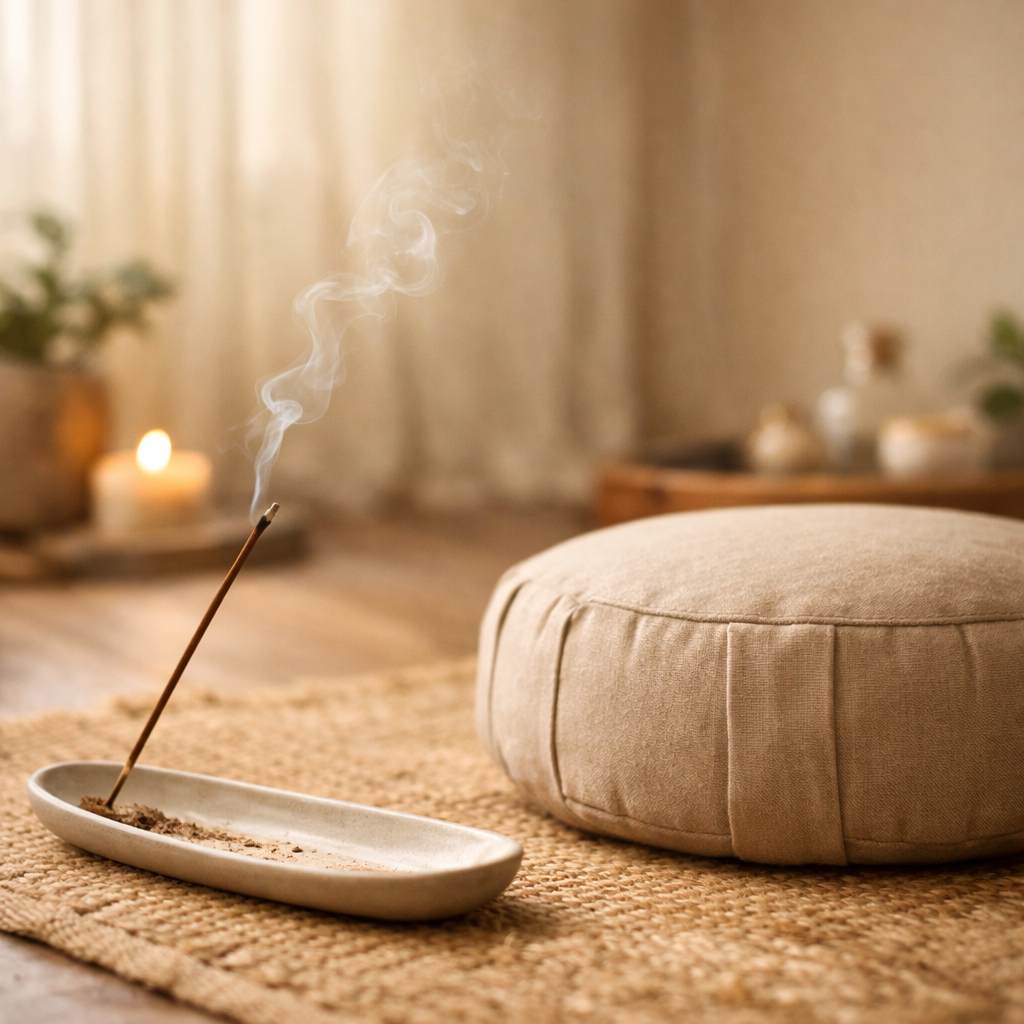
Beyond neurochemistry, incense serves a practical purpose: it creates a ritual. Lighting incense, watching the smoke curl, noticing the first wave of scent - these small acts transition you from doing mode to being mode. Over time, the scent itself becomes a conditioned cue. Your brain associates it with calm, and the transition into meditation becomes faster and easier.
Many experienced meditators report that even catching the scent of their practice incense outside of meditation produces an immediate sense of relaxation. That’s classical conditioning working in your favor.
The Best Scents for Meditation
Sandalwood - The Universal Meditator
Profile: Warm, creamy, woody with a subtle sweetness.
Sandalwood has been the meditation incense of choice across Buddhist, Hindu, and Jain traditions for centuries. Its scent promotes a calm alertness - relaxed but focused, which is exactly the mental state you want in meditation. It doesn’t make you drowsy the way lavender can, and it doesn’t energize the way citrus does.
Best for: Seated meditation, mindfulness practice, any session where focus is the goal.
Quality note: Authentic Indian sandalwood (Santalum album) is increasingly rare and expensive due to overharvesting. Australian sandalwood is a good sustainable alternative with a slightly drier scent profile.
Frankincense - The Ancient Temple Scent
Profile: Resinous, slightly citrusy, warm with balsamic undertones.
Used in spiritual ceremonies for over 5,000 years across Egyptian, Christian, Islamic, and Jewish traditions. Frankincense has the most research behind its calming effects, particularly the compound incensole acetate. It creates an atmosphere of reverence - the kind of scent that makes any room feel like sacred space.
Best for: Contemplative meditation, prayer, spiritual practice, evening sessions.
Nag Champa - The Ashram Classic
Profile: Sweet, floral, earthy with sandalwood and champaca flower.
If you’ve ever walked into a yoga studio, you’ve probably smelled nag champa. It’s the signature scent of Indian ashrams and has been synonymous with spiritual practice since the 1960s. The blend of sandalwood, halmaddi resin, and champaca flower creates a rich, complex aroma that’s instantly recognizable.
Best for: Yoga, movement meditation, group practice, creating a devotional atmosphere.
Palo Santo - The Cleansing Wood
Profile: Sweet, warm, piney with hints of mint and citrus.
Palo santo (“holy wood”) comes from a tree native to South America and has been used in Amazonian shamanic traditions for centuries. The scent is lighter and brighter than most meditation incense - less smoke, more sweetness. Many people use it for energetic cleansing before meditation rather than during.
Best for: Pre-meditation space clearing, intention setting, morning practice.
Sustainability note: Authentic palo santo comes from naturally fallen trees, not harvested live wood. Buy from suppliers who can verify sustainable sourcing.
Cedarwood - The Grounding Earth Scent
Profile: Dry, woody, slightly smoky with a clean finish.
Cedarwood has a grounding quality that roots you in the present moment. It’s less sweet than sandalwood, more austere, and particularly good for practices focused on stability and presence. Used extensively in Native American smudging traditions and Japanese temple incense.
Best for: Grounding meditation, body scan practice, sessions focused on stability.
White Sage - The Purifier
Profile: Herbaceous, slightly sharp, cleansing.
Sage smudging is a practice from Indigenous North American traditions used for energetic cleansing. The scent is distinctive and polarizing - some people love it, others find it too sharp. It’s typically burned before meditation to cleanse the space, then extinguished before practice begins.
Best for: Space clearing before meditation, transition rituals, seasonal practice.
Cultural consideration: White sage smudging is a sacred practice in many Indigenous cultures. Approach it with respect, buy from Indigenous-owned businesses when possible, and learn about the tradition behind the practice.
Types of Incense: Sticks, Cones, and Resin
Incense Sticks (Agarbatti)
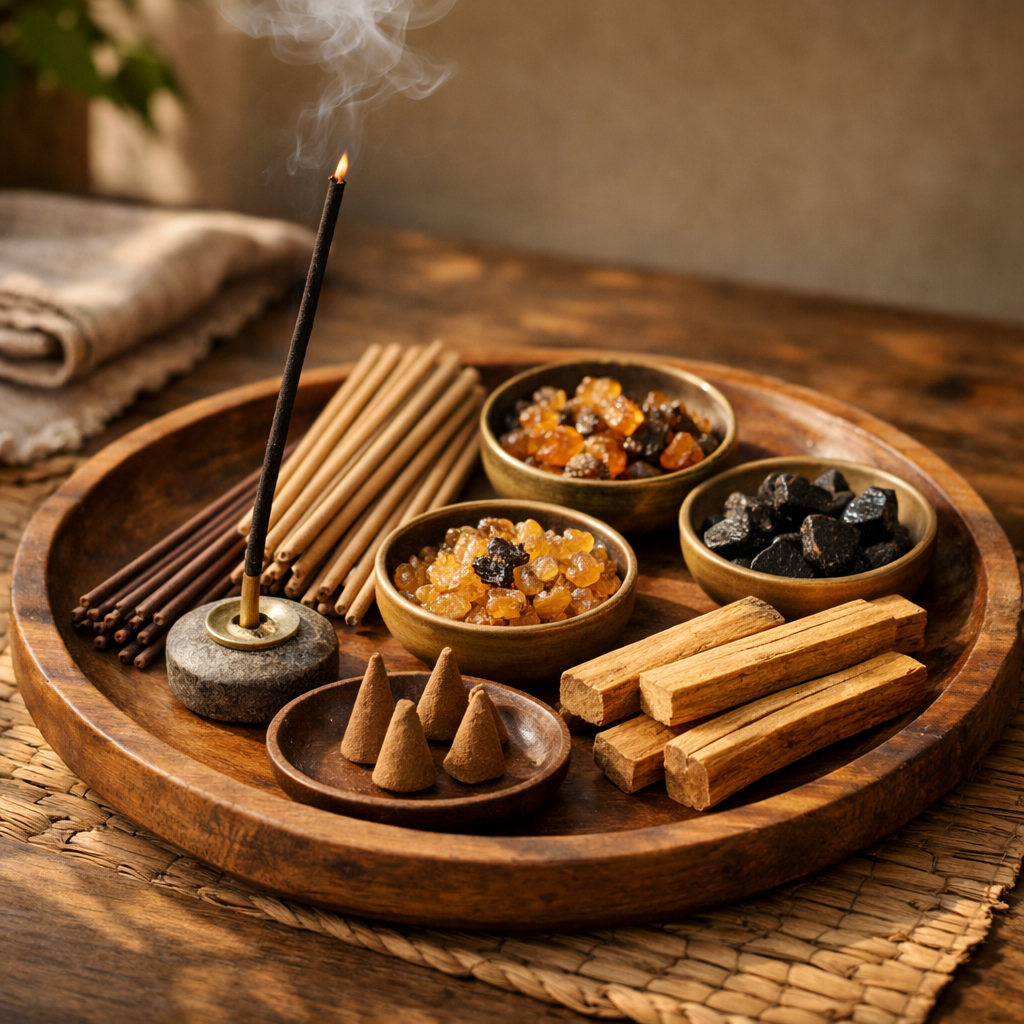
The most accessible form. A thin bamboo stick coated with aromatic paste. Light the tip, blow out the flame, and let it smolder. Burns for 20-45 minutes depending on length.
Pros: Easy to use, consistent burn, widely available, minimal setup. Cons: Bamboo core can add a slightly woody note to the scent. Some cheap sticks use synthetic fragrances.
Tip: Look for “masala” sticks (hand-rolled with natural ingredients) rather than “charcoal” sticks (dipped in synthetic fragrance). The difference in quality is dramatic.
Incense Cones
Cone-shaped compressed incense that sits on a heat-proof dish. Burns from the top down, producing more concentrated smoke than sticks.
Pros: No bamboo core, more concentrated scent, attractive smoke patterns (especially with backflow cones). Cons: Shorter burn time (15-20 minutes), can produce more smoke than sticks.
Resin on Charcoal
The most traditional method. Place a charcoal disc in a heat-proof burner, light it, and sprinkle loose resin granules on top. The resin melts and releases aromatic smoke.
Pros: Most authentic, purest scent, you control the intensity, beautiful ritual. Cons: More preparation needed, charcoal can produce its own smell until fully lit, requires a proper burner with sand or ash.
Japanese Incense (Koh)
Premium quality, typically without a bamboo core. Japanese incense is subtler and more refined than Indian varieties - less smoke, more nuanced scent profiles. Brands from Kyoto have been making incense for centuries.
Pros: Subtle, refined, minimal smoke, excellent quality control. Cons: More expensive, scent may be too subtle for those used to Indian-style incense.
Setting Up Your Incense Practice
-
Choose one scent to start. Don’t buy five varieties. Pick one - sandalwood is the safest choice - and use it consistently for at least two weeks. Let your brain build the association.
-
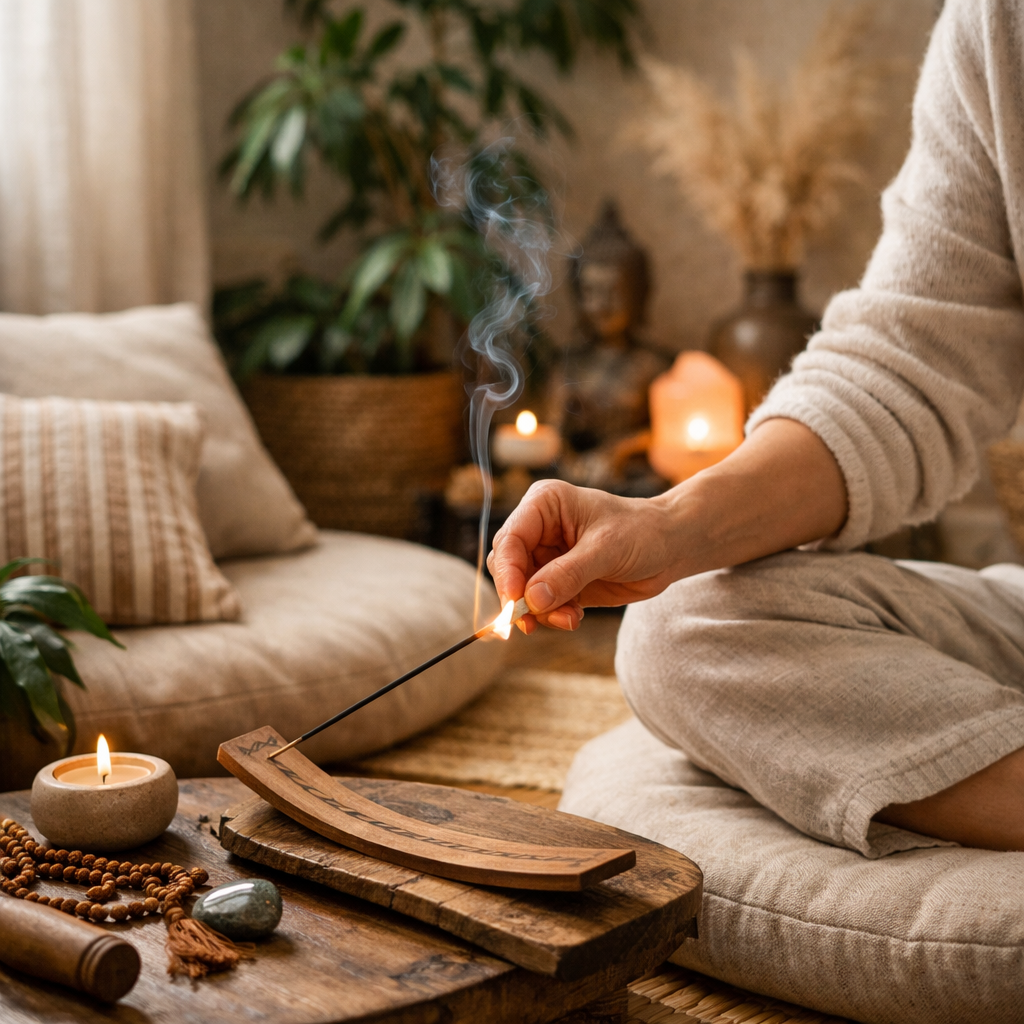
Light it before you sit. Give the incense 30-60 seconds to establish the scent before beginning meditation. Use the lighting ritual itself as a transition - a deliberate act that marks the beginning of practice.
-
Ventilate. Crack a window or leave a door ajar. You want to smell the incense, not suffocate in it. Fresh air circulation also prevents the room from becoming hazy.
-
Position it safely. Use a proper incense holder on a heat-proof surface, away from curtains, paper, or anything flammable. Ash falls - plan for it.
-
Match scent to practice. As you develop your practice, you might find that different scents suit different sessions. Sandalwood for morning focus, frankincense for evening contemplation, palo santo for intention-setting.
Quality Matters: What to Avoid
The incense market is flooded with cheap synthetic products. Here’s how to identify quality:
Avoid: Incense with ingredient lists that include “fragrance oil,” “parfum,” or “artificial fragrance.” These produce headaches and don’t offer the therapeutic benefits of natural compounds.
Look for: Natural ingredients listed specifically - sandalwood powder, frankincense resin, essential oils, natural binders (makko powder, halmaddi). The fewer ingredients, generally the better.
Price indicator: If a pack of 100 incense sticks costs $3, they’re almost certainly synthetic. Quality natural incense costs more - $8-$15 for a pack of 20-30 sticks is reasonable.
The Bottom Line
Incense isn’t essential for meditation. Plenty of people meditate beautifully without it. But as a ritual anchor - a sensory cue that deepens your transition into practice - it’s remarkably effective.
Start with sandalwood sticks. Burn one before each session for two weeks. Notice whether your meditation feels different with the scent as an anchor.
If it does, you’ve found a tool that costs pennies per session and has been enhancing contemplative practice for five millennia. That’s a pretty good deal.