Grounding Techniques for Anxiety: Earthing Practices That Actually Work
Anxiety lives in the future. It feeds on what-ifs, catastrophic predictions, and imagined disasters that haven’t happened and probably won’t. When you’re caught in an anxiety spiral, your body is here but your mind is somewhere else entirely - racing through scenarios, rehearsing failures, bracing for impact against threats that exist only in thought.
Grounding is the antidote. Not because it solves the underlying problem - that might require therapy, medication, lifestyle changes, or all three. But because in the acute moment of anxiety, grounding does something remarkably useful: it brings you back to the only place where you’re actually safe. Right here. Right now. This breath. This body. This floor beneath your feet.
These techniques are used by therapists, first responders, trauma survivors, and millions of ordinary people who’ve discovered that the fastest way out of an anxiety spiral isn’t thinking harder - it’s feeling more.
Why Grounding Works: The Neuroscience
When anxiety activates your sympathetic nervous system (fight-or-flight), your prefrontal cortex - the rational, problem-solving part of your brain - goes partially offline. Blood flow shifts to survival-oriented brain regions. This is why you can’t “think” your way out of a panic attack. The thinking brain isn’t fully available.
Grounding bypasses the thinking brain entirely. By directing attention to sensory input - physical touch, sounds, temperatures, textures - you engage the somatosensory cortex and activate the parasympathetic nervous system. This shifts the body out of fight-or-flight without requiring any cognitive work.
In simpler terms: your body can calm your mind faster than your mind can calm your body.

Sensory Grounding Techniques
The 5-4-3-2-1 Method (The Gold Standard)
This is the most widely recommended grounding technique in clinical psychology, and for good reason - it works fast and you can do it anywhere.
Name:
- 5 things you can see
- 4 things you can touch
- 3 things you can hear
- 2 things you can smell
- 1 thing you can taste
Be specific. Not just “I see a wall” - try “I see a crack in the plaster near the ceiling where the paint is slightly darker.” The specificity forces your brain to engage with present-moment reality instead of abstract worry.
Time to effect: 1-2 minutes.
Temperature Grounding
Cold water. Run cold water over your wrists for 30 seconds. Or hold an ice cube in your palm. The sharp temperature contrast sends an immediate sensory signal that overrides anxious thinking. Your brain can’t simultaneously process “this is freezing” and “what if I lose my job” - the physical sensation wins.
Warm drink. Wrap your hands around a warm mug. Focus on the heat transferring into your palms. Sip slowly, feeling the warmth move down your throat. The combination of warmth, taste, and physical sensation engages multiple senses simultaneously.
Time to effect: 30-60 seconds.
Texture Grounding
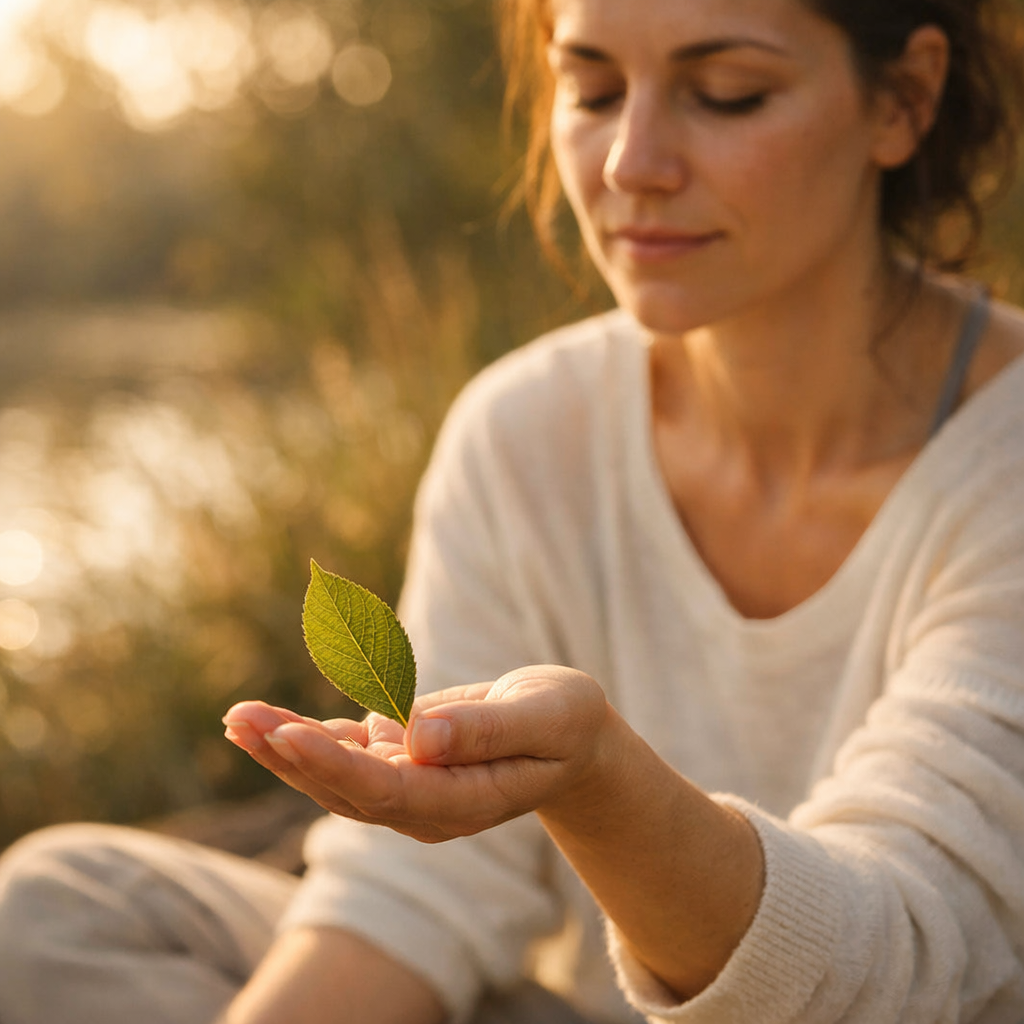
Pick up an object and explore it with your full attention. A stone, a piece of fabric, a coin, a leaf. Notice every detail: weight, temperature, texture, edges, smoothness, roughness. Turn it over in your hands. This is a form of focused meditation disguised as curiosity.
Some people carry a grounding object - a smooth stone, a textured keychain, a piece of wood - specifically for this purpose. Having it in your pocket means you always have a grounding tool available.
Auditory Grounding
Close your eyes and identify every sound you can hear, from loudest to softest. The hum of a refrigerator. A car passing outside. Birds. Your own breathing. Wind against the window.
Try to find five distinct sounds. Then focus on the quietest one. Holding attention on a subtle sound requires the same focused awareness that meditation cultivates - it’s inherently calming.
Physical Grounding (Earthing)
Barefoot Walking
Walking barefoot on natural surfaces - grass, soil, sand, even concrete - is the most literal form of grounding. The practice, called earthing, has a growing body of research behind it.
A 2012 review in the Journal of Environmental and Public Health found that earthing reduced inflammation markers, improved sleep, reduced pain, and shifted the autonomic nervous system toward parasympathetic activity. The proposed mechanism involves the transfer of free electrons from the earth’s surface into the body, which may neutralize free radicals.
The science is still developing, but the experiential benefits are immediate and widely reported: feeling calmer, more present, and physically connected to the ground beneath you.
Practice: Walk barefoot on grass, soil, or sand for 10-20 minutes. Focus on every sensation - the texture under your feet, the temperature of the ground, the shift in balance with each step. This combines earthing with walking meditation.
Body Scan Grounding
Sit or lie down. Starting at your feet, slowly move your attention up through your body: feet, ankles, calves, knees, thighs, hips, belly, chest, hands, arms, shoulders, neck, face, scalp. At each point, notice whatever sensation is present - warmth, tension, tingling, numbness, pressure.
Don’t try to change anything. Just notice. The act of noticing sensations in your body pulls awareness out of your head and into your physical experience.
Time to effect: 3-5 minutes for a full scan.
Pressing and Pushing
Push your feet firmly into the floor. Press your palms flat against a table or wall. Push hard enough to feel the resistance. This activates proprioceptive input - your body’s awareness of itself in space - which is inherently grounding.
Variation: Stand against a wall with your back flat. Press your shoulder blades, the back of your head, and your heels against the wall simultaneously. Feel the solid surface supporting your weight. This is particularly effective during acute anxiety because it provides strong, unambiguous sensory input.
Movement-Based Grounding
Stomping
Literally stomp your feet on the ground. Hard. The impact vibration travels up through your legs and activates your vestibular system. It sounds ridiculous, and it works remarkably well. The physical intensity breaks the anxiety loop through sheer sensory force.
Shaking
Stand and shake your body - hands, arms, legs, torso, everything. Let it be messy and vigorous. Animals do this instinctively after a threat passes (watch a dog shake after a stressful encounter). It discharges the physical tension that anxiety stores in your muscles.
Shake for 1-2 minutes, then stand still and notice how your body feels. Most people report an immediate sense of release and calm.
Mindful Walking
Walk slowly - much slower than normal. Feel the heel contact the ground, then the ball of the foot, then the toes. Feel the weight transfer from one foot to the other. Count your steps if it helps focus. The deliberate slowness forces present-moment attention.
Creating a Grounding Toolkit
Build a personal toolkit of 2-3 techniques that work for you:
- One fast technique for acute anxiety (ice cube, cold water, 5-4-3-2-1)
- One physical technique for moderate anxiety (barefoot walking, body scan, stomping)
- One subtle technique for public situations (pressing feet into floor, grounding object in pocket, auditory grounding)
Practice these when you’re calm so they become automatic when you need them. Grounding is a skill - it gets more effective with repetition.
The Bottom Line
Grounding techniques won’t cure anxiety. But they will interrupt the spiral. They will bring you back to the present moment when your mind is lost in future catastrophe. And they will give you a sense of agency - the knowledge that you have tools available, right now, in your body, that can shift your state without medication, without anyone else, without anything at all except your own awareness and the ground beneath your feet.
The earth has been here for 4.5 billion years. It’s not going anywhere. When everything else feels unstable, put your feet on it and breathe. That’s grounding. That’s enough.